Dedication
28 - Mission Report- The Great Eve Rescue
Through thick and thin, through pain and loss
The bravest of them all
The toughest of the tough are there
Though rather green and smallThe kerbals build their rockets tall
And sometimes they explode
But when the danger levels rose
They still the rocket rodeThrough darkest space to purple spheres
From marbled shores to doom
They dauntless venture forth abroad
They take their crafts and zoomSo gather round and listen close
Link to original
To hear the epic tale
Of how the kerbals did succeed
After some massive fails
Foreword
In my poetry inspo note, I have the Kerbal Space Program (KSP) forums as one of the things to write a poem about.1 Those forums, specifically the Mission Reports section, hold some of the formative stories that I read in my early teens. Some post cut-and-dried descriptions of the things that they did in the game, but others use KSP as a canvas to write prose that’s a cross between fanfiction and machinima. A few threads stand out as compelling stories that I’d recommend to any sci-fi fan, e.g. The Saga of Emiko Station (completed), Voyage: The Final Warning (completed, but not when I completed it, finishing it is now on the summer to-do list), Project Intrepid (ongoing, author on hiatus), and Forgotten Space Program (incomplete) are in my bookmarks to this day.2
In that vein, and as a follow-up to Eve, I present my very own mission report, reconstructed from the dozens of save files and around twenty hours of combined gameplay and writing.
Part One - Introduction
It was a beautiful day at the Kerbal Space Center, and the director of the space agency decided that after the program’s decades of successes, with landings on the Mun, Minmus, Duna, Moho, and Tylo3 completed in recent years, it was time for a mission that would test the ingenuity, intelligence, and intrepidity of the program to the limit.
It was time for a mission to Eve.4
Landing on Eve was a milestone the program had completed a handful of times. It wasn’t very difficult. All you had to do was strap whatever you wanted landed to a few parachutes and a heat shield, and Eve would to the rest. The atmosphere, thicker by far than Kerbin’s was more than sufficient to safely decelerate any vessel that descended into the murky depths. Even the gravity, 170% that of Kerbin’s wasn’t enough to markedly reduce parachute effectiveness. What the incredibly thick atmosphere and incredibly high gravity did do was make returning from the purple planet’s surface next to impossible.
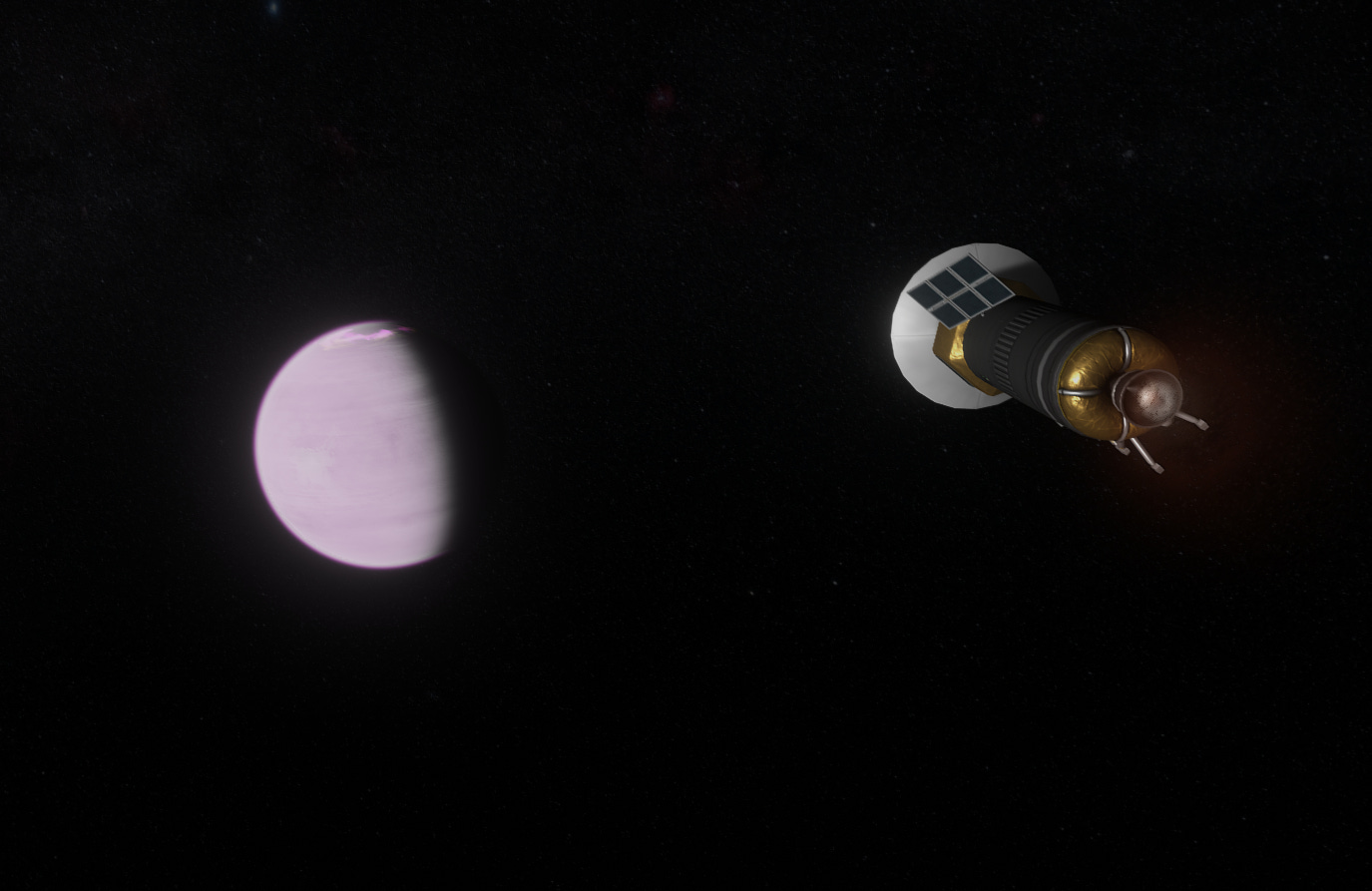
I have a complicated relationship with this planet.
It was time to prove the difference between “next to impossible” and “impossible.”
Part Two - The First Lander
The engineers had drafted plans for a working Eve lander years ago, but much like the original Mun landing tapes, the blueprints had been overwritten by signal data collected from a local space station’s karaoke night which had been accidentally broadcast to half the planet. New plans needed to be drawn up.
The first order of business was the lander. It needed to large enough to successfully escape the clutches of Eve’s surface, but small enough that it could be reasonably transported to those clutches in the first place. After a short Monster fueled drafting session, the engineers came up with this:
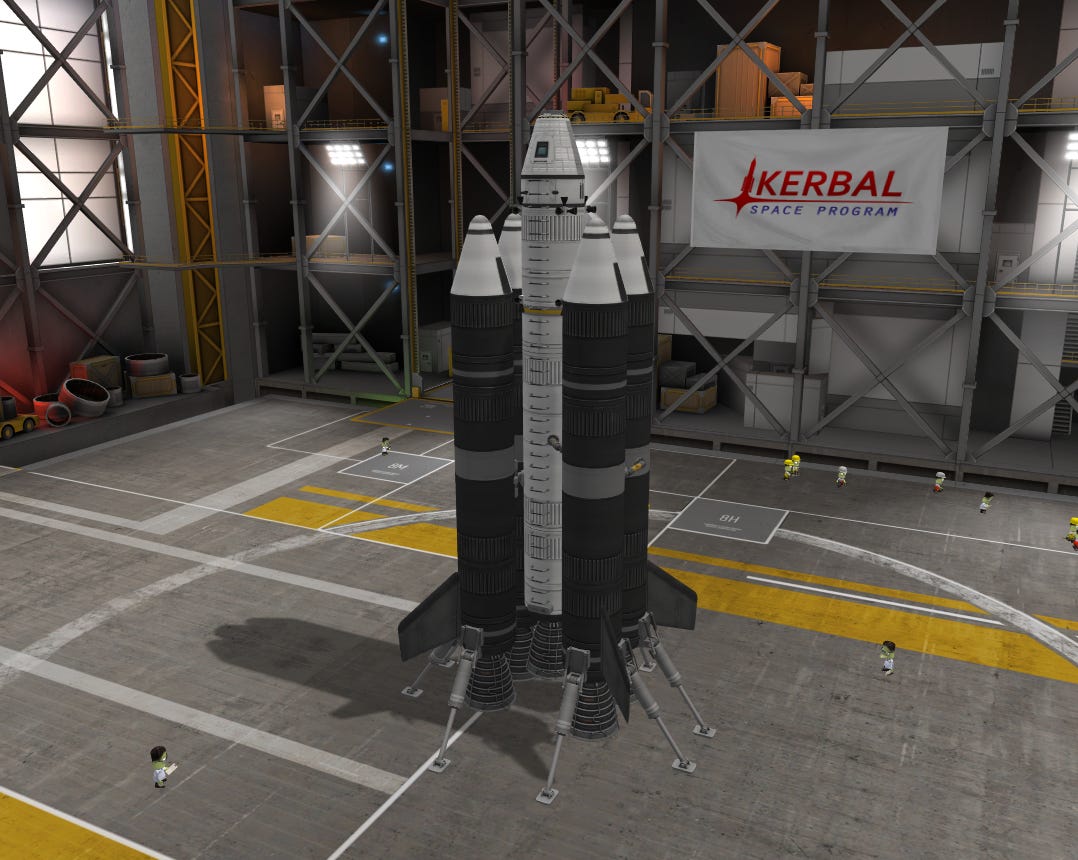
I was so innocent when I thought that this would work.
The craft was a powerful rocket with enough fuel to theoretically visit most planets in the system if launched from Kerbin.
Practically, testing offered a few reasons for concern.
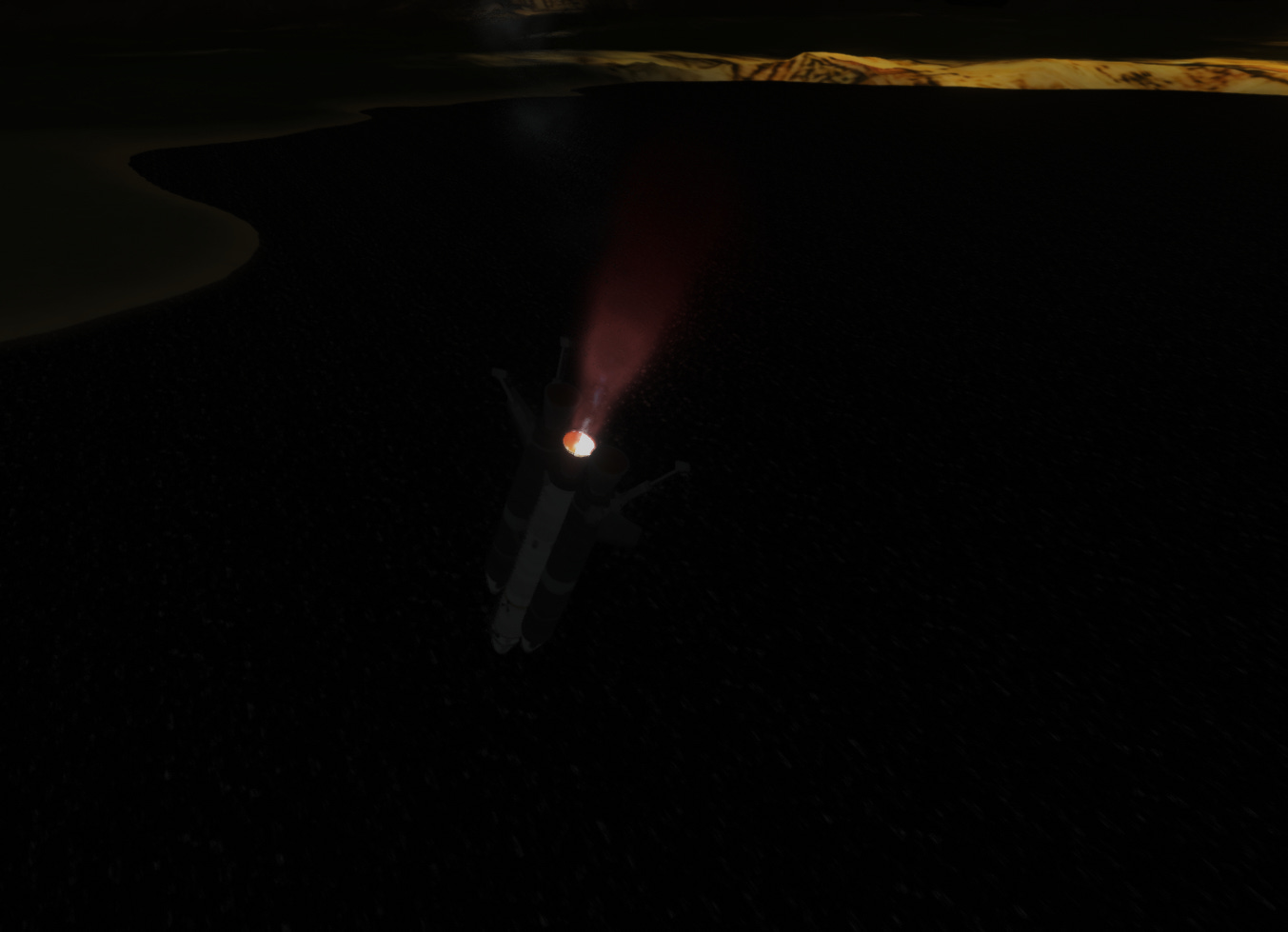
Typically, the rocket should point up, not down.
The lack of stability, especially in later stages was obviously a possible issue, but the engineers assumed that quality piloting and a thicker atmosphere would get it off the ground safely given enough test runs in the simulator. Unfortunately, the simulator was built into the command pod that was already strapped to the top of the rocket, and the pilot would only be able to run it once landed on Eve.5
Speaking of pilots, Munmore Kerman was the man for the job.
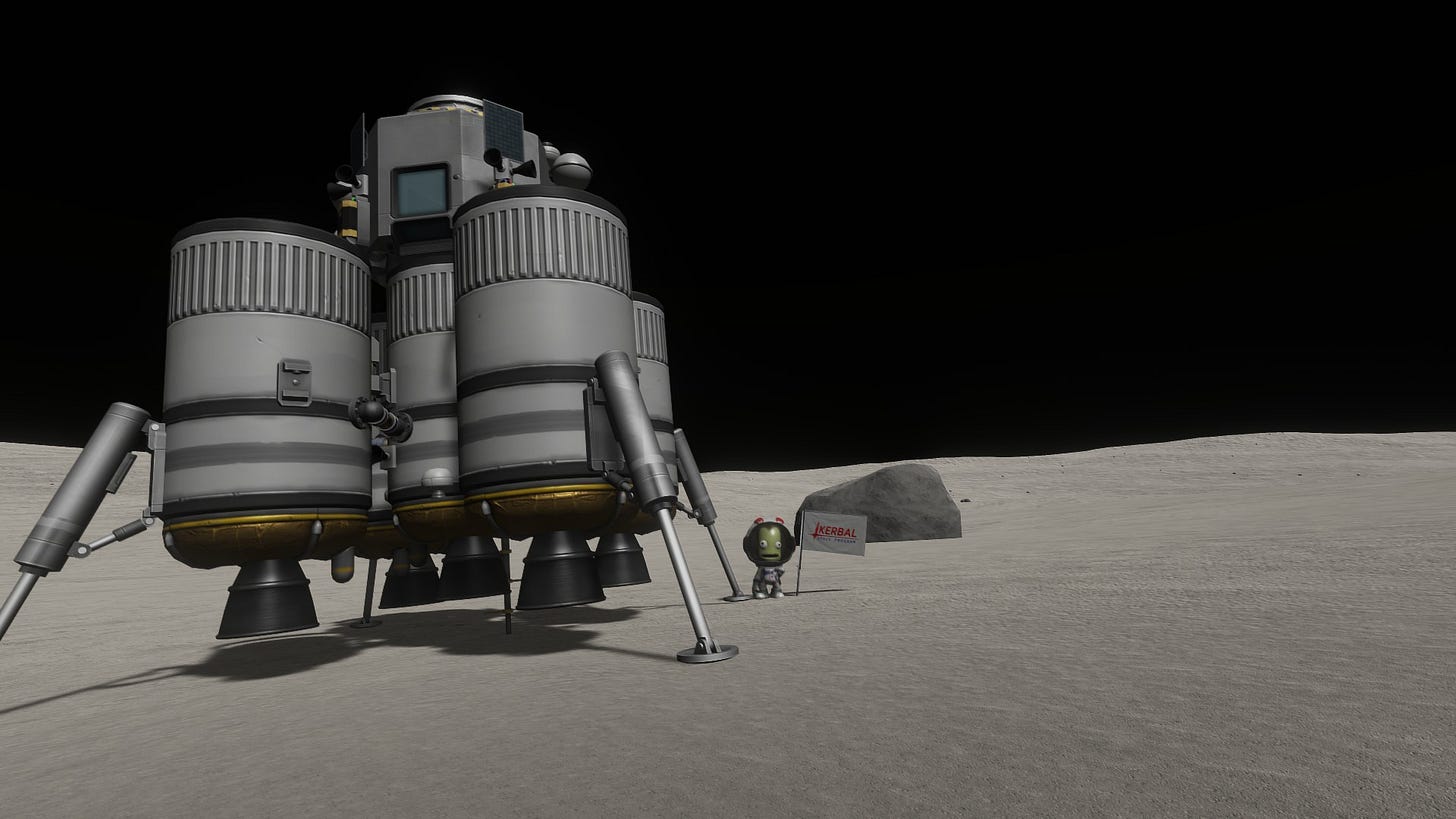
Here’s Munmore landed on Tylo. The expression on his face was probably from the fact that his craft had been 10 seconds away from hitting the surface at 230 meters per immediately before the picture, but it also might be a glimpse of what’s to come.
Munmore was the KSP’s star pilot, with successful landings on more planets than any other kerbal, living or dead, even the long-lost legendary Jebediah Kerman. Munmore was the only possible choice for the mission.

Just smart enough to not be stupid, and just brave enough to not pull the parachutes too early.
The rest of the design process of the craft was simple.
First, strap a bevy of detachable parachutes to the lander,6 as well as dock a heat shield to the top of it.7 (The heat shield was also an independently operated probe which could dock and undock at will, just in case Munmore decided that he wanted it attached to another lander instead.)8
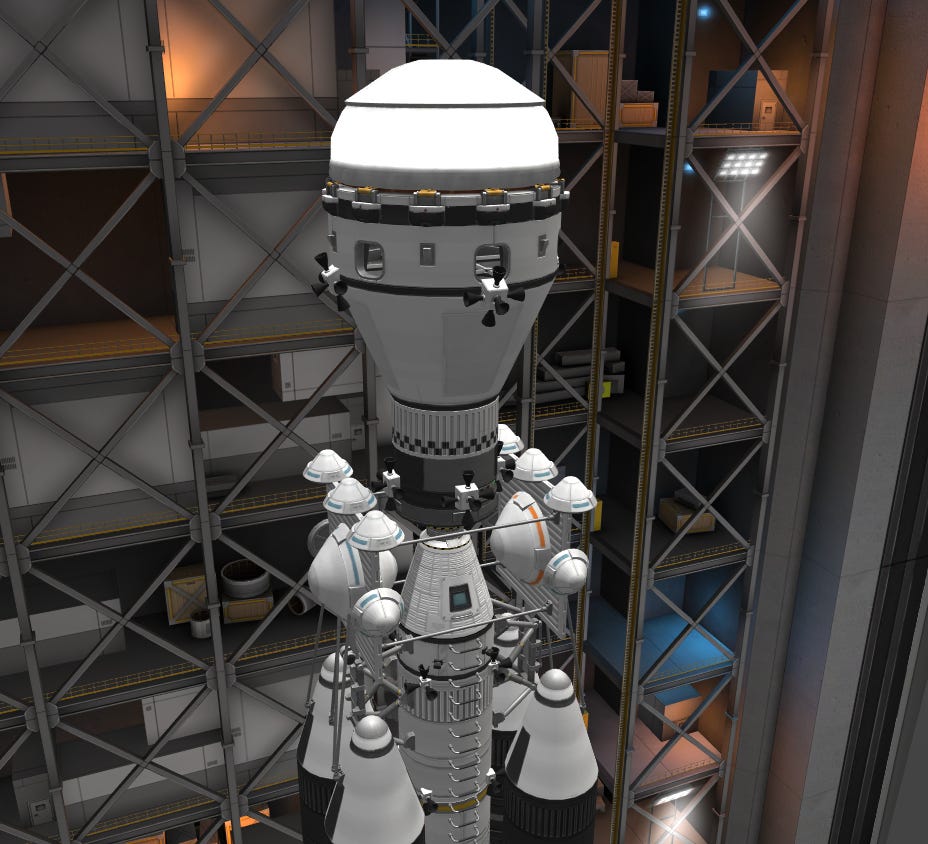
Then an inflatable heat shield was bolted onto the bottom,
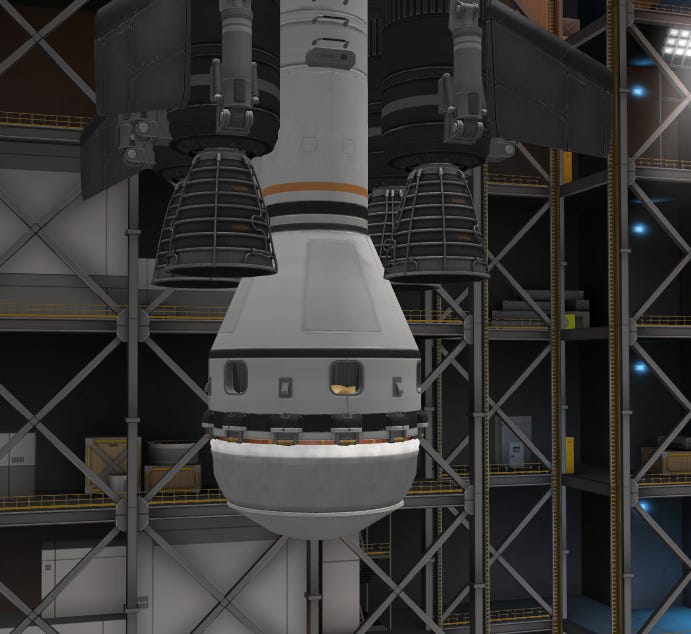
and the whole thing was covered in an aerodynamic fairing.
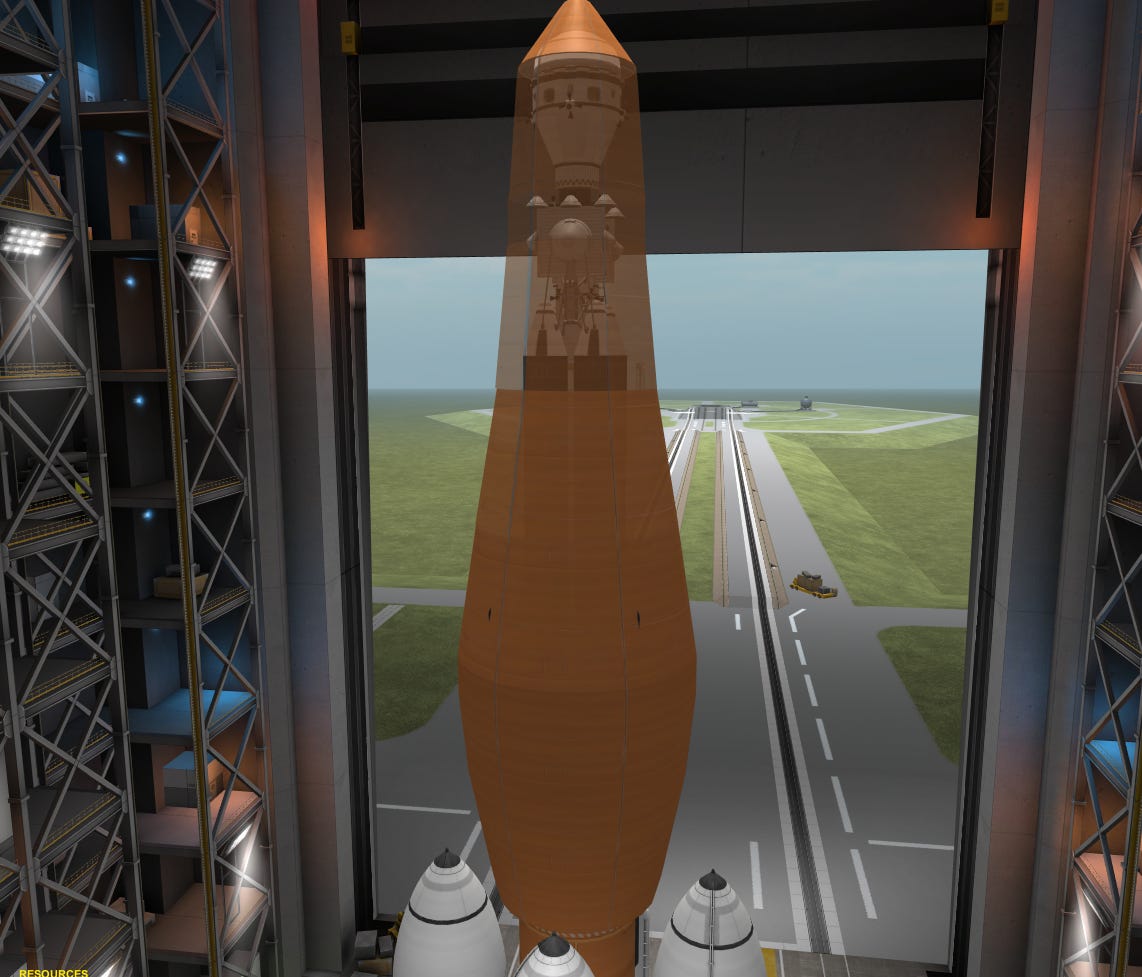
Which was put on top of one of the largest boosters ever built.
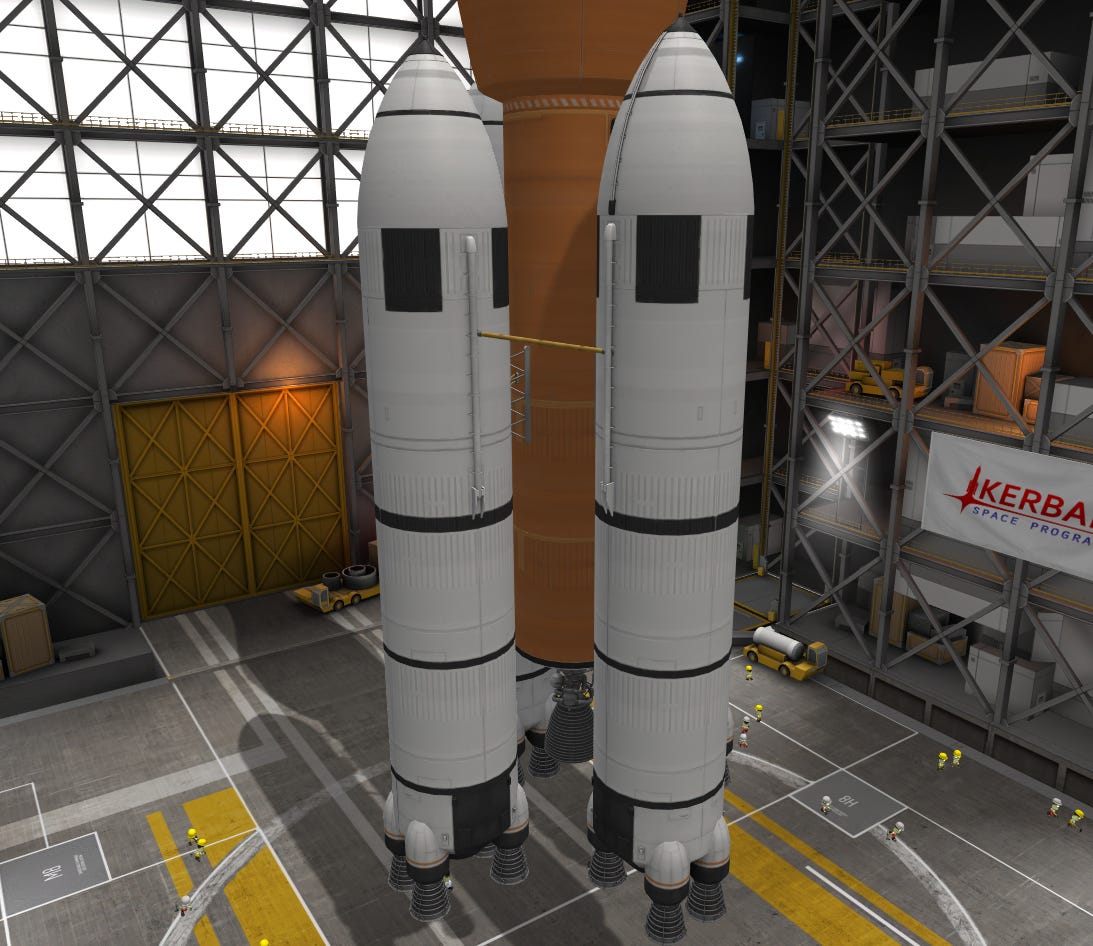
I proceeded to never use this launch system again. No reason, just forgot to save it as a subassembly.
The whole assembly was then rolled onto the launchpad, and Munmore Kerman was on his way. In the crowd of cheering onlookers, Munmore’s son, Munmore Kerman Jr. was struck by the majesty of the rocket as it made its way into space. He promised himself that someday he’d build rockets just like the one that his dad was on.
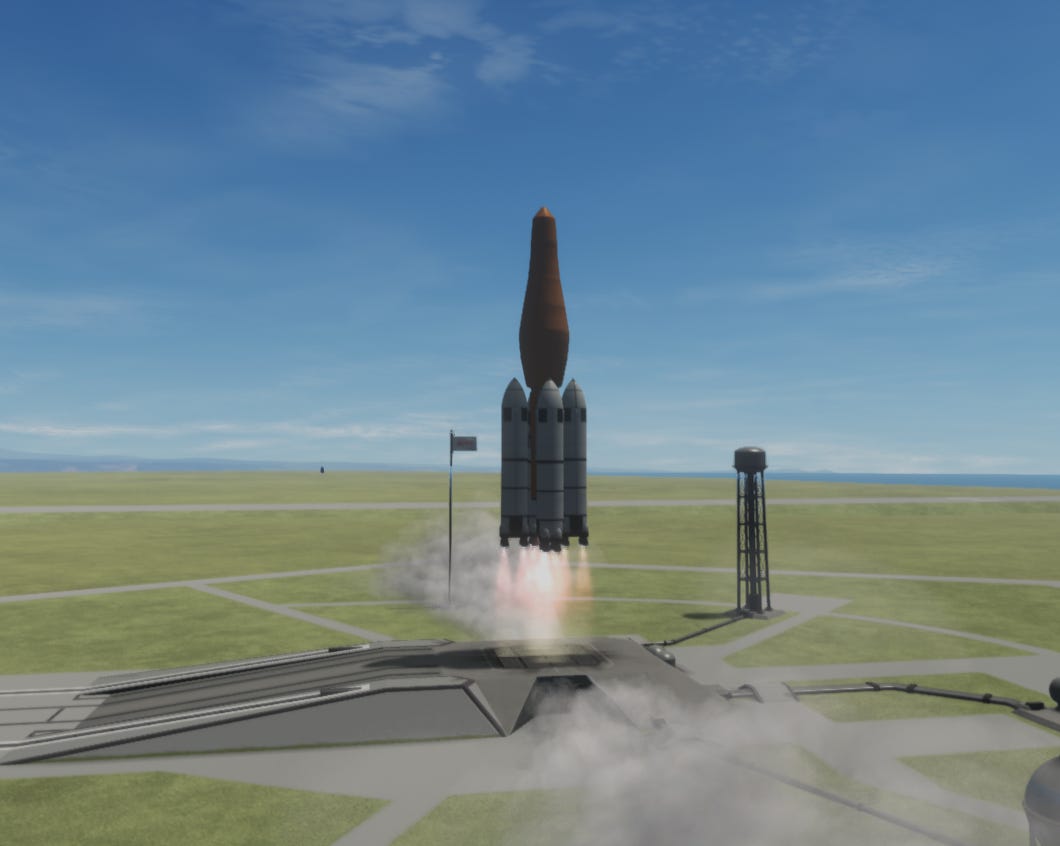
Before long, Munmore was in orbit with a trajectory to Eve. The party that mission control threw to celebrate the successful launch was legendary. No launch in living memory was celebrated with as much pizzaz. When asked why that was, the lead party planner explained that the lander had come in so far under budget that the only acceptable response was to blow 50 grand on a shindig.
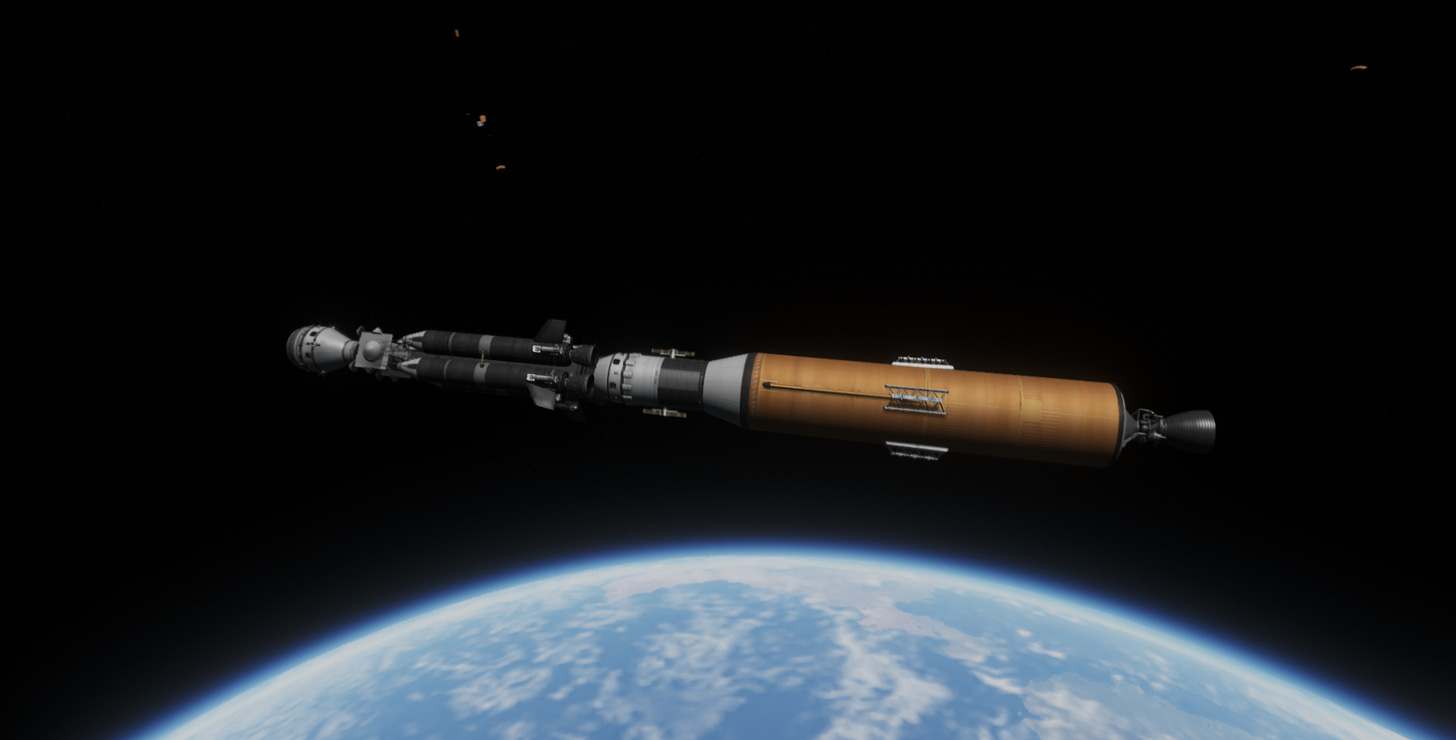
Looking back at this, I’m still not sure why I thought that this thing would be sufficient to escape Eve.
Soon enough he was orbiting Eve.
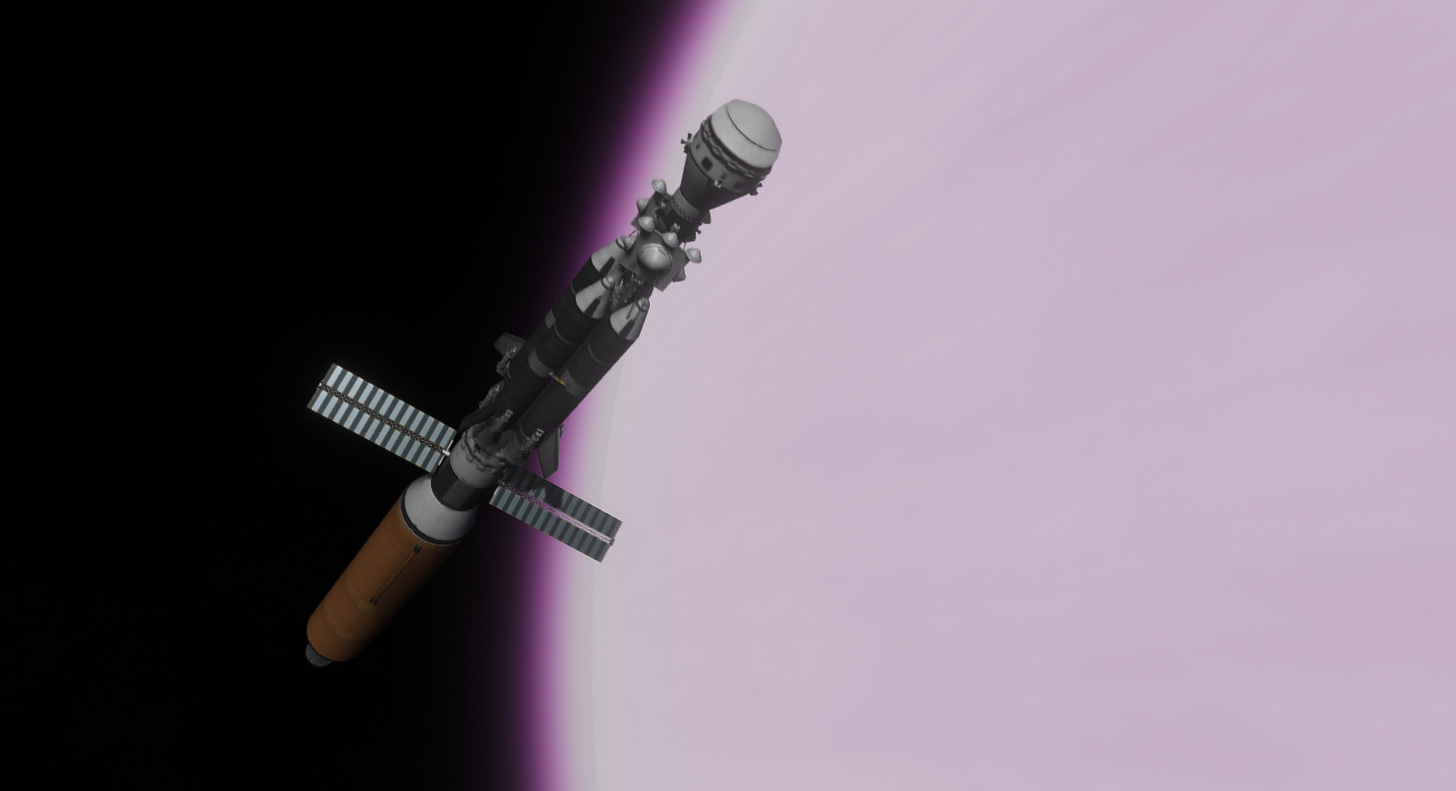
Everyone at HQ was ecstatic at the successful transfer, and though Munmore was hungry, he was glad that Kerbal anatomy didn’t actually require food to survive (a fact that would be a great boon to him in the coming years).
The next step was atmospheric entry. Told to expect nothing aside from the usual heat, Munmore inflated the heat shields, pointed himself retrograde9, taped a few marshmallows to the side of his pod, and prepared for to breach the atmosphere.
A few minutes later, the marshmallows were burned.
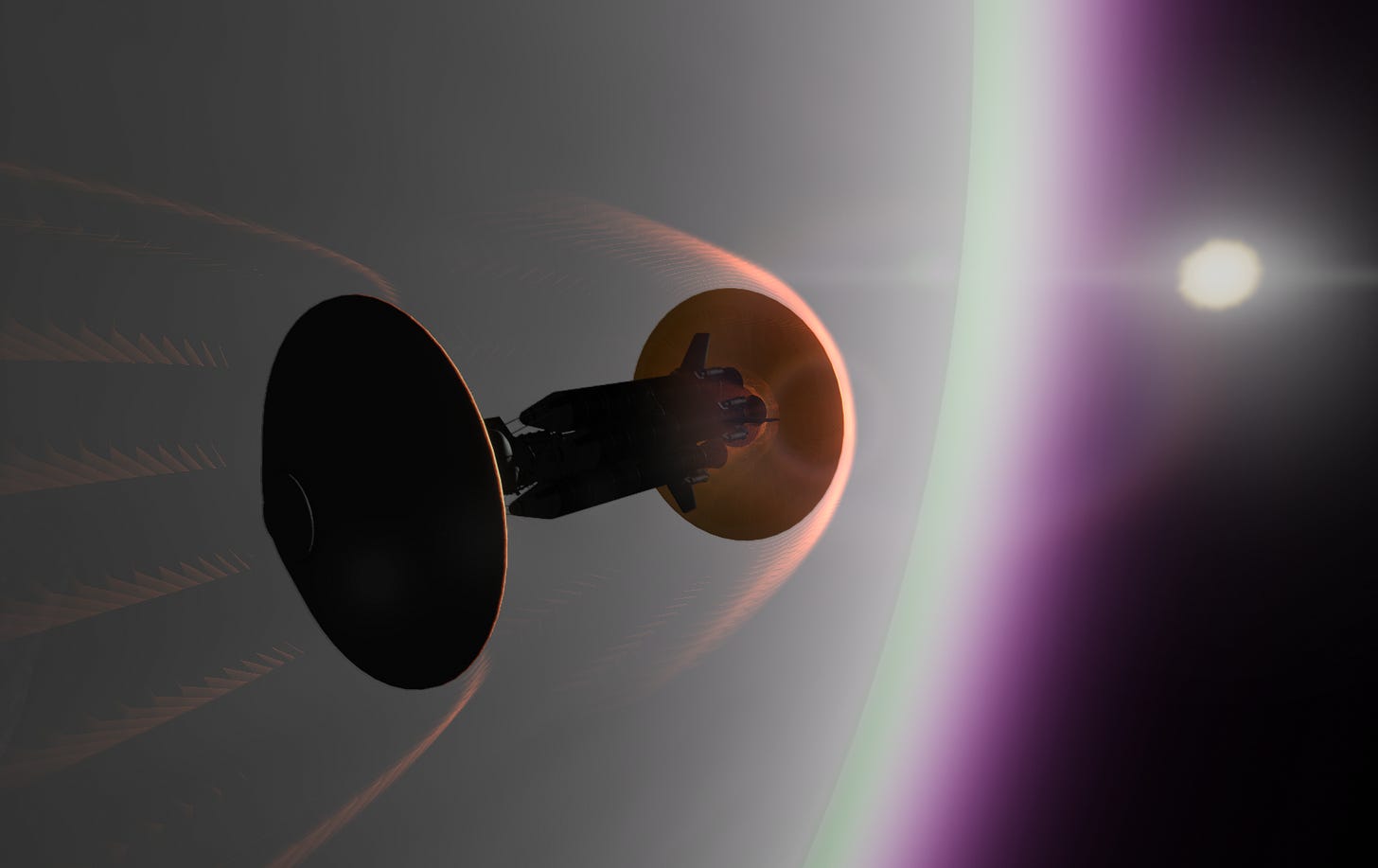
I had ninety-nine problems this mission, but successful atmospheric entry wasn’t one of them.
The remainder of the descent was uneventful, though the video feed of the lander’s rapid rotation caused by misaligned control surfaces and the auto-stabilizer induced several staffers in mission control to develop motion sickness, triggering a rush to the restrooms and a number of calls to the janitorial staff.10
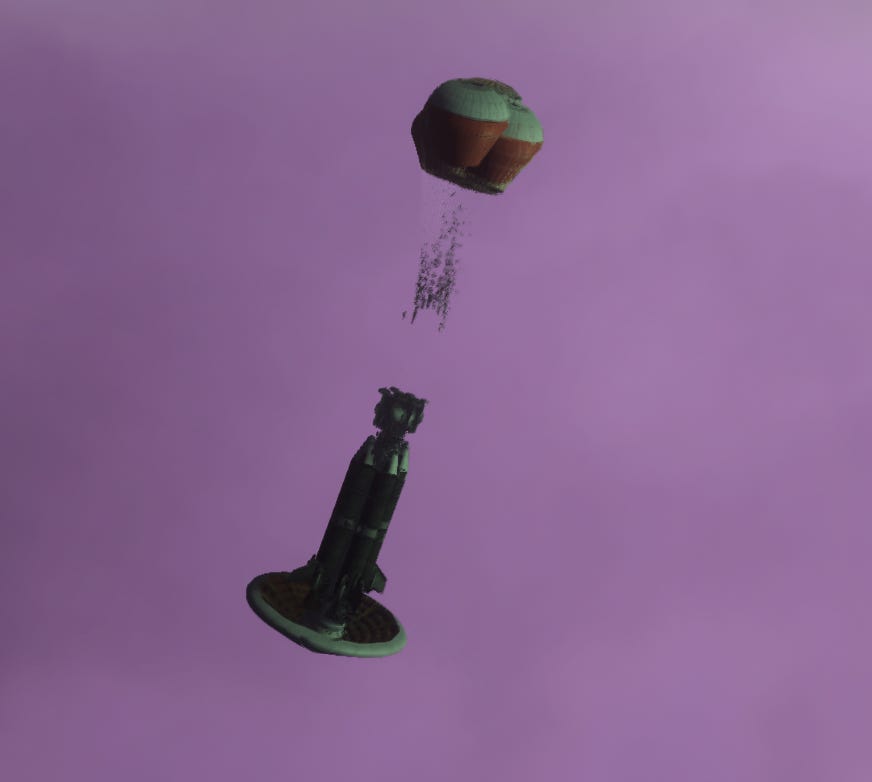
Motion not captured in still image, news at 11.
The parachutes having done their job, Munmore departed the craft, planted the flag and posed for a picture.
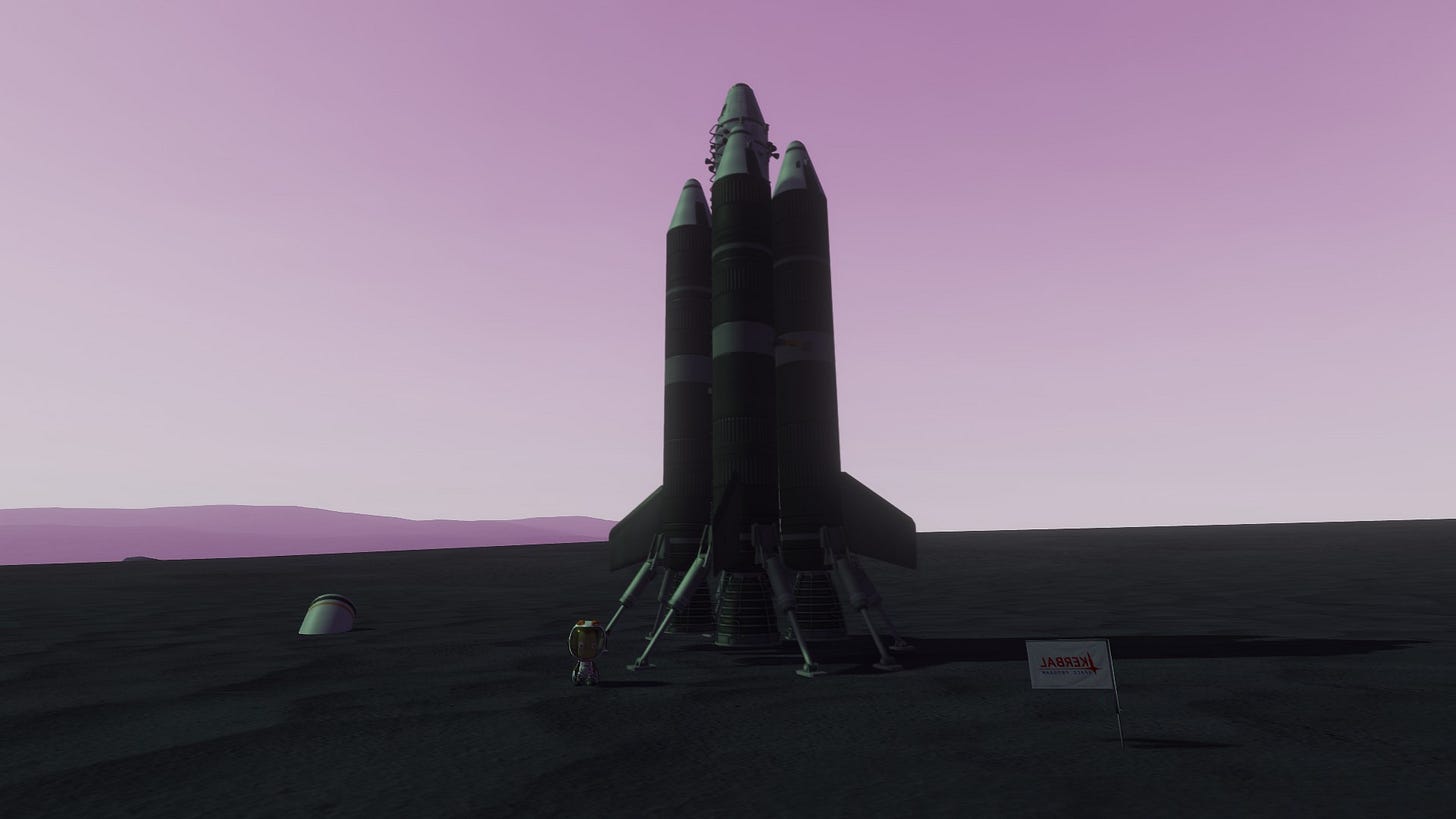
The lander’s inexplicable sliding across the ground not pictured, but inferable from the distance between the craft and flag.
Having completed the easy part of his task, Munmore prepared for the difficult and untested ascent with stoicism. Calling upon the Kraken, the Creator of the Monoliths, and Advanced Tweakables, he appealed for fair winds and happy landings. At mission control, champagne was already all but uncorked in celebration of the mission’s anticipated success and the engineers were already doodling out extravagant plans for the craft that would be required to bring Munmore back home from Eve orbit. (The engineers had been so excited to get Munmore to Eve that they forgot he’d need to get back once he made it there.)
Priming the engines, he ejected the parachute modules and fired the engines, fully ready to go home.
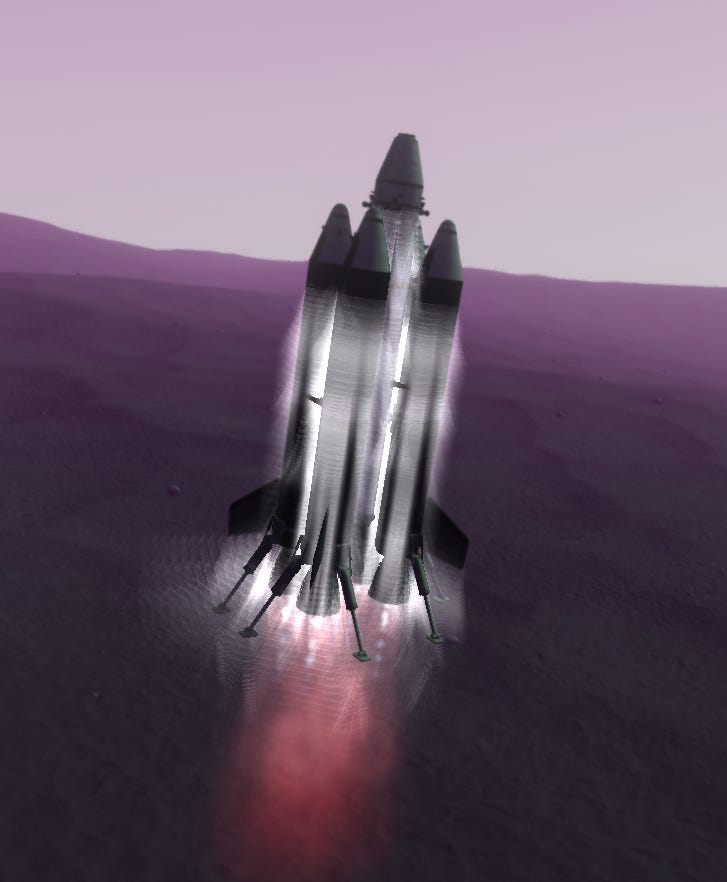
He detached the first set of boosters
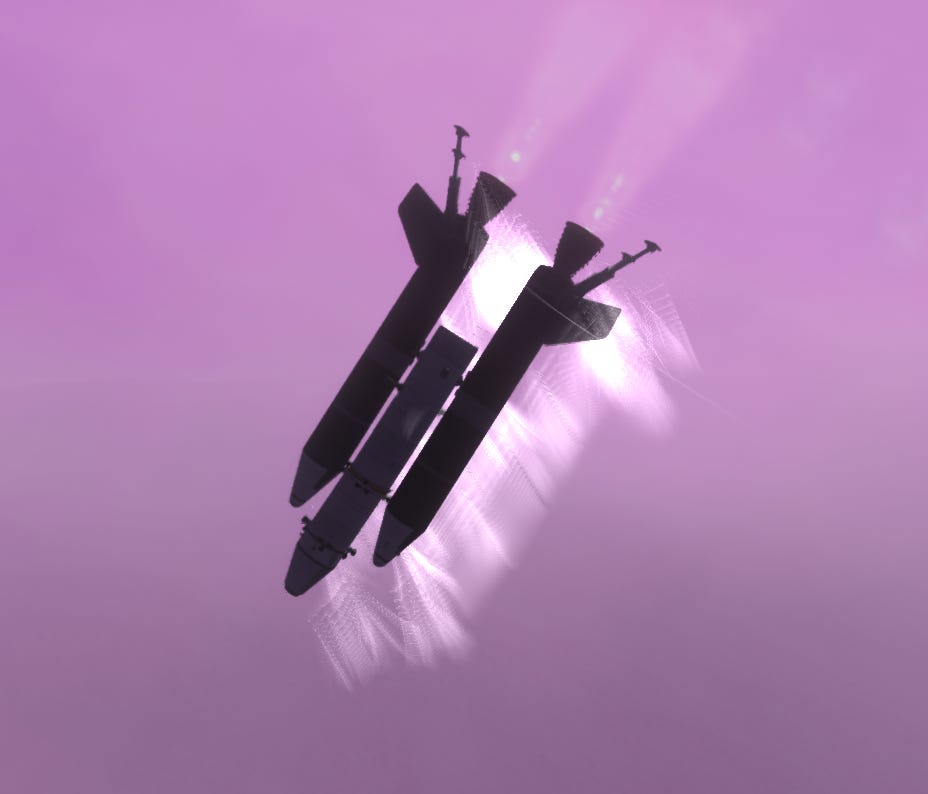
It was at this moment that Munmore realized the design was flawed.
and asked: “where did my rocket go?”
The simulator module powered down, and the corks on the champagne were surreptitiously placed on table for use next year, when the replacement lander successfully broke the atmosphere.
While the engineers went back the drawing board, Munmore gave the craft a few more runs, each equally catastrophic.11 The lander, unstable to begin with, consistently flipped as soon as the first set of boosters detached (that is, when there was a rocket left to flip).12
Kerbin, we have a problem.
Part Two - The Second Lander
The design of the first lander had been an exercise in hubris. The basic motto of the KSP: “MOAR BOOSTERS” had been ignored in favor of elusive concepts of elegance, fuel efficiency, and “budget.” That error would not be repeated.
The new lander had a nosecone, nearly double the engines, 160% the mass, retractable ladders, double the crew capacity, and even remembered cupholders (the night shift at mission control had listened to Munmore complain for a literal year about that particular oversight on Lander Mk. 1).
It was a masterpiece of engineering.
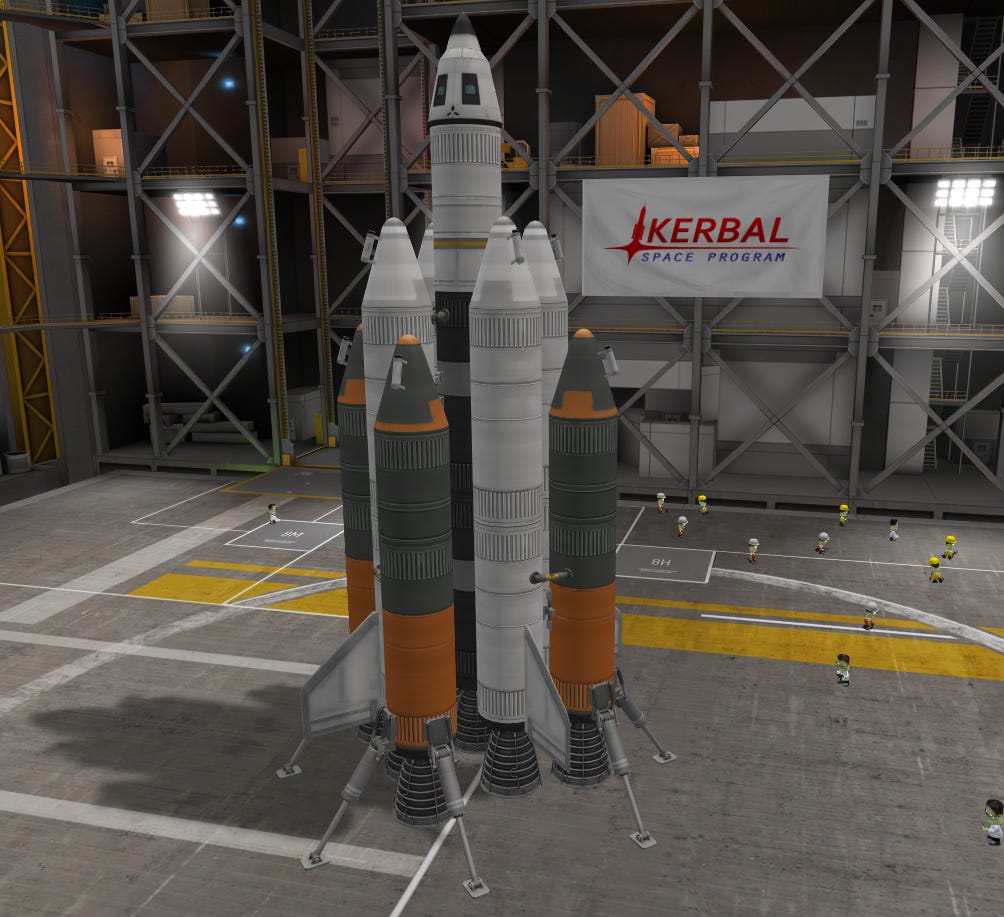
You can tell I was serious about this thing because I put separatrons on it.
Some engineers raised concerns about the lack of fins on the main stage, and others asked about the wisdom of having an upper stage with a thrust to weight ratio of 0.8, but the consensus view was that the lander was more than adequate to escape Eve’s surface. Unfortunately, it was impossible to say for certain. The simulator had accidentally been taped to the top of the rocket yet again. As such, the consensus view reigned, and program veteran Valentina Kerman, a program legend second only to M.I.A. Jebediah, was selected to pilot the craft on its maiden voyage to Eve.
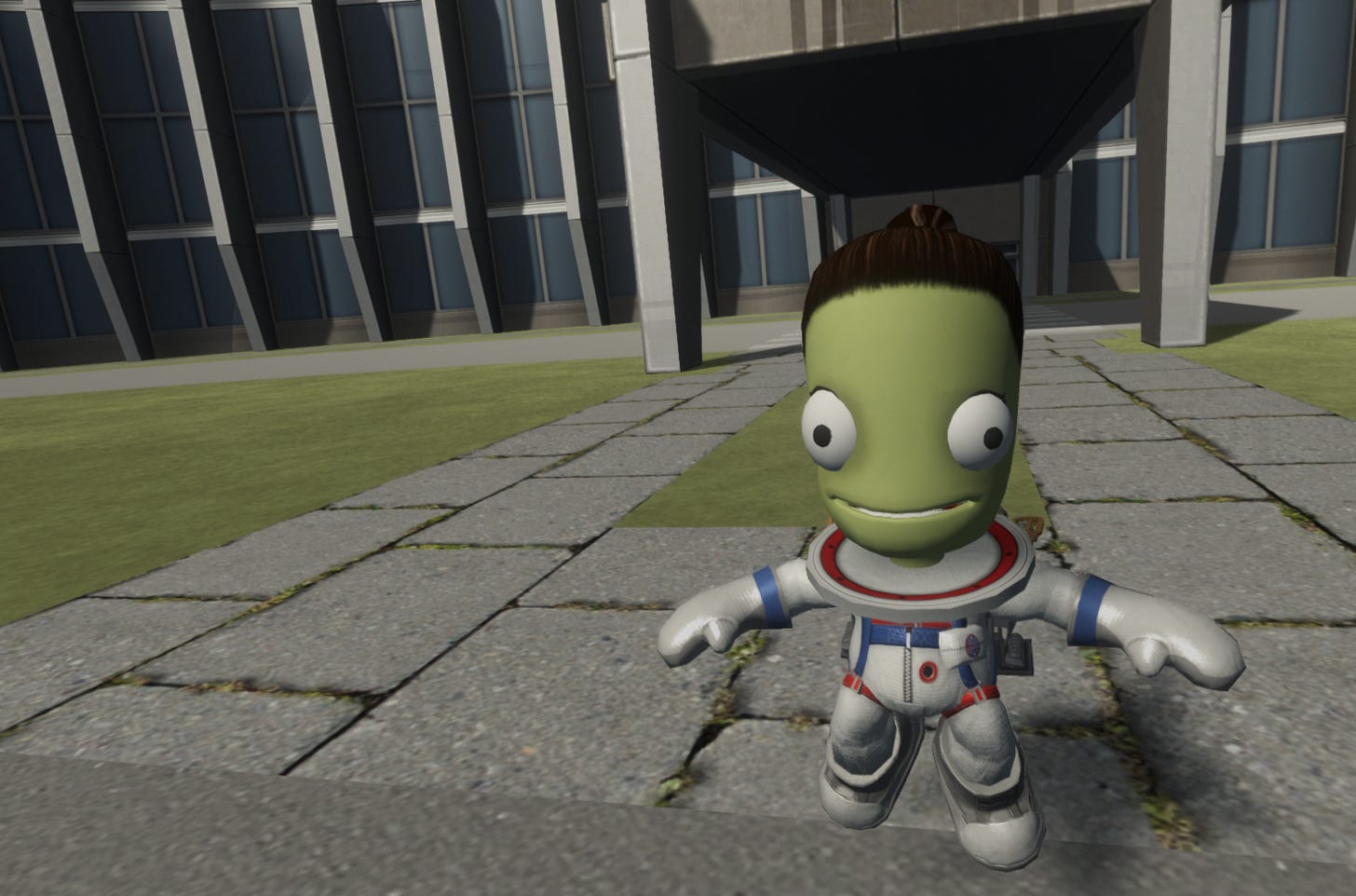
Valentina had won the Miss Universe pageant before she became an astronaut, and when asked what she wanted to accomplish in life, she had shocked the judges by telling them: “I want to be the first kerbal to return from the surface of Eve.”
She was the right woman for the job.
First though, parachutes and heat shields13 were attached
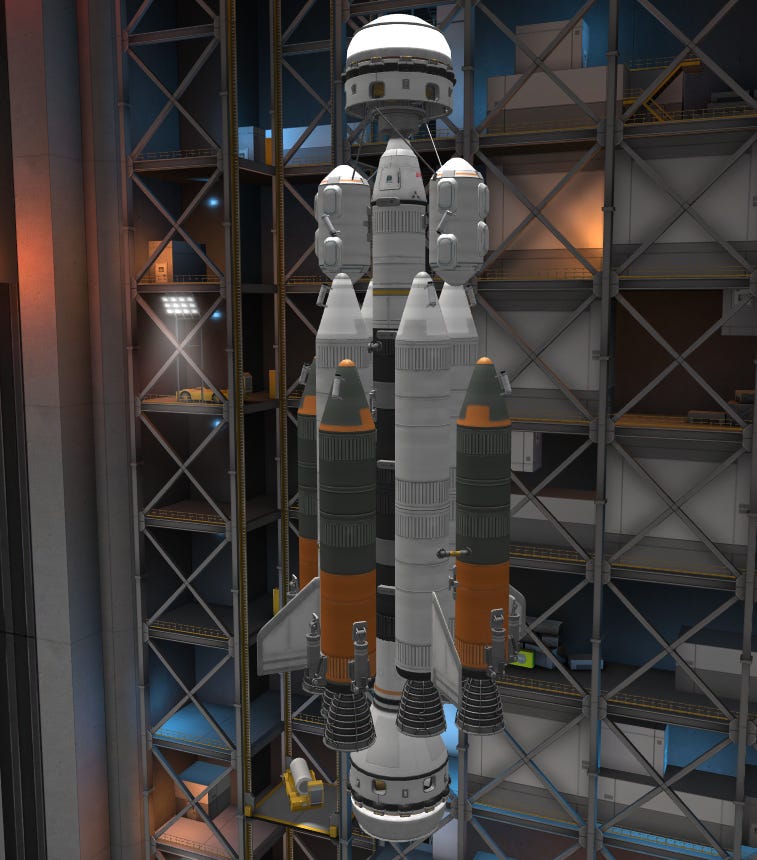
and the largest booster constructed in recent history was affixed to the bottom of the upgraded lander. This thing was so big that the official vehicle assembly building cameraman didn’t have a wide enough lens to capture the entire thing in one shot. It worked out; his capture of lift-off made the official Christmas card.14
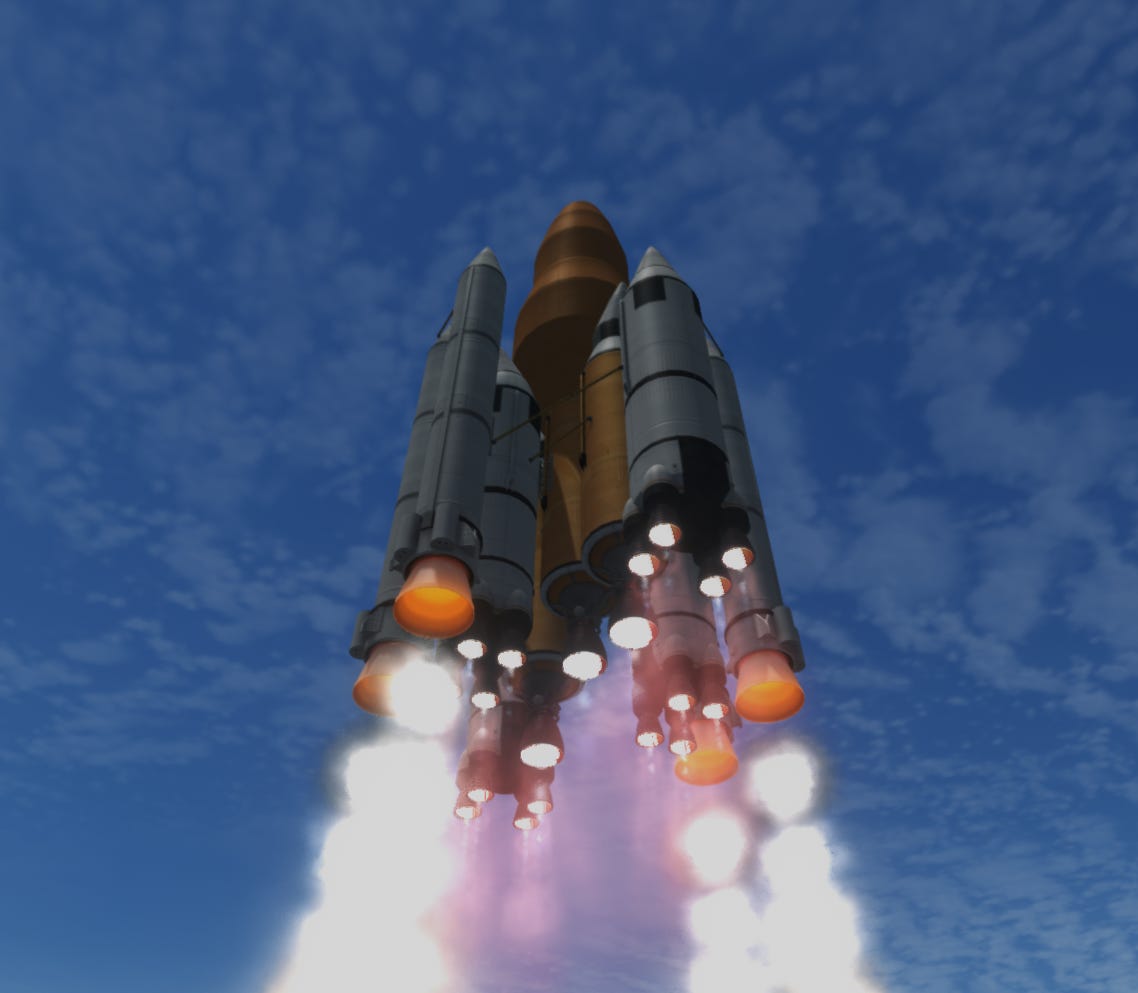
While I’m sure that I’ve built bigger rockets, it’s been a hot minute.
A successful orbit, transfer to Eve, year, and two hundred and five days of waiting in deep space later, the lander was finally in orbit of Eve.
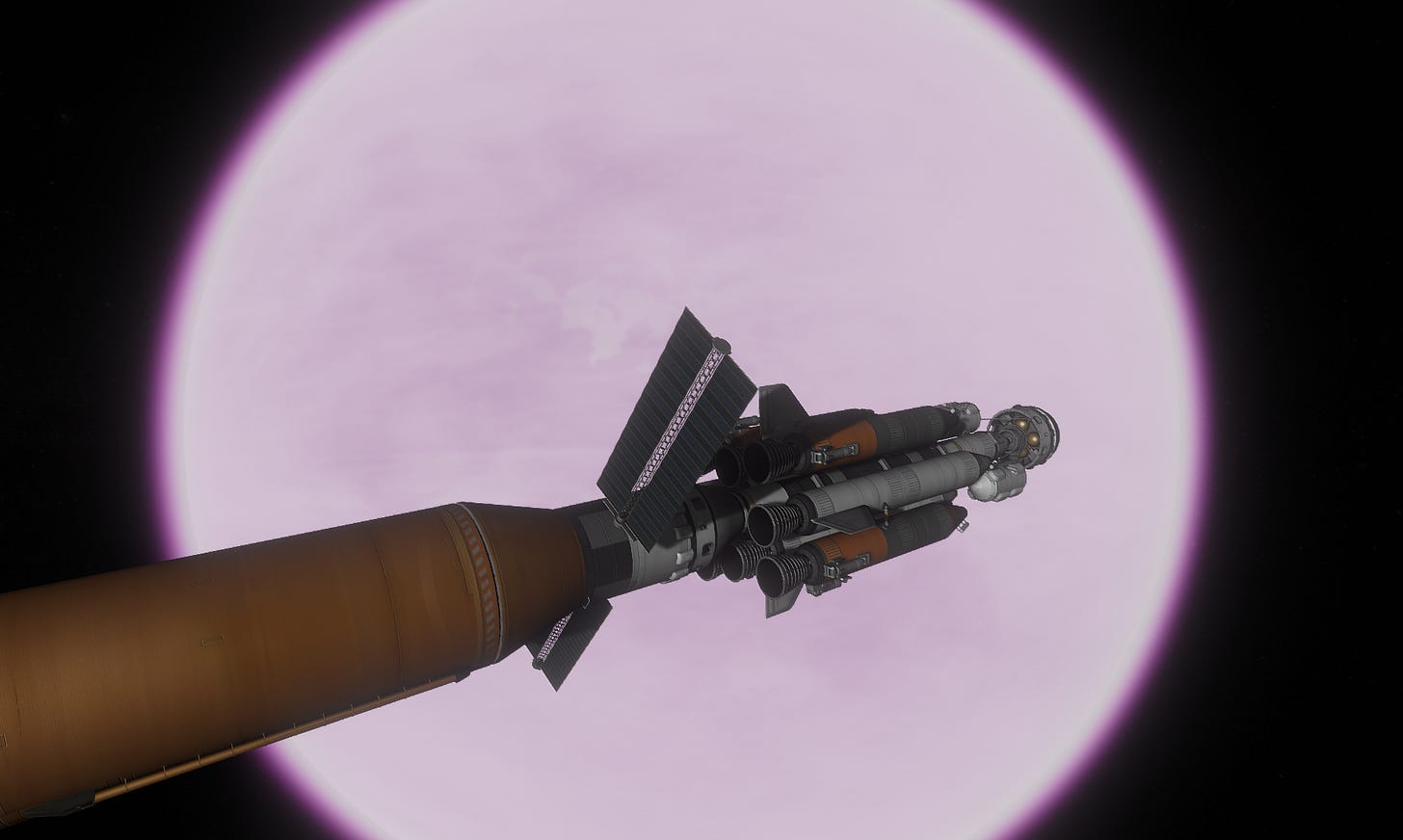
I took this screenshot thinking it was Lander Mk. 1 lol
Valentina, a more complex chef than Munmore, chose to staple her last remaining steak to the side of the lander for her entirely uneventful reentry. Seared to a crisp, it had a strange purple flavor that has yet to be replicated.
Valentina had landed.
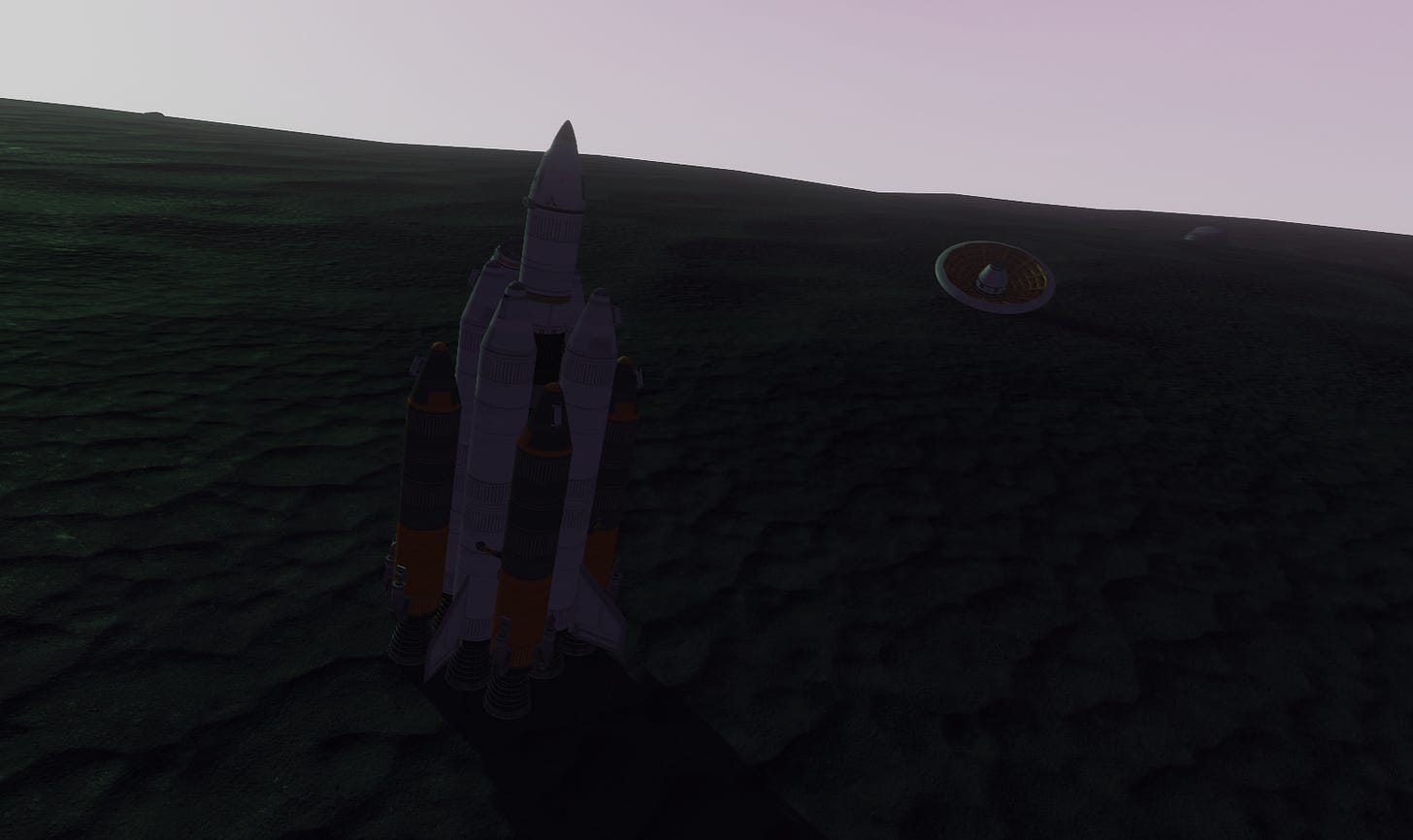
You can only barely see it, but if you look carefully, you’ll note that the parachute module didn’t actually clear the side of the rocket and was stuck on its side.
It was at this point that mission control noticed a small problem in the current plans to get Munmore and Valentina home. It was this: planets are big and Munmore and Valentina were not at all near each other. They weren’t on opposite sides of the planet, but there was a substantial gulf between the two kerbals.
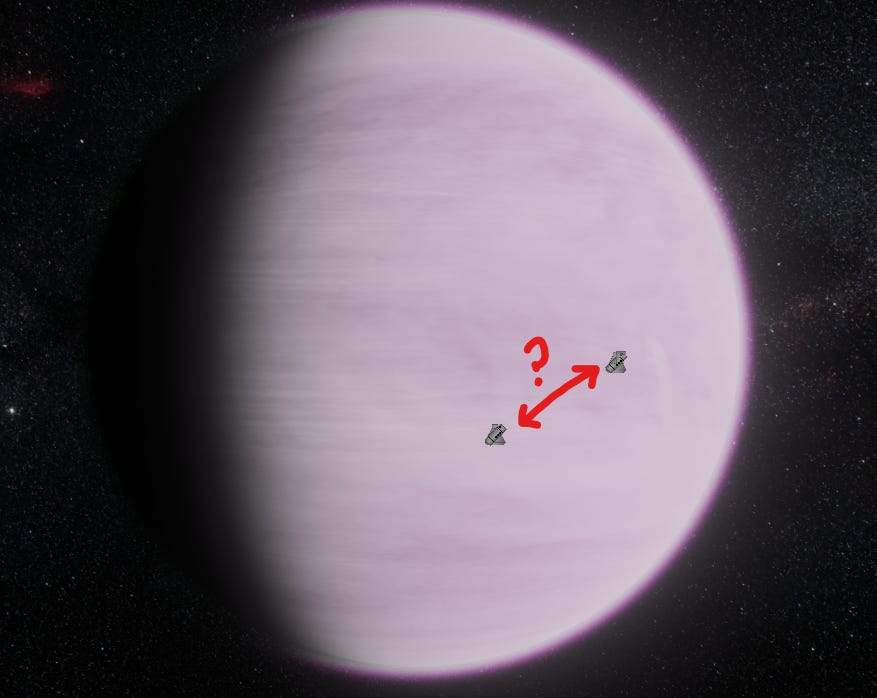
This certainly could have been alleviated with a more careful reentry, but even then, the walking speed of the average kerbal is low enough that a transportation system was necessary.
Planning began for a transportation system for Eve, but in the meanwhile, Valentina initiated the simulator and began plotting a trajectory that would eventually return both her and Munmore to the lovely shores of Kerbin, where the oceans were made of water (in contrast to Eve’s explodium seas). She sent an email to the Kraken, toggled KerbNet on and off, thanked the devs for AutoStrut, and began her engines.
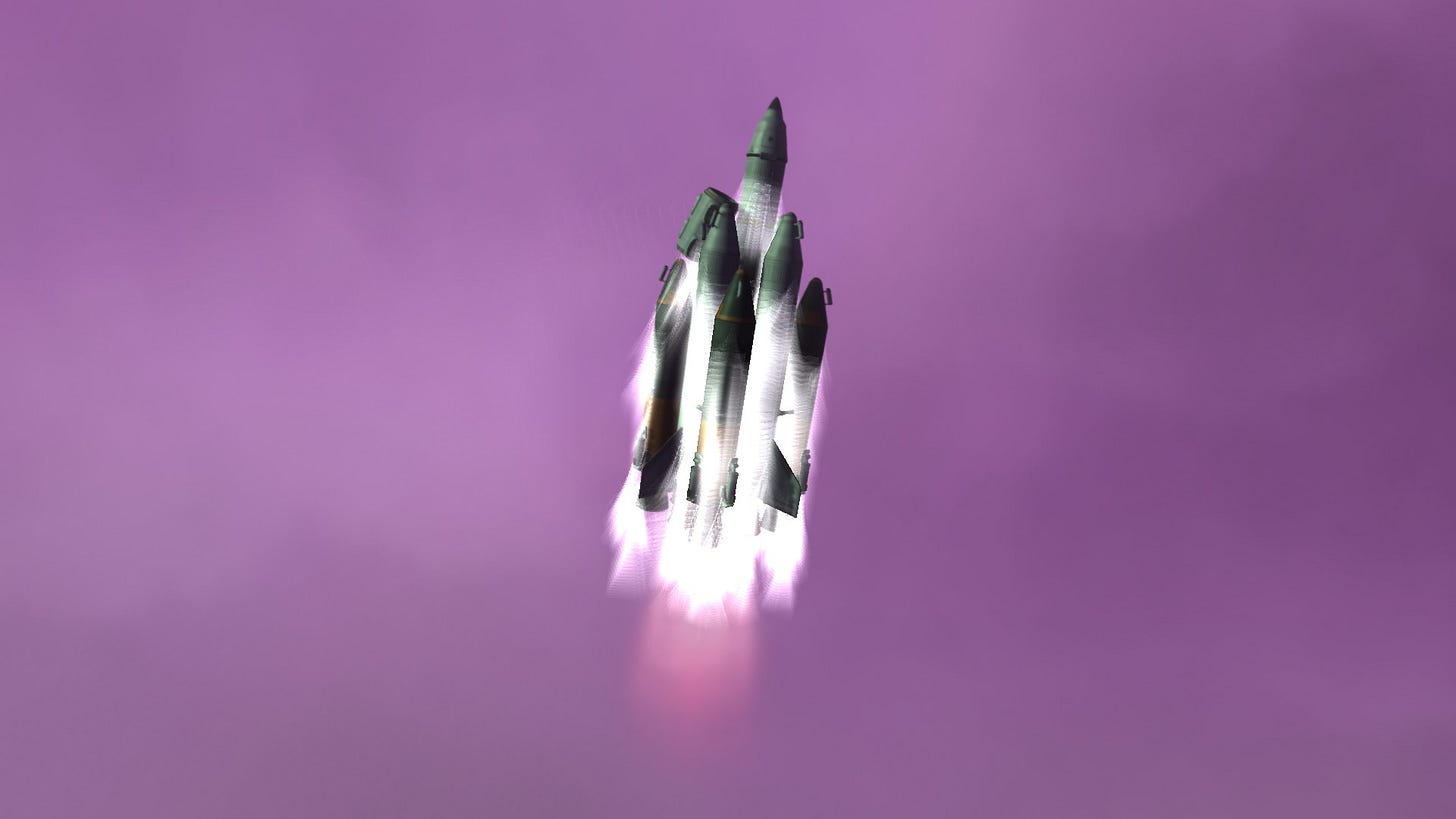
You can see the parachute module here even more clearly. It had boosters on it to enable it to clear the rocket, but they were (clearly) insufficient.
All was going well until she detached the first set of boosters.
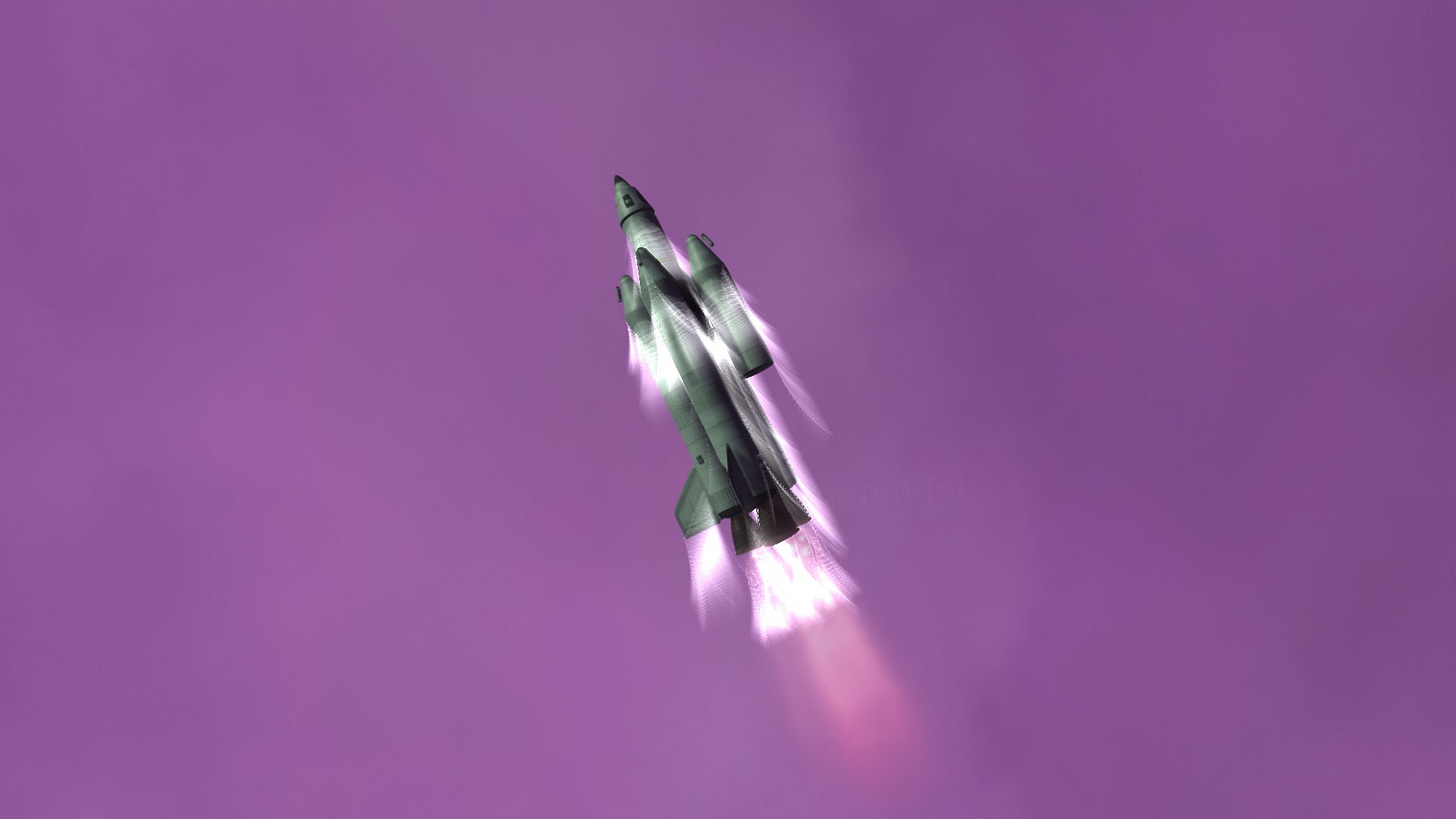
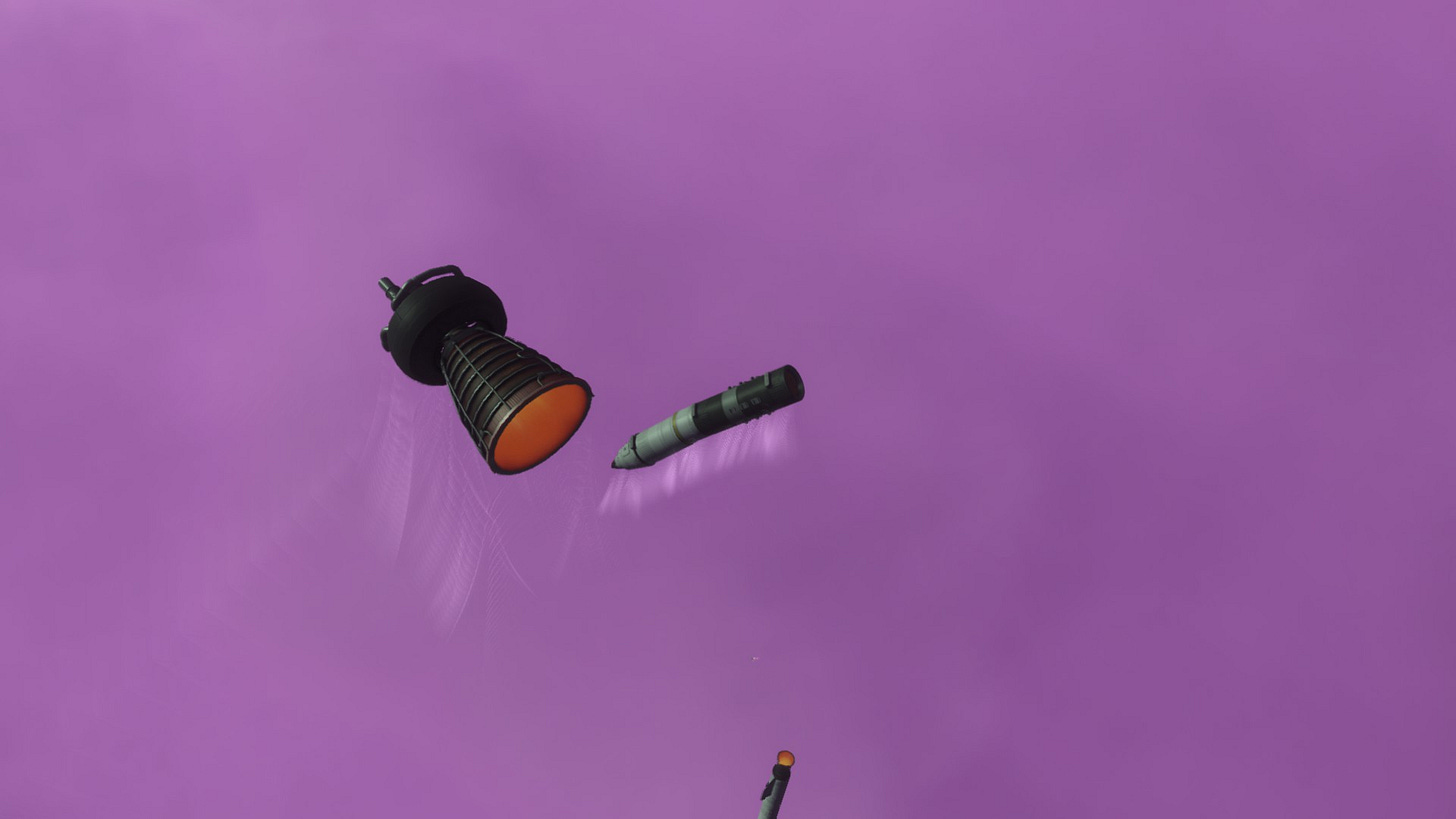
This was less than ideal.
The new lander had the same stability problems in most instances and was almost impossible to control in the lower atmosphere unless the target direction was straight up. Repeated testing of the lander did eventually breach the atmosphere on a suborbital trajectory, but even optimal flying left it on a trajectory far short of a stable orbit.15
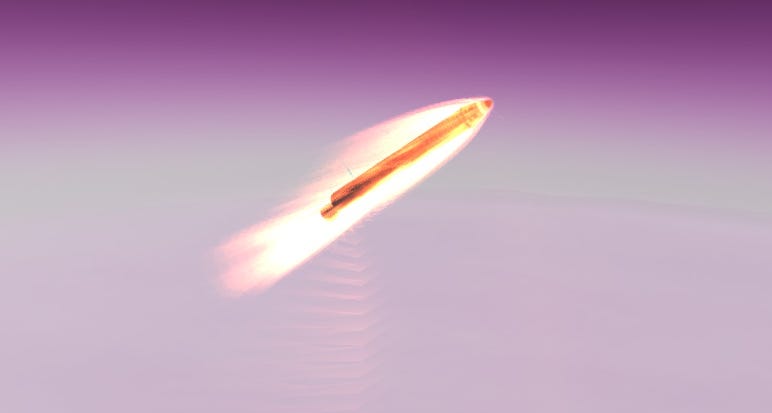
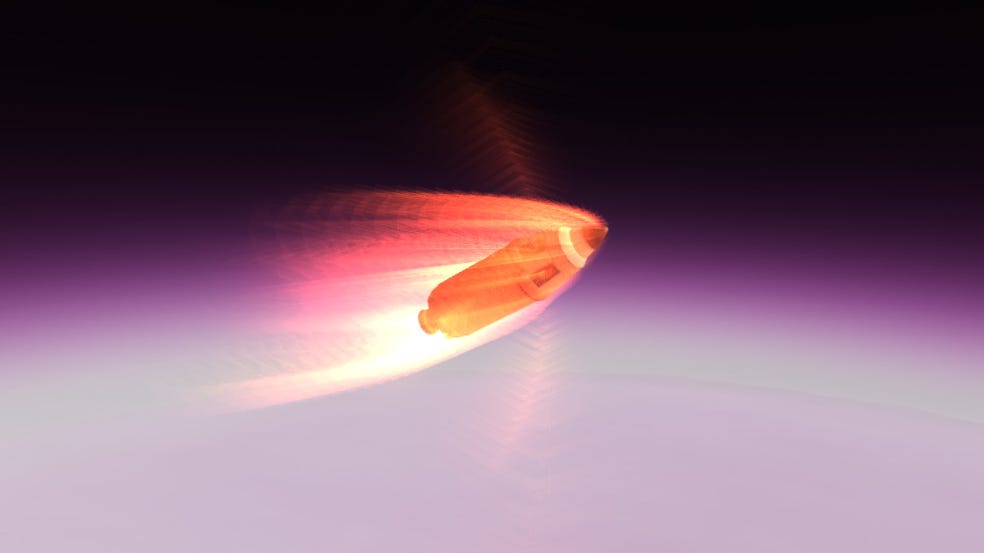
My best flight was within 1600 m/s of delta-v of making orbit. The only problem was that a) I didn’t have it and b) the thrust to weight ratio was so low that even if I did, I would have already fallen into the atmosphere by the time the fuel was fully expended.
Valentina’s best efforts weren’t enough. The champagne, already locked in the closet until a plan to unite the kerbals on Eve’s surface crystalized, was given to an intern for use in graduation photos. Half the engineering staff was fired. It was a dark day at the Kerbal Space Center.
It was an even darker night for Munmore, as he learned that his time on the surface of Eve (without cupholders) was only just beginning.
Part Three - The Third Lander
Lander Mk. 3 needed a new design philosophy. It needed fins and a thrust to weight ratio higher than 1. The remaining engineers, in a brief moment of lucidity and powered by Mountain Dew, developed the following design.
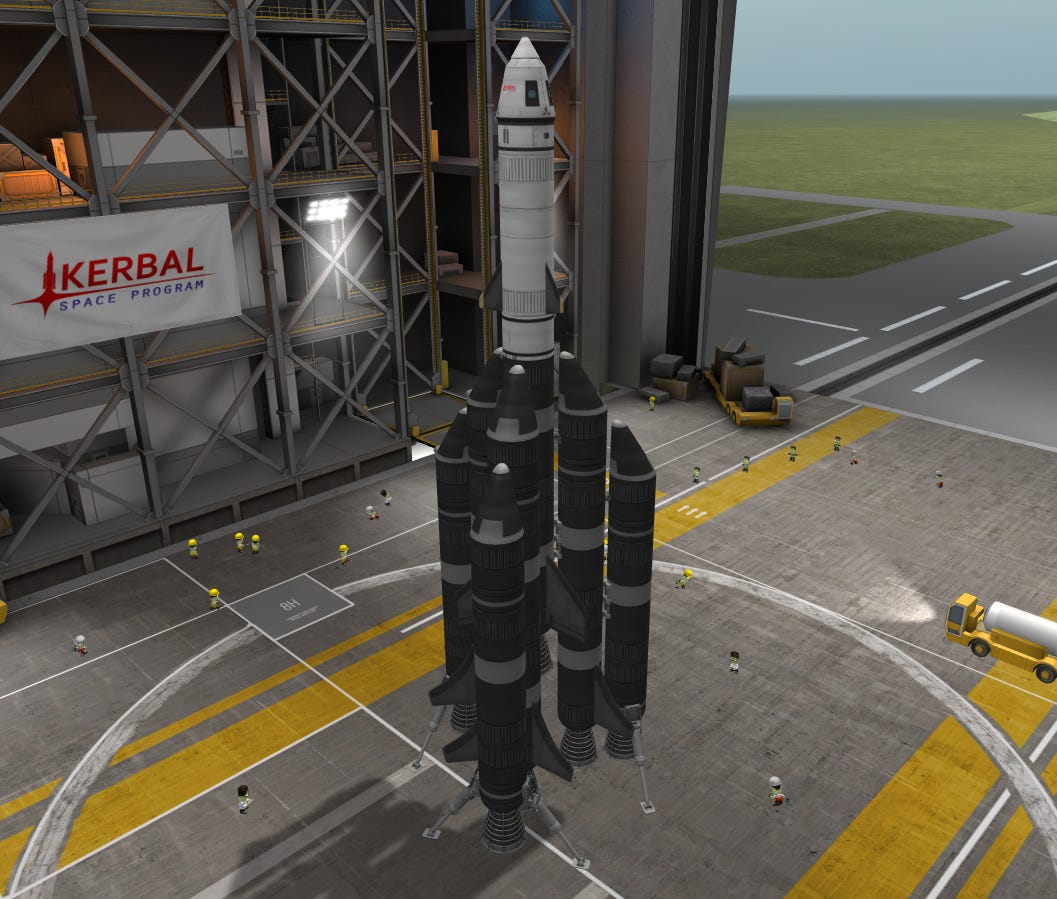
Included in the service bay was a battery, three reaction wheels, and two solar panels. Were they necessary? No.
Lander Mk. 3 was a whole new beast. It weighed 7% less than Lander Mk. 2, but it had three times the fins and substantially more bang for its buck. New design philosophies based on the concept of less engines and more fuel dominated the craft, and a state-of-the-art ladder system required kerbals to climb in upside down (studies showed upside down kerbals increased morale).16 Perhaps most importantly, the craft’s upper stage had an engine that produced three times the thrust than the old terrier and worked at all levels of the atmosphere. Failure was not an option.
Unwilling to design a new booster for the lander and not realizing that the new lander was actually lighter than the old, the Mk. 3 was built with efficiency in mind.17 All fuel was drained from the craft to save weight, and a mining system was installed to enable in-situ refueling. The mistake of stranding Valentina on the rescue mission was not to be repeated with the implementation of automated systems capable of piloting the craft without risking another life.
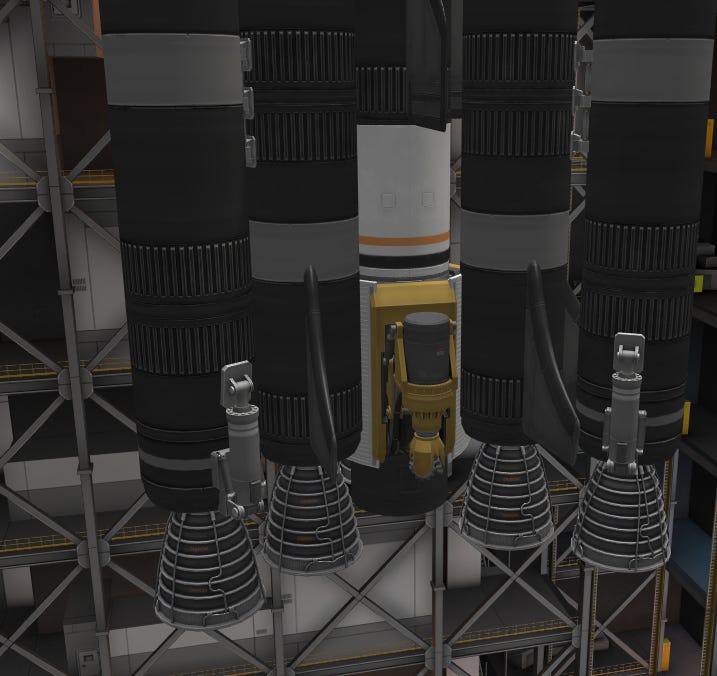
The mining system and probe core in question.
Heat shields, boosters, and struts were all attached and moved into position with little fanfare. Wrapped in a fairing, the rocket was ready to be strapped to a booster. By this time, the space center knew how to build rockets larger than skyscrapers almost instantaneously (though build times did grow as the part counts increased).18
Launch, orbit, and a successful transfer to Eve were executed in quick succession. Circularized at Eve, the incredibly lightweight and entirely necessary camera drone snapped a picture of the craft in orbit, awaiting simulations to fine-tune the landing area to avoid stretching the upcoming intra-Eve transport system any thinner than necessary.
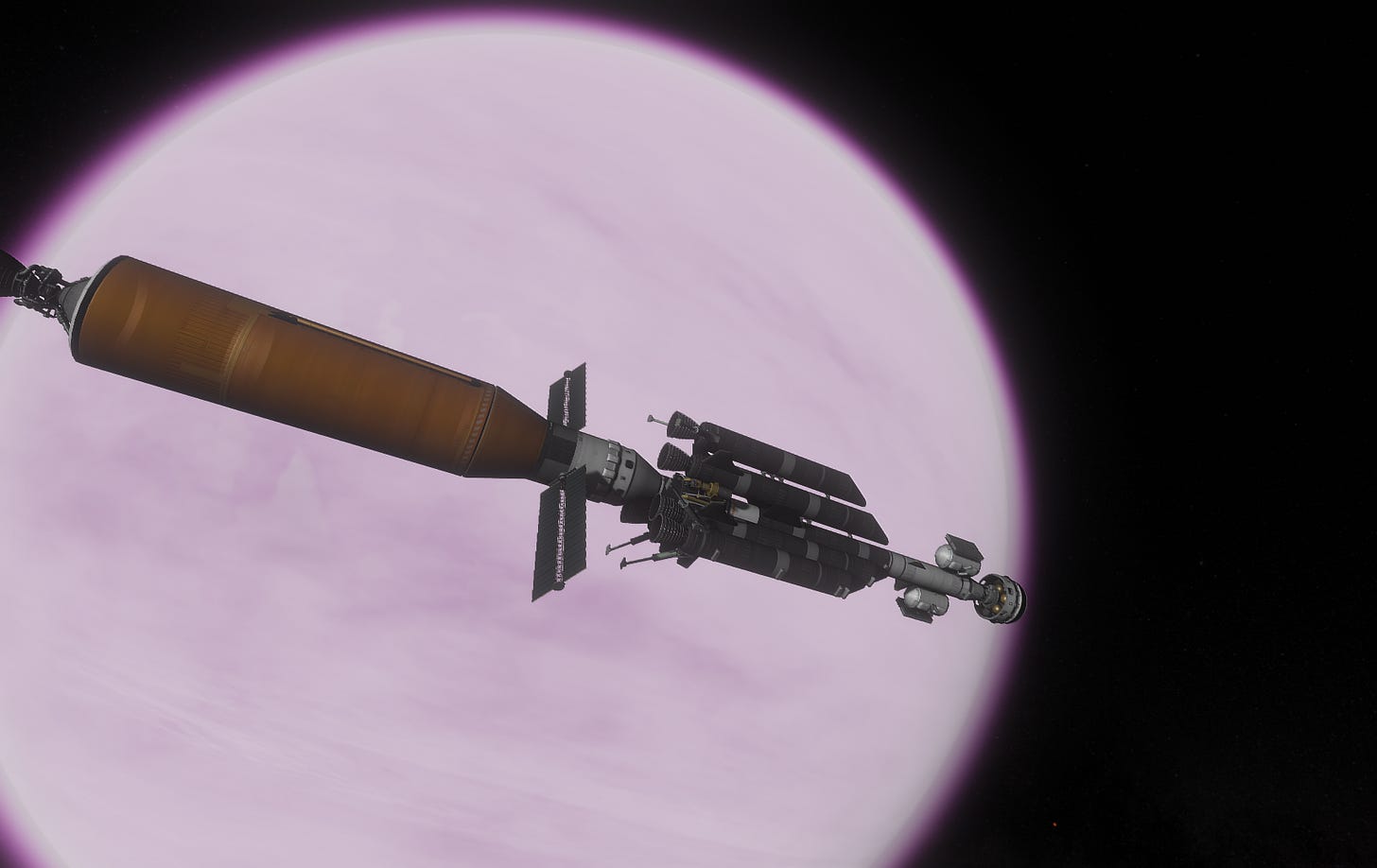
For those of you wondering, I used the same booster and heat shield set up for Lander Mk. 3 as I did for the Mk. 2.
Atmospheric entry and landing weren’t difficult, parachutes still worked like a charm. That was especially fortunate because the uplink to the probe had failed midway to Eve, and the limited AI on the craft was unable to do any more than the most basic piloting (several engineers were fired for forgetting an antenna). Tired of Eve, and hopeful that this would be the last necessary launch to the planet, beer was brought out to celebrate the landing and the initiation of the snail-like refueling.
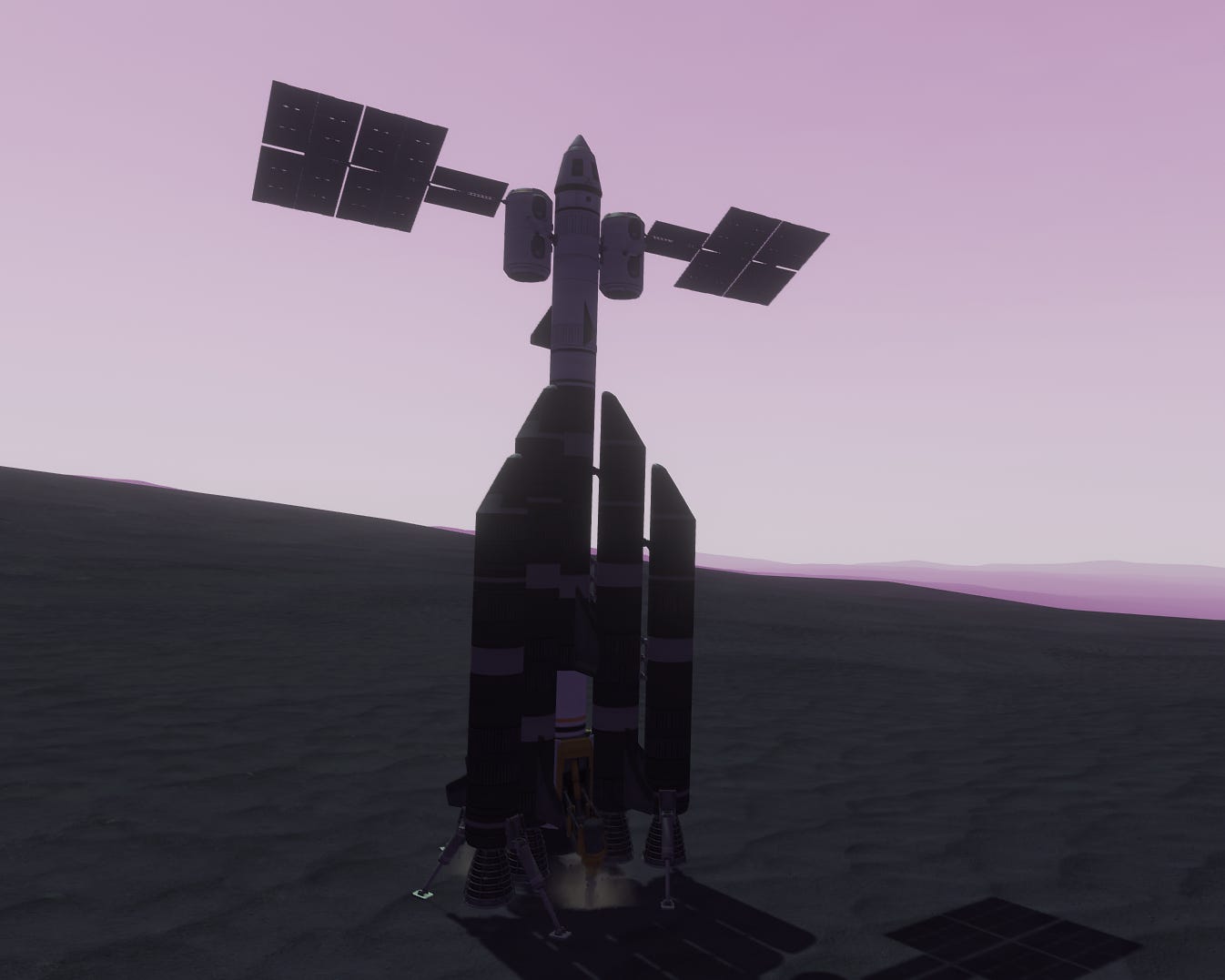
The mining was incredibly slow, but fortunately a) there was ore to mine b) there were several more missions that still needed to go to Eve.
Several more engineers were fired when it was discovered that the probe core had been attached to the detachable mining unit, and there was no way to run simulations of launch efficiency because the probe core would refuse to control the vessel, even in simulations, once it had been detached. Given this flaw, it was now time to build a system to get Munmore and Valentina to what the whole of Kerbin hoped would be their salvation.
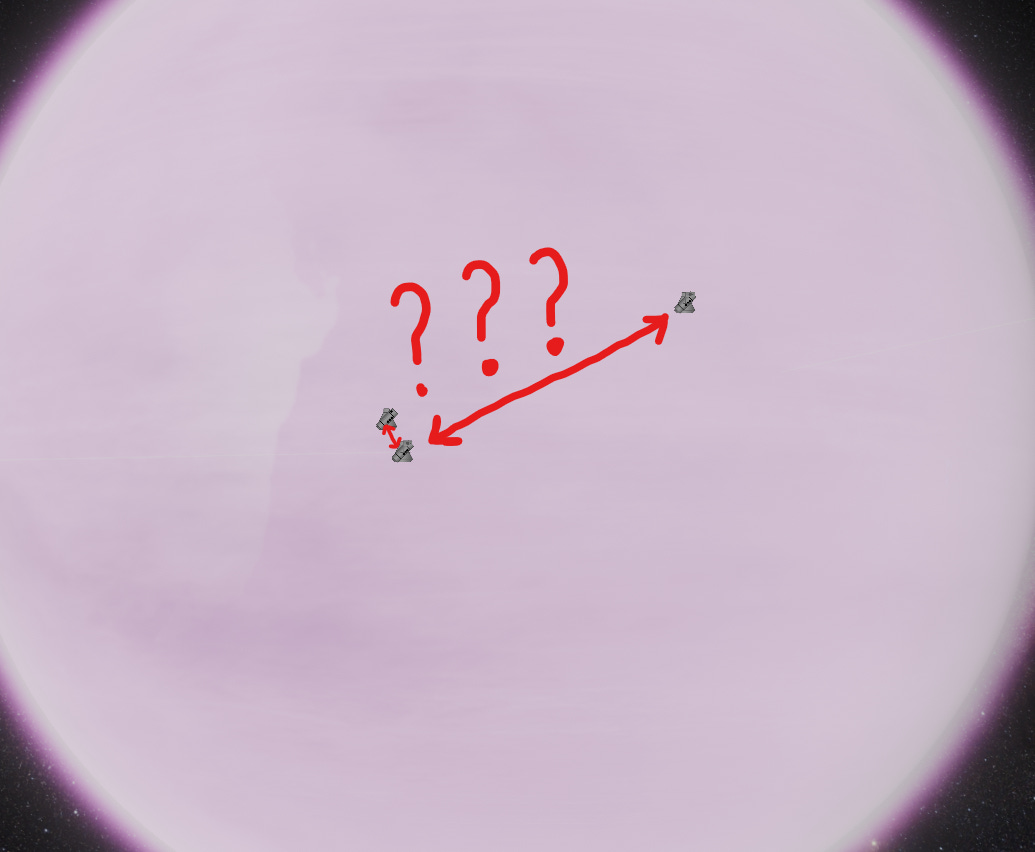
As for the connection failure, a few engineers argued that fixing it should be a higher priority, but their concerns were drowned out by the army that was hopping up and down to build a public transportation for another planet.
Part Four - Eve Plane Mk. 3
The newly turned-over staff of the space program’s design department filled an entire chalkboard with ideas for the Intra-Eve Transit System (IETS). Some office favorites included a rover, a planetwide light rail system, a series of underground tunnels that standard cars could run on, and a set of carefully spaced catapults similar to those used by the residents of Dover.19 Despite the creative outpouring, in the end the budget hawks and prudent and safety-minded forced the construction of a propellor plane instead (propellors being necessary as the murky atmosphere of Eve lacked oxygen for jet engines to burn).
Initial drafting rendered the following craft which was speedily built and slated to be put on the Jebediah Kerman Memorial Runway.
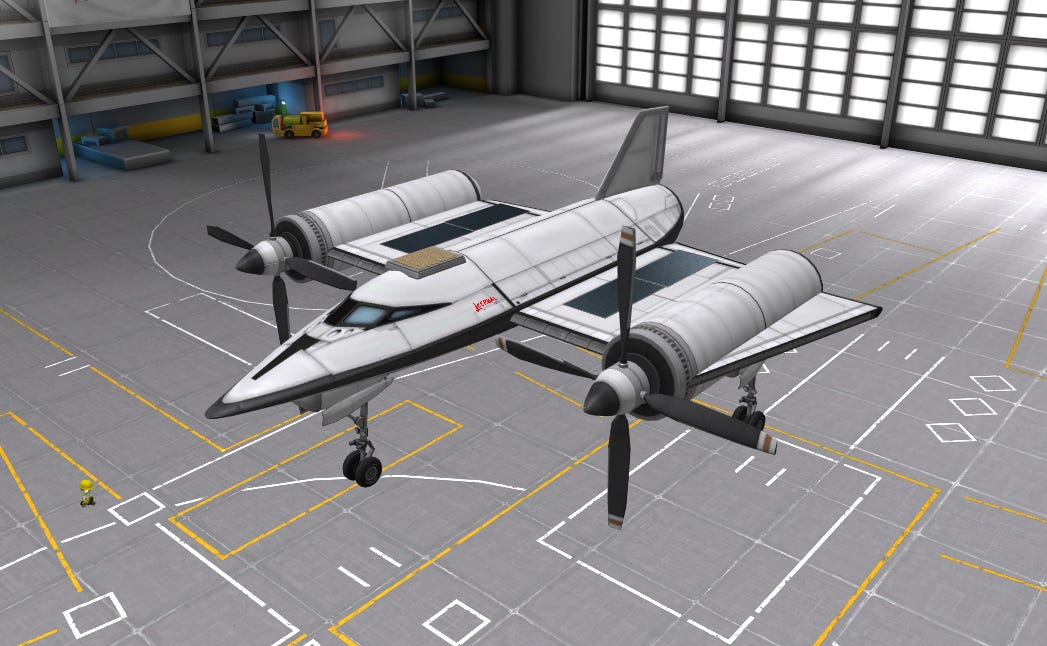
This didn’t accelerate because I had no idea how to use propellors. It also didn’t help that the propellors would run into the ground on landing.
It had been more than a decade since the runway had been used, and the last recorded flight was by one Jebediah Kerman (M.I.A.). The staff hired to operate the runway had initially put up a board counting the number of days since last use, but when they hit 5,000, they stopped counting. Finally, on the fateful day of Eve Plane Mk. 1’s first test launch, they finally got around to checking the condition of the runway …
They found Jebediah, sitting, happy as a clam, in the cockpit of the ill-fated ion engine powered plane, just waiting for the go-ahead to launch.
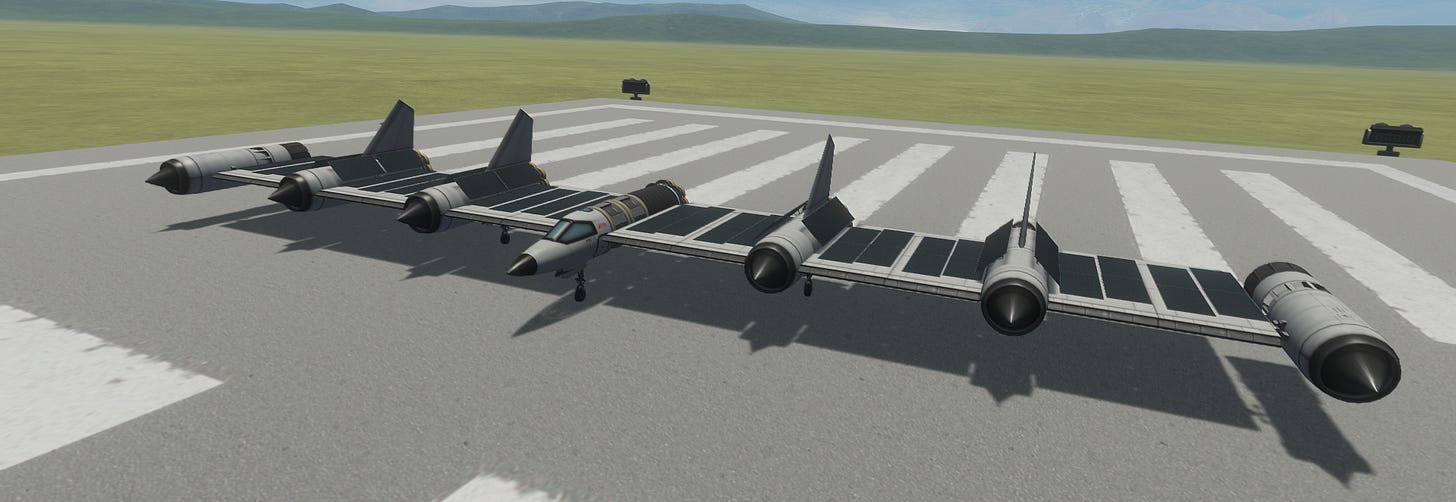
This particular mission was doomed from the outset, though Bradley Whistance once made orbit on a plane powered purely by ion engines by starting the flight on top of a mountain.
Mission control, ecstatic to have found the long-lost Jebediah Kerman, immediately ordered him to take a week of bedrest, hit the nearest all-you-can-eat buffet for a decade overdue dinner, and then report to the space center for the test flights of the Eve Plane.
In the meantime, the drone pilot test for Eve Plane Mk. 1 revealed irreparable flaws in the design, including poorly angled, too long propellors that hit the ground if not aligned perfectly for landing, a high take-off speed, low accelerations, and poor stability.
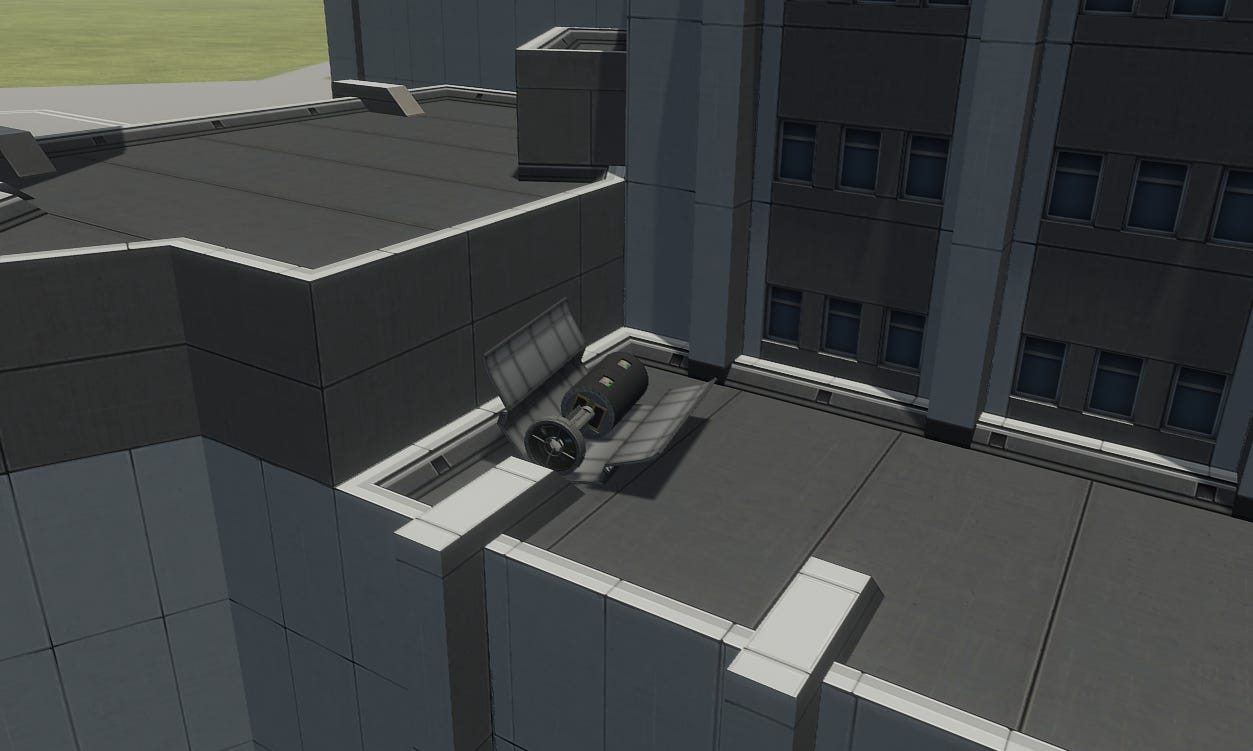
The flaws with the propellor angle stemmed from failures to understand how they worked, but even when testing with an improved understanding of propellors, the control problem led to rapid unplanned disassembly into the side of the spaceplane hangar.
Learning from the mistakes of the past, the team scrambled together a new design, built with the singular goal of maximizing lift on a limited footprint. It featured double the wing and half the propellors as well a distinct lack of ladders (to be added later depending on the result of unmanned test flights).
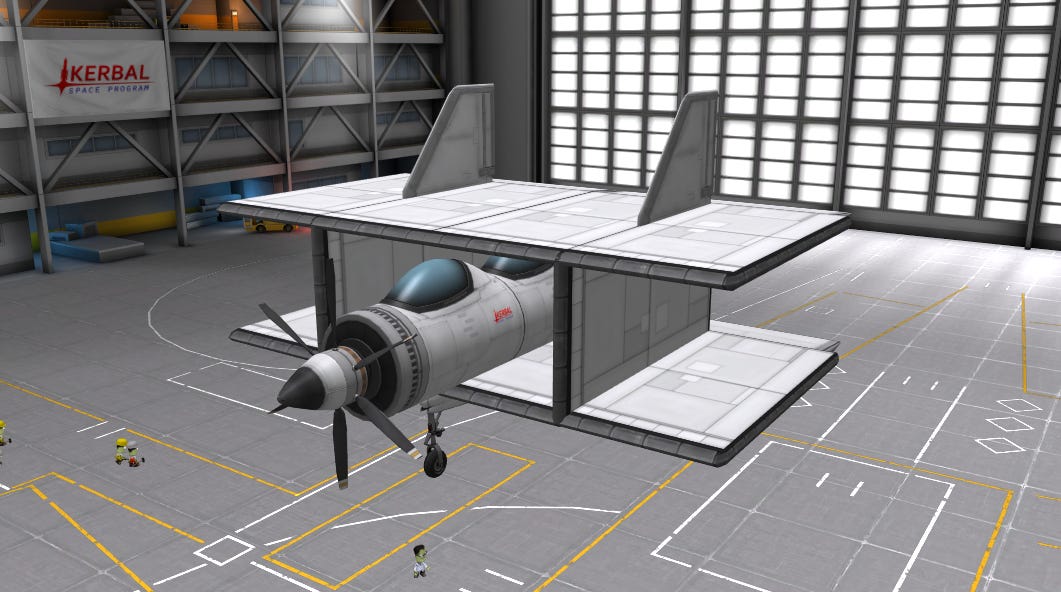
The redesigned craft successfully took off but lacked the high-speed maneuverability and general pizzaz that the design team needed. Early drone testing also failed to produce appreciable maneuverability, though years later Jebediah would test the controls and discover that the craft was serviceable, given a skilled pilot. Even so, the speed was entirely insufficient and Munmore demanded that any vehicle delivered be acrobatic enough that if Lander Mk. 3 failed he would have something to entertain himself with for the added years of imprisonment. The design team, recognizing Munmore’s frustration and unnerved by Valentina’s refusal to answer questions about her preferred design, scrapped the Mk. 2 and started work on a new craft.
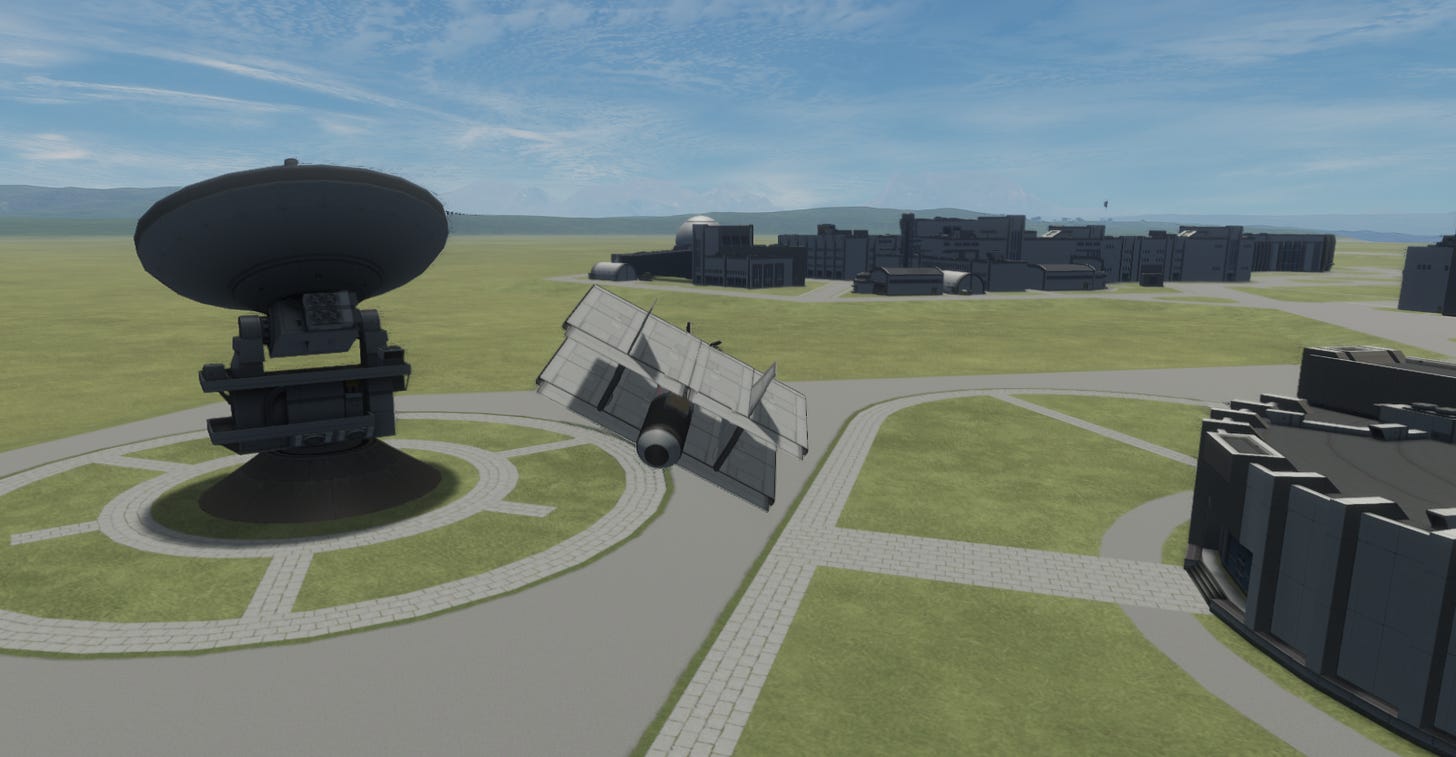
Found footage of Eve Plane Mk. 2 moments before the test flight crashed into the side of the R&D complex destroying the result of a multi-year audit. Strangely, Building VII of the complex also collapsed although the plane made no contact with the building and the destruction was announced live nearly an hour before it fell.
The new craft, in an attempt to remedy the past craft’s lack of speed, quadrupled the number of engines. (It also integrated a docking system’; it’ll make sense soon.) Other major improvements included the ladder system, expanded wing length, and canards.20
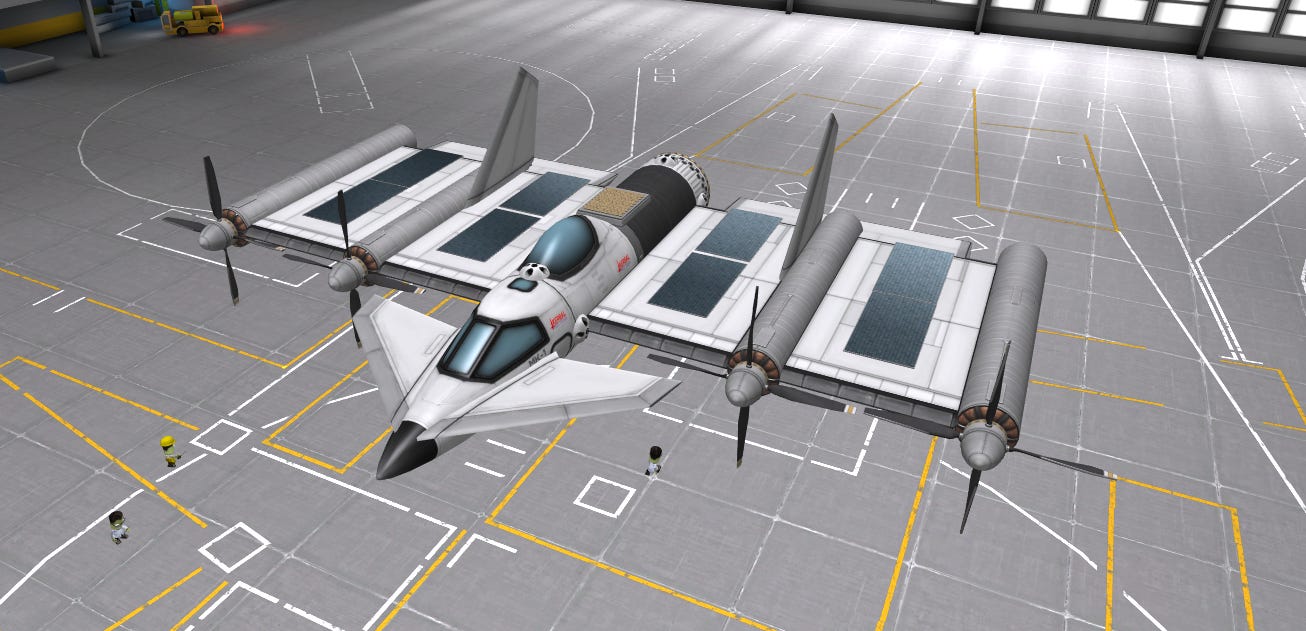
On the final test run, Jebediah himself flew it out to the abandoned island airfield, demonstrating that, when given a plane with engines that actually function in atmosphere (read: not ion engines), his piloting skills were unmatched. Faster and more maneuverable than all prior plane designs combined, the team passed the design on to the crew at the vehicle assembly building for them to figure out how to get the thing all the way to Eve.
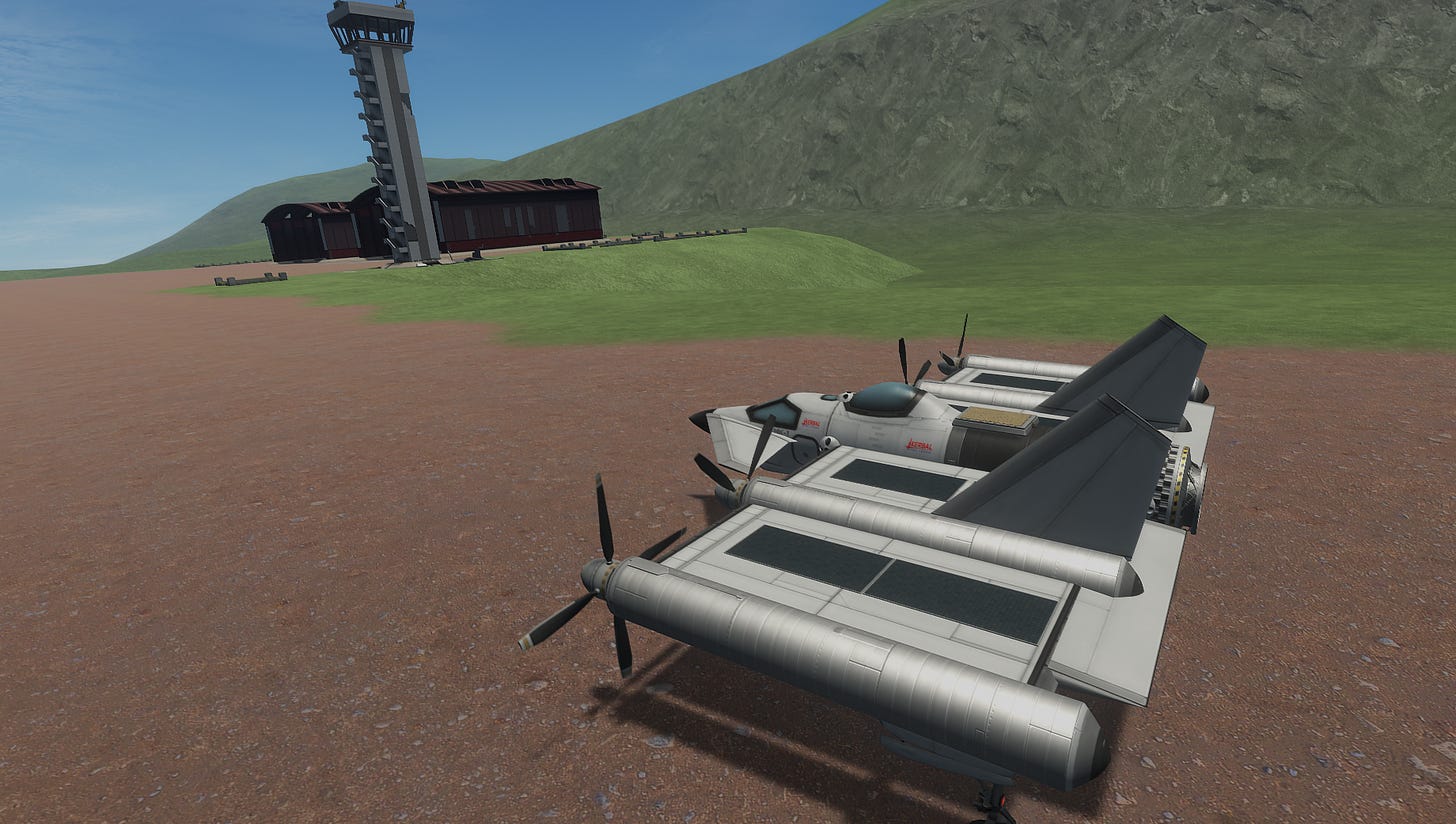
That team had already been hard at work designing new methods for transporting the craft through the long shadows of interplanetary space. Having communicated earlier, the team already had a solution built to accommodate the plane’s broad wingspan: double-wide heat shields. Unfortunately, the plane had to shipped separately, as the aerodynamics of strapping the plane to the top of the heat shield module had caused catastrophic failures in simulations and aerodynamic fairings lacked the width to fully cover the full plane.
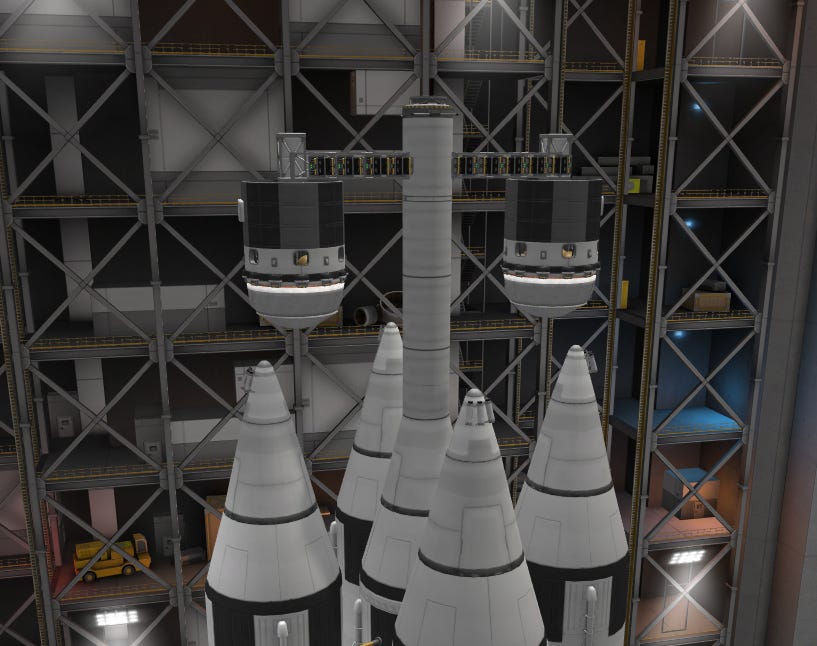
A probe core, six reaction wheels, two inflatable heat shields and a docking port walk into a bar. Ouch.
The heat shields, safely aboard a substantial booster, and prepped to dock with the plane as soon as it could be rendezvoused made orbit without issue.
As for the finding a way to get the plane into orbit, the engineers were having trouble. Fortunately, drawing on imagery from the hit game Human Space Program (inexplicably abbreviated NASA), the staff slapped a booster to the back of the plane and built out a shuttle design that looked something like this.
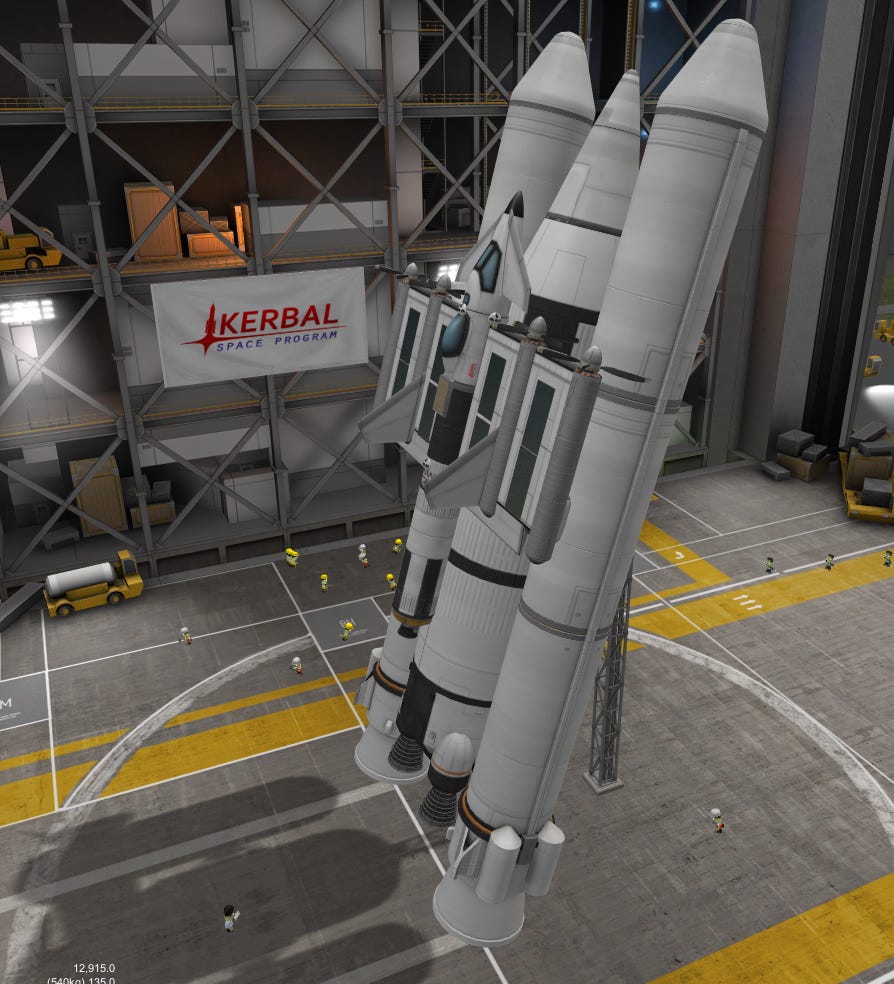
Artist’s depiction. This is approximately the design that I used; the original worked so poorly that I decided not to save it.
Four test flights, three times as many explosions, and half a billion dollars later, the team realized that just because something works in a video game doesn’t make it effective in real life. On his way back to the drawing board, the lead designer tripped on a power cord and accidentally opened a vault of old designs, one being for a plane that turned into a rocket. Realizing that what he wanted was a rocket that turned into a plane, he pitched the following:
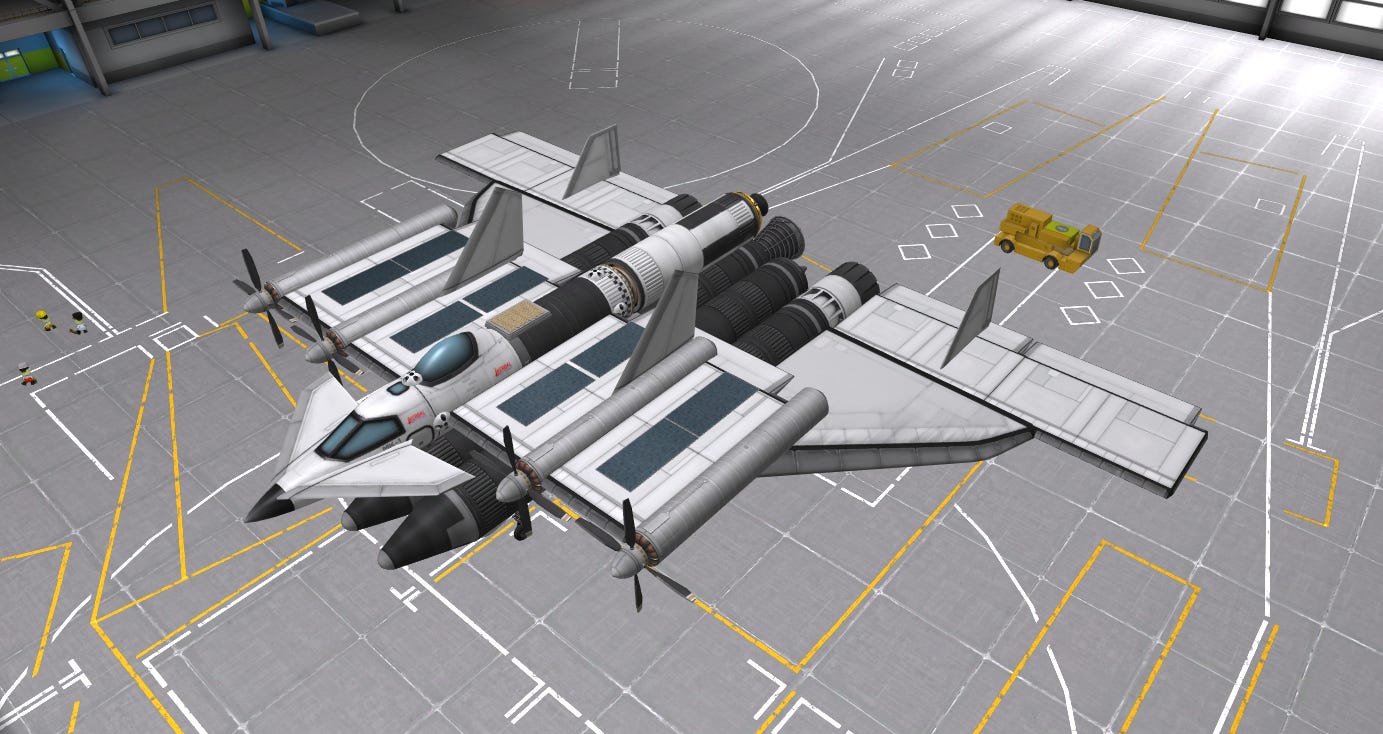
Yes, I really did put this together and think “this might work.” To be fair, at this point I was kinda fried and lacked the willpower to check the alignment between the center of thrust and mass. Had I done so, even the shuttle design might have had a shot at working.
A plane that turns into a rocket that turns into a plane.
It didn’t work. It barely launched. It was incredibly slow. It was unstable as soon as the jet engines detached. It was glorious. It was half the remaining budget. It was the next day that seventeen more engineers changed their LinkedIn status to “Looking for Work.”
Realizing that the program was 0 for 2 on craft designs that relied on adding complexity, the design was passed back to the team at the vehicle assembly building with a stick note on the side reading: “try being less clever and adding moar boosters instead.”
The end result of the new design process was the following:
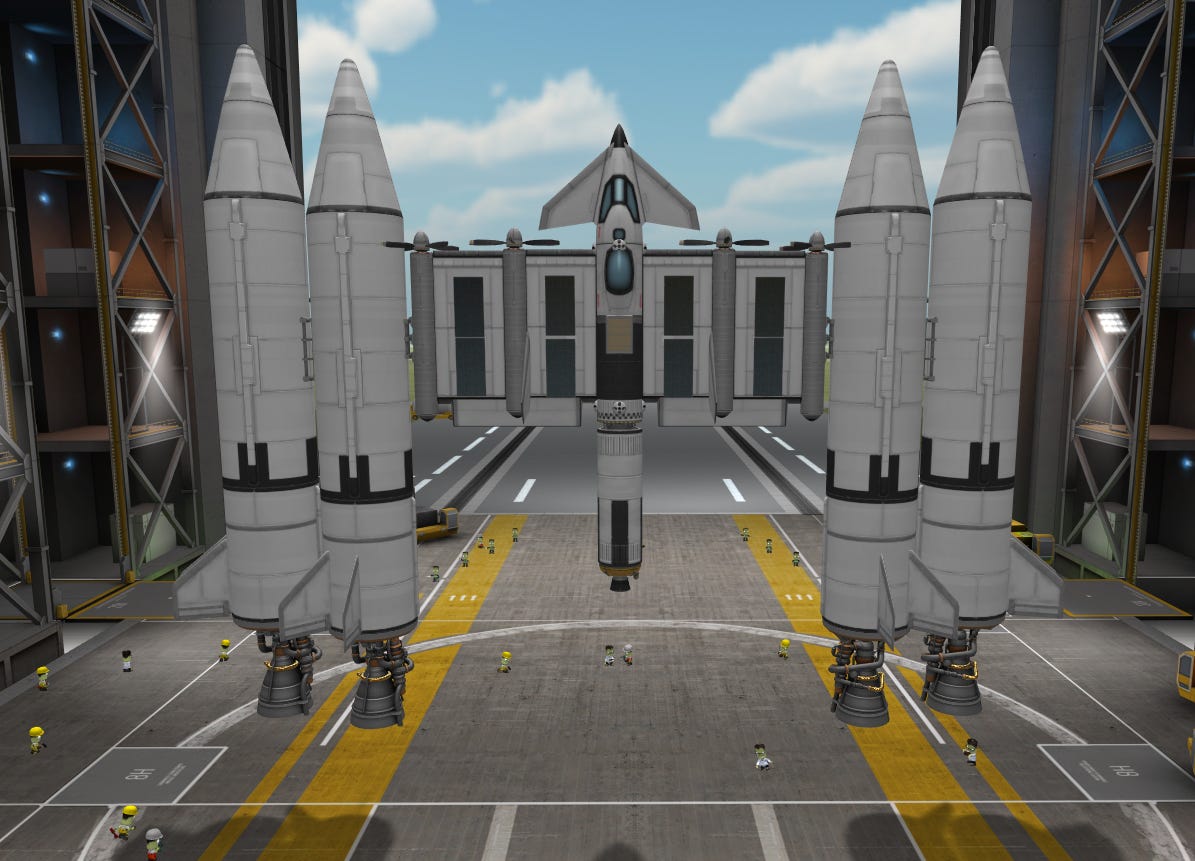
It took approximately four launches to realize that the appropriate number of fins to attach to the vessel was “yes” (14)
Continuing the trend of unmanned launches, but remembering an antenna this time, the engineering team brought out a bottle of Hi-C to celebrate the successful docking and settled in to wait for the long transfer to Eve and the constant sound of Jebediah buzzing the space center in his personally designed and newly built jet.
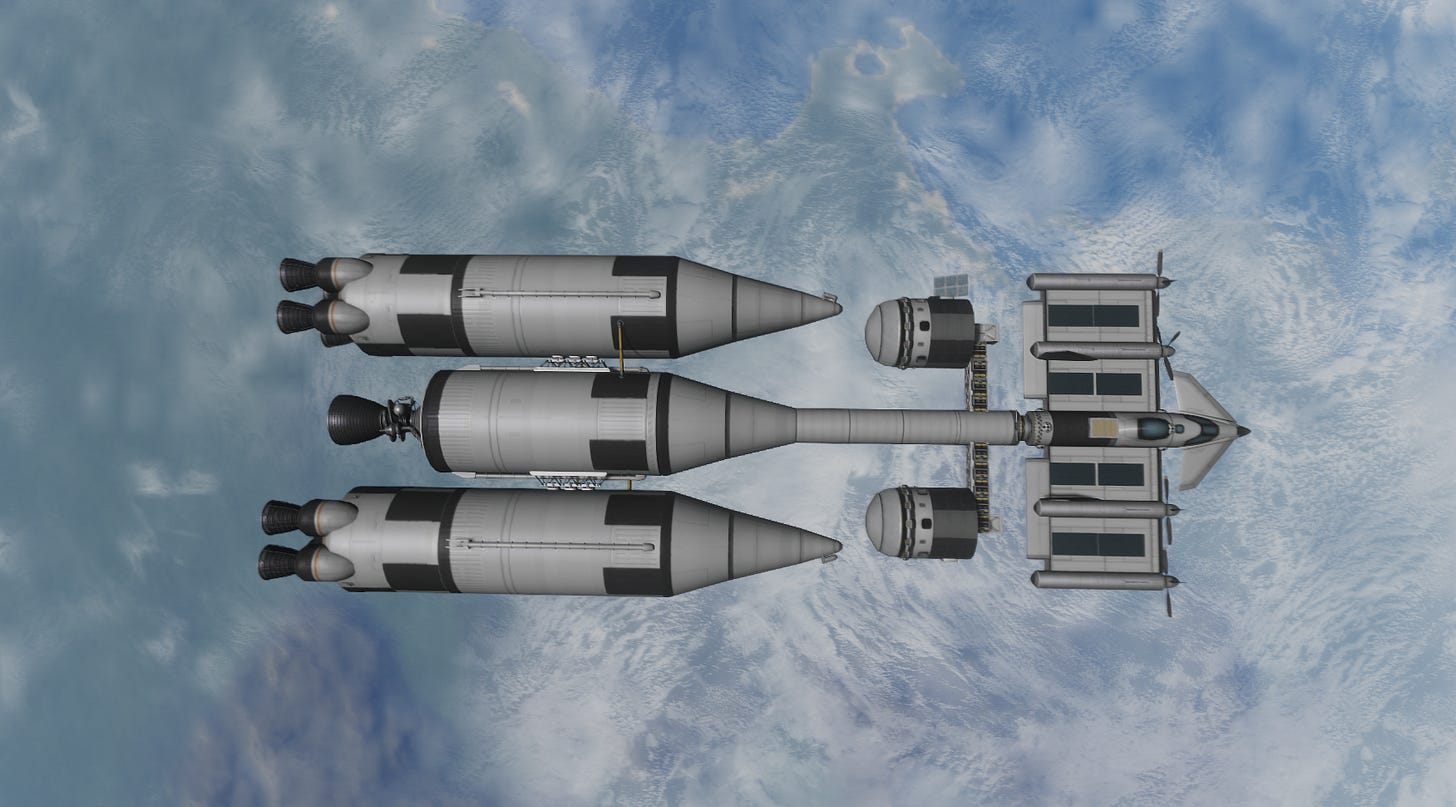
I could not have asked for a more aligned docking (it was intentional). As for why only one solar panel is deployed on the reentry module: the other broke and I don’t know how.
Sped on its way to Eve by all the thoughts, prayers, and actual rocket fuel the space program could afford, it wasn’t long before craft successfully entered Eve orbit. Once there, the engineers began running simulations of how the craft could be landed safely.
Step One: Deploy heat shields and point draggy side down.
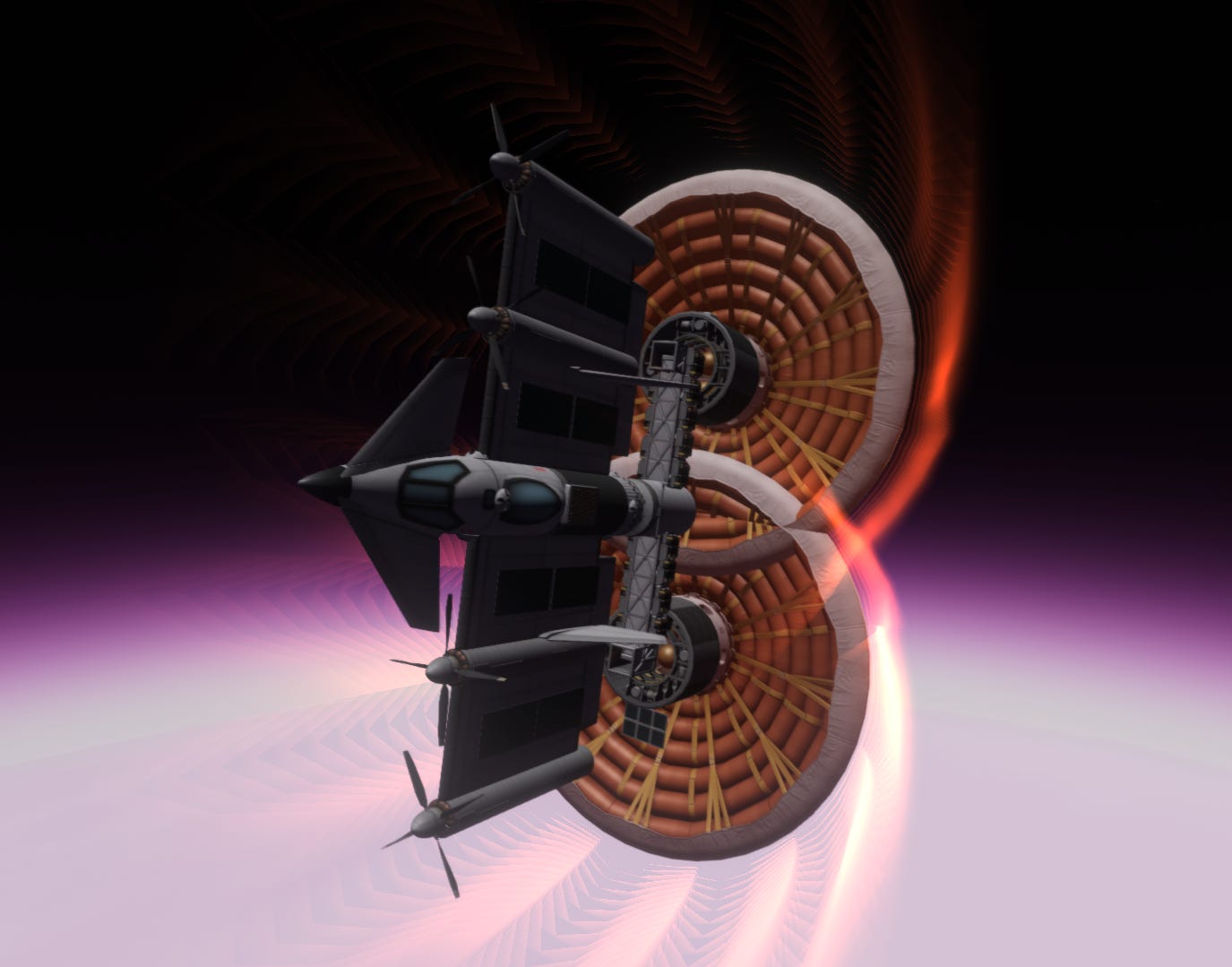
Step Two: Detach heat shi … wait a minute
Although the engineers had remembered to include an antenna this time, it was only effective when it was in range and sight of Kerbin. That only occurred when the craft was on the night side of Eve, Kerbin being a planet further out from the sun.21 The craft lacked capacity to manipulate any control surface absent a direction from the still functional onboard S.A.S. unit. The mission might as well have been a dud. Even so, Jebediah insisted that the simulation be completed.
Step Two: Detach the heat shield and land the plane
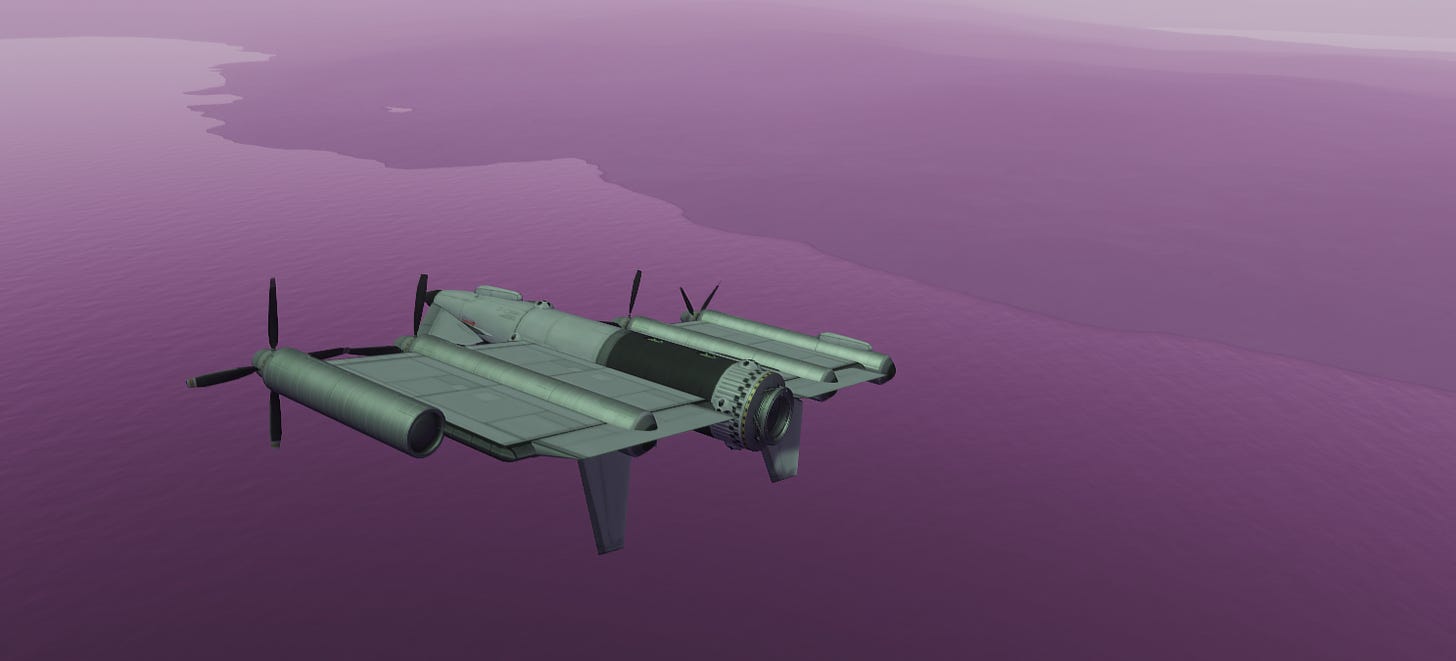
This landing attempt went a lot better than it did when I first realized and then bailed on my error. If the plane weren’t upside down, this would be downright picturesque
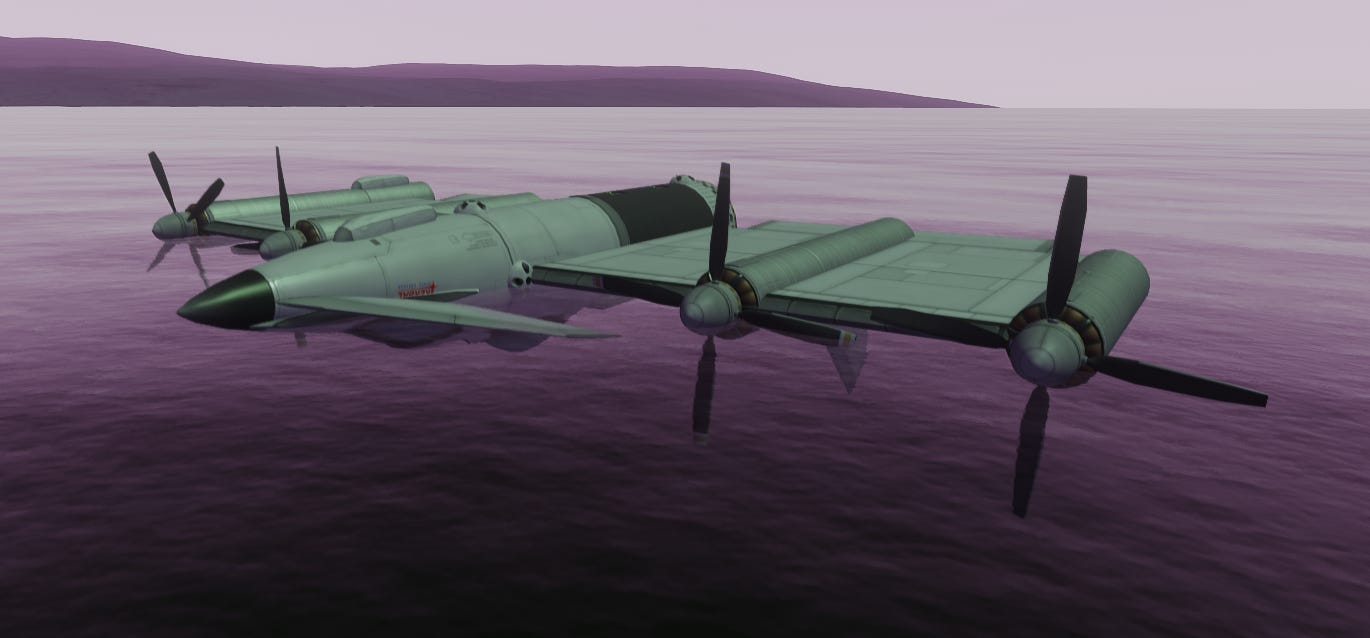
The craft would have been corroded into nothing had Jebediah not ordered the simulation shut down before that happened
The total lack of roll and fine-tuned throttle control meant that landing was not in the cards. As the simulation booted down, whispers of “relay” were heard throughout mission control, and the remaining members of the engineering staff immediately started rifling through their desks, in an attempt to look busy in hopes that the head of the program wouldn’t choose them to call Munmore that night to explain why he a) wouldn’t be going home that year and b) why the original staff, now all long gone, had failed to build cupholders into his command pod.
Part Five - The Relay
The following was a dream that Munmore had after he ate the last of his reentry toasted marshmallows, his supply of other smore fixings long since depleted:22
Understanding the need for continued satellite communication was of the utmost concern, an outside group was contracted by the KSP to build a relay that could “get 5G in interstellar space.” The design used the largest antenna ever constructed and seven max size reaction wheels to give it the handling of sports car crossed with a fighter jet. It was a probe so overbuilt that the designers assumed that if the probe ever lost a direct line to whatever antenna is projecting to, the signal would be able to pierce the obstructing planet, and data would continue to flow. (Unfortunately, the designers forgot that data goes both ways, and if the receiving antenna was unable to also pierce the planet in its way, the plot would fail.)
It was a masterpiece of engineering, or, failing that, it would at least get the job done.
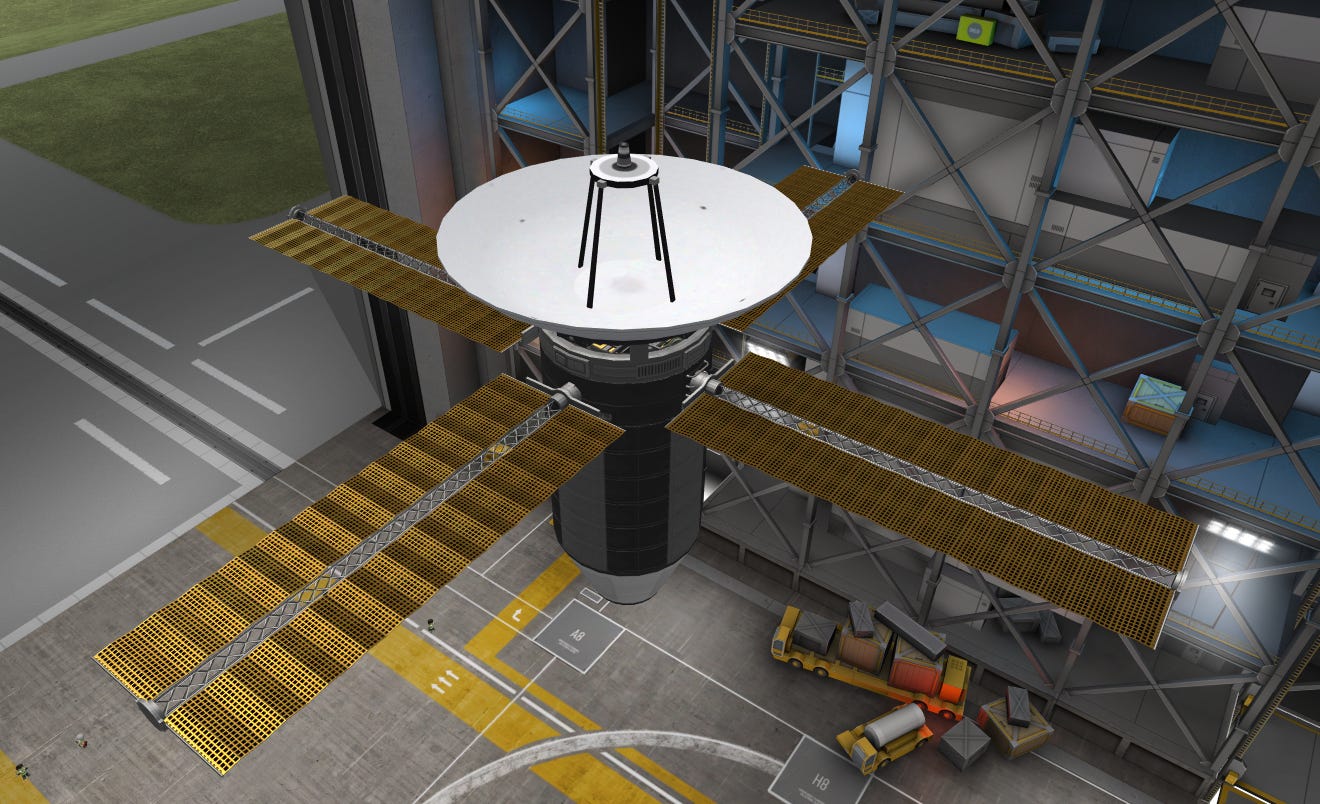
Strapped to a comedically large booster for its size and transferred to a polar orbit around Eve, the new relay was fully armed and operational. It was time to land Eve Plane Mk. 3 for real.
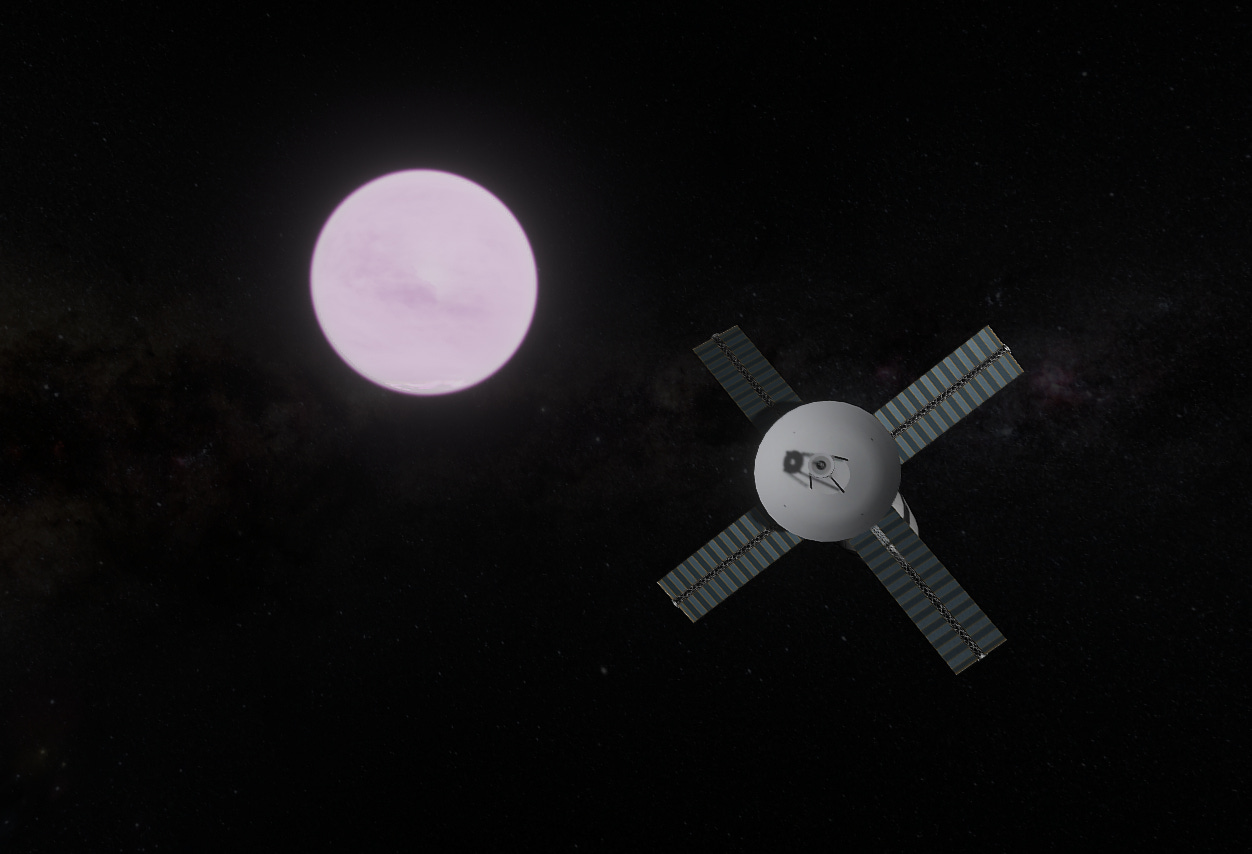
Left with the incredible task of piloting the plane remotely from Kerbin, Jebediah set out once again to do his part in helping get Munmore and Valentina safely home. Carefully decoupling and deploying the heat shields, Jeb took every precaution landing the craft, fine-tuning the landing site to be just over Munmore’s stranded vessel and beginning the descent.
The huge reaction wheels on the reentry stage were more than enough to flip it after the worst of the atmosphere was cleared, and the plane entered into a calm fixed glide with nary a care in the world. The rotors spun up and propelled the craft just as they were intended, and all was well on Kerbin and on Eve.
Though carefully selected, the reentry trajectory for the plane wasn’t perfect. A bit of a glide was necessary for Jeb to land the plane near Munmore. Even so, all was well. All was calm.23 The data was flowing nicely. Munmore’s lander was in view. Then …
“Connection Lost”
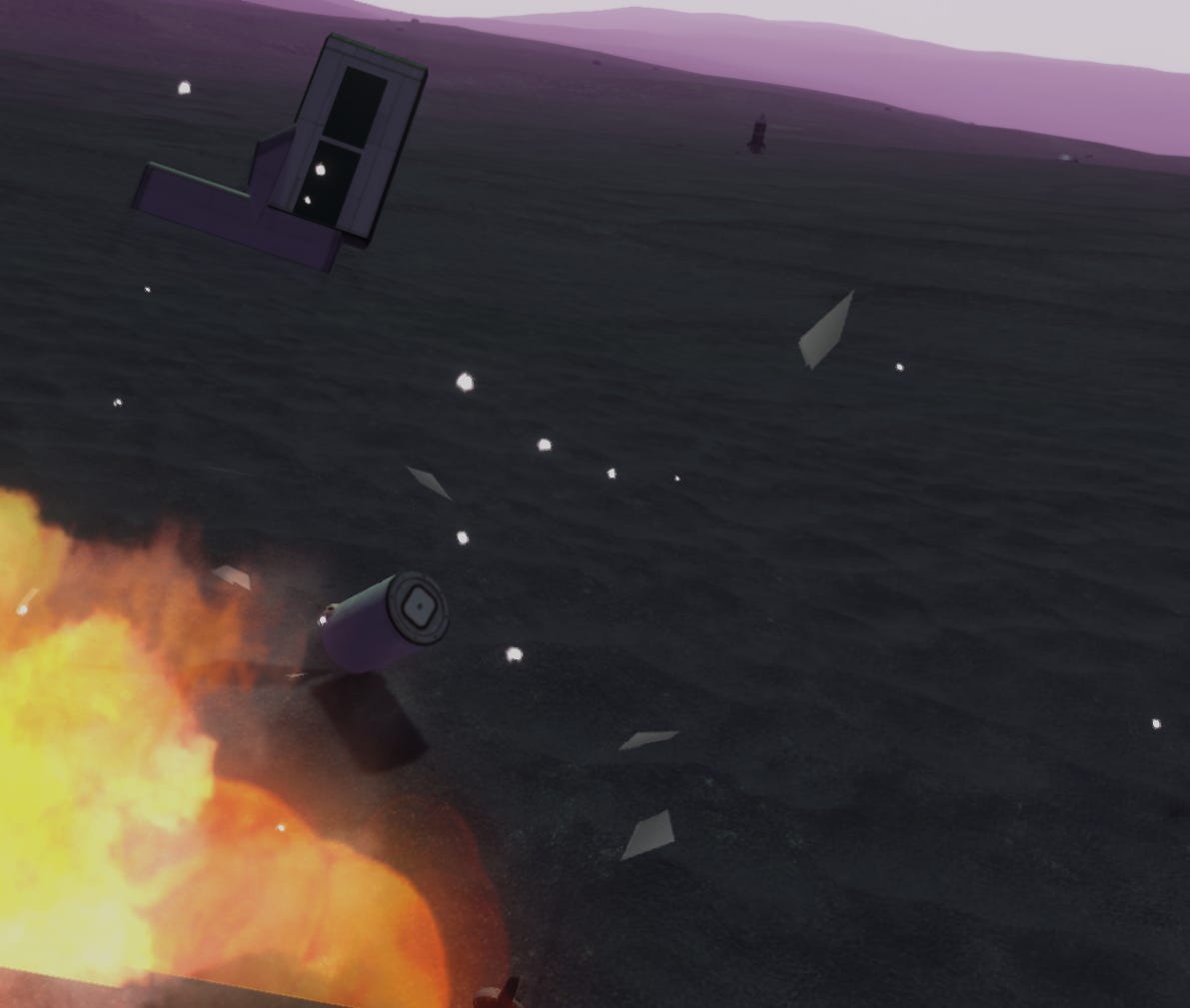
It’s hard to make out in this picture, but Munmore’s lander is visible in the top right near the middle.
Munmore woke up screaming.24
Part Six - Relay City
While not totally sold on the prophetic nature of Munmore’s dream, the higher-ups in at the agency realized that he wasn’t totally wrong in his concerns about a polar orbit being insufficient. It turns out that even a polar orbit will occasionally have its connection occluded, poorly oriented relays more than most.
Given the wretched recent wretched failures in the unmanned vessel department, the in-house engineering team was fired, and a new designer was tested. The court of popular opinion. The task, design a relay to send to Eve, was given to all 3rd graders as a class project, and Munmore Kerman Jr. submitted the following design:
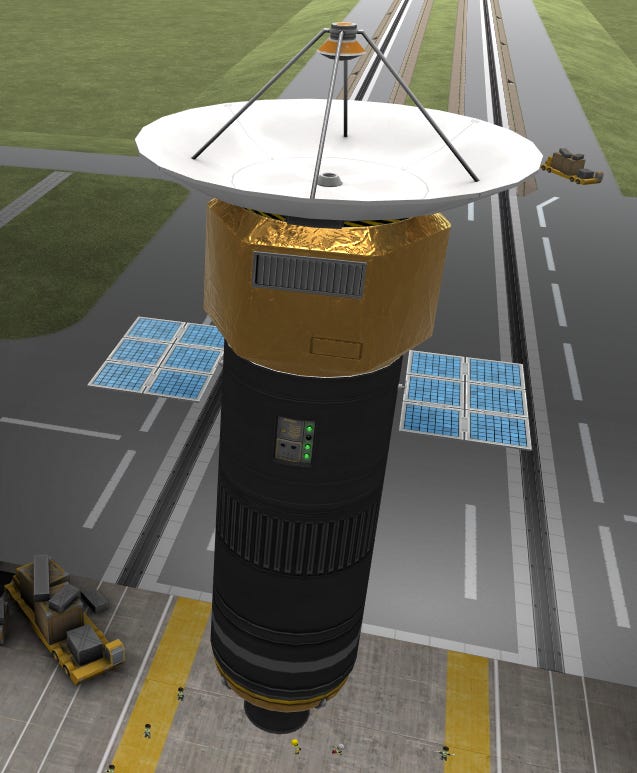
This is great, but I need a little more …
Deemed sufficient by the administrative team and more importantly Munmore Sr. and Valentina, the design was sent to the pension department to be finalized, with the following request:
Please make the launch vehicle cheap enough that we can fit several of them in the budget. The more we can produce, the better the chance that we can rescue Munmore and Valentina.
Unfortunately, email was down, and a carrier pigeon with a hand-written note was dispatched instead. In the rain. The following message is what actually reached the pension department
***** make the launch vehicle ***** ****** **** ** *** fit several ** **** in *** ******. The more ** *** *******, the better *** ****** **** ** *** ****** ******* *** Valentina.
Taking the clear contents of the message, the surprisingly design savvy pension team added to the design, implementing structural girders and decouplers to enable easier tiling.
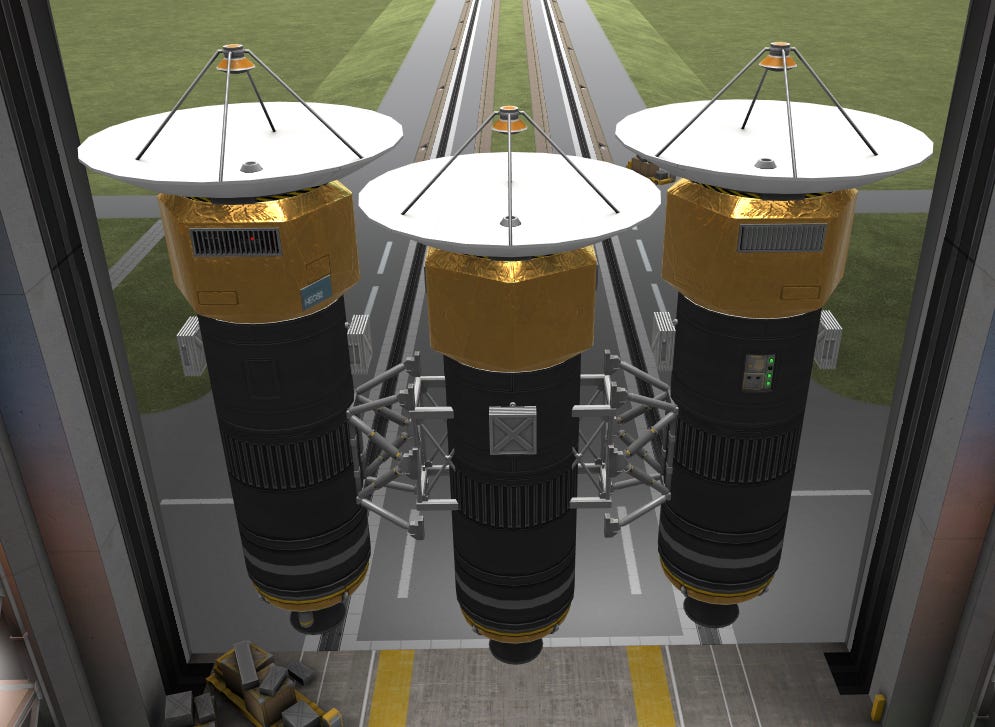
Not happy with just three relays, the team looked into just how far they could push existing launch vehicles and found that the lifter in the budget was so massive that they could fit another four on without an issue.
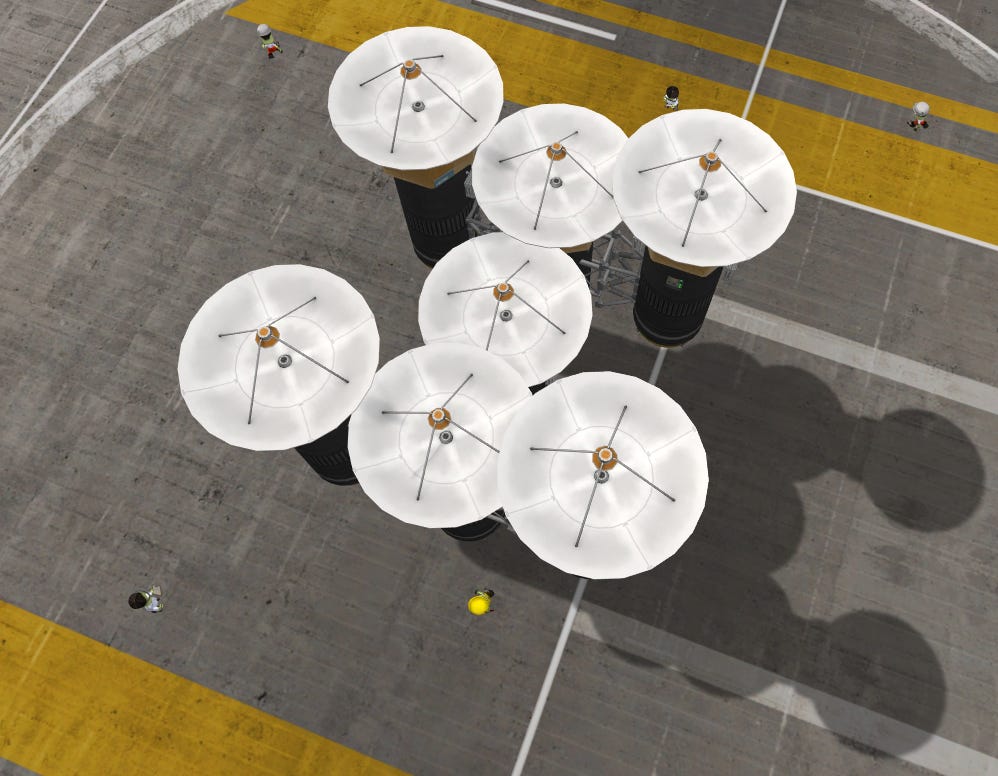
With seven relays strapped together like a barrel of fireworks ready for a celebration of Jebediah day (instituted in the decade when the world thought he was dead), the crack team at the vehicle assembly building put together what everyone hoped would be the last booster assembled until Val and Munmore were safely off the surface of Eve.
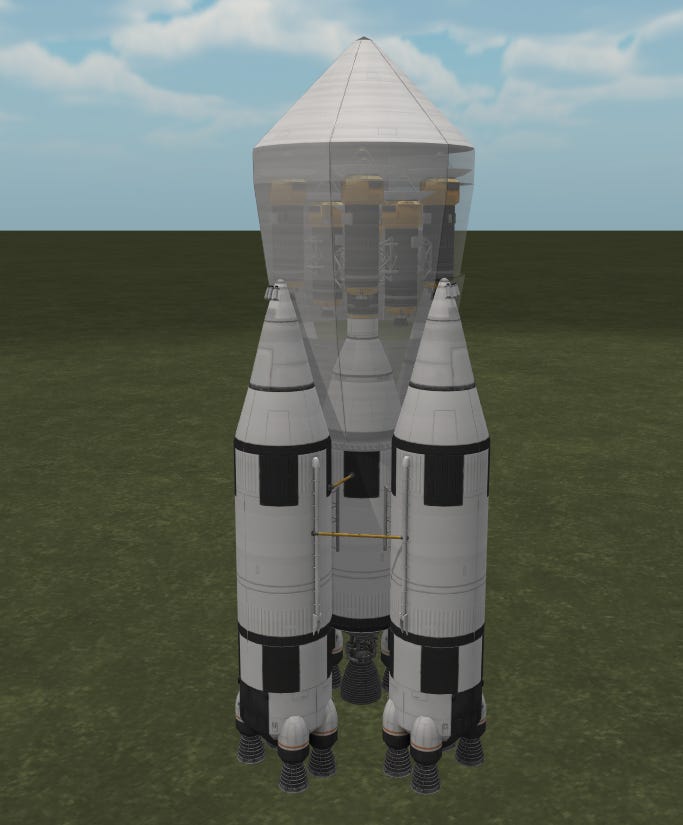
Safely launched and on an Eve intercept25, the pension department watched the screens in mission control with reservation, pensively awaiting the result of what would hopefully separate the still-connected relays from their original booster.
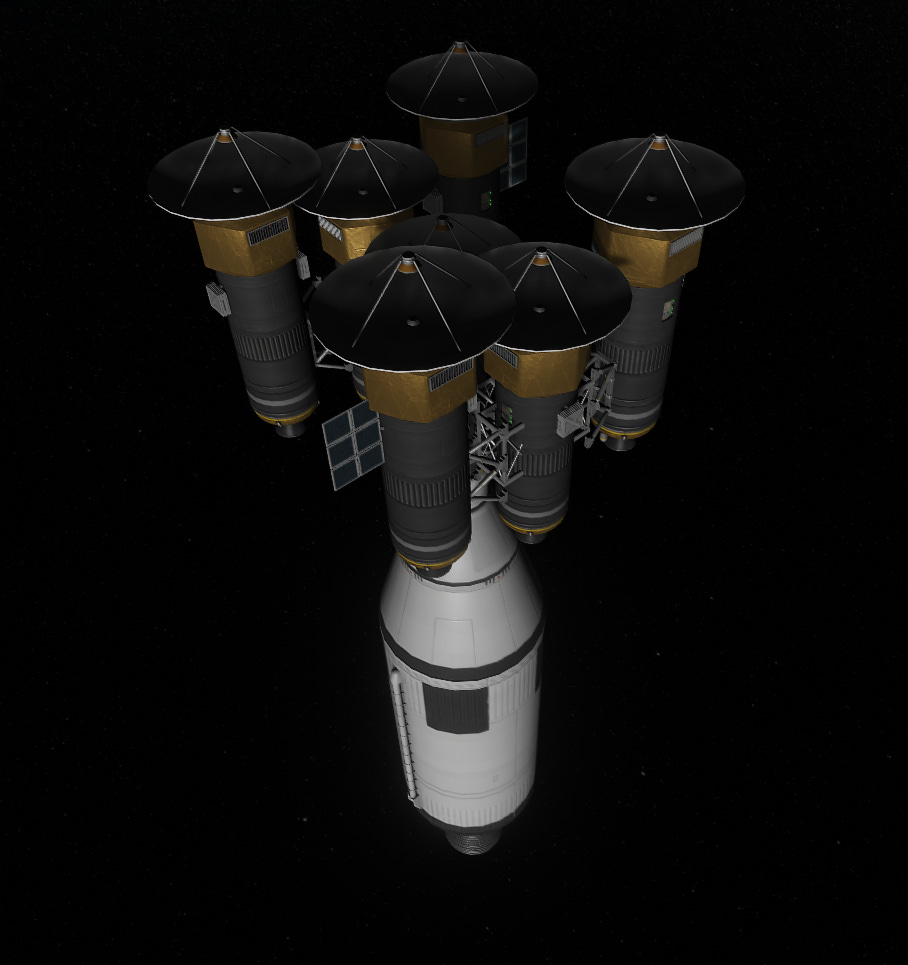
In the moment of truth, all seven probes separated cleanly, arrayed like a flower of life in the darkness of deep space.
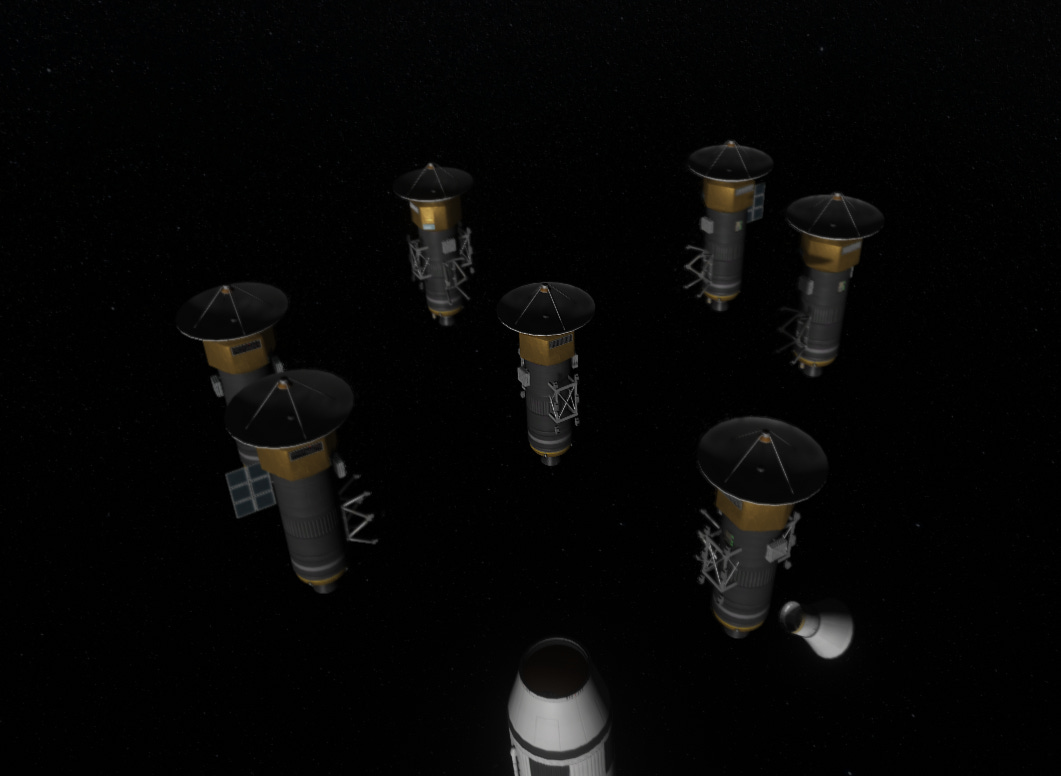
After deploying the solar panels and nudging each of the probes onto a unique trajectory, the long wait until everywhere on Eve had access to 5G began.
The days were long at the space center for everyone except the pension department which had brought out the sparkling wine to celebrate their engineering accomplishment, eschewing champagne and its apparent curse. Half the team was promoted to full-time designer status, and the other half got raises funded by the sale of the prior engineering team’s desk ornaments. All things considered, they were living it up.
Following circularization burns from six of the seven relays,26 the signal reception around Eve had gone from this
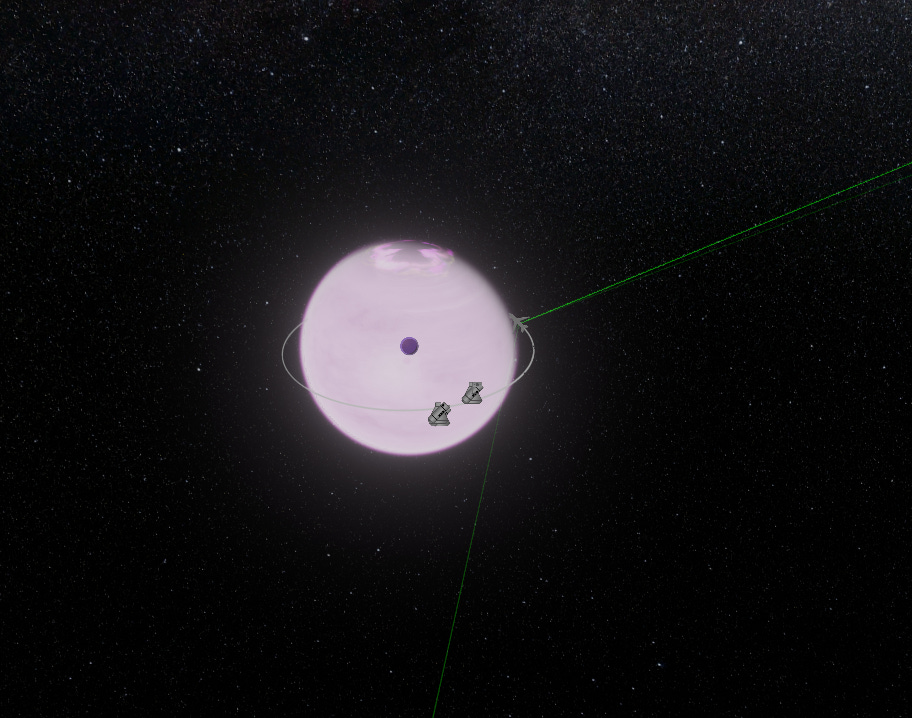
to this.
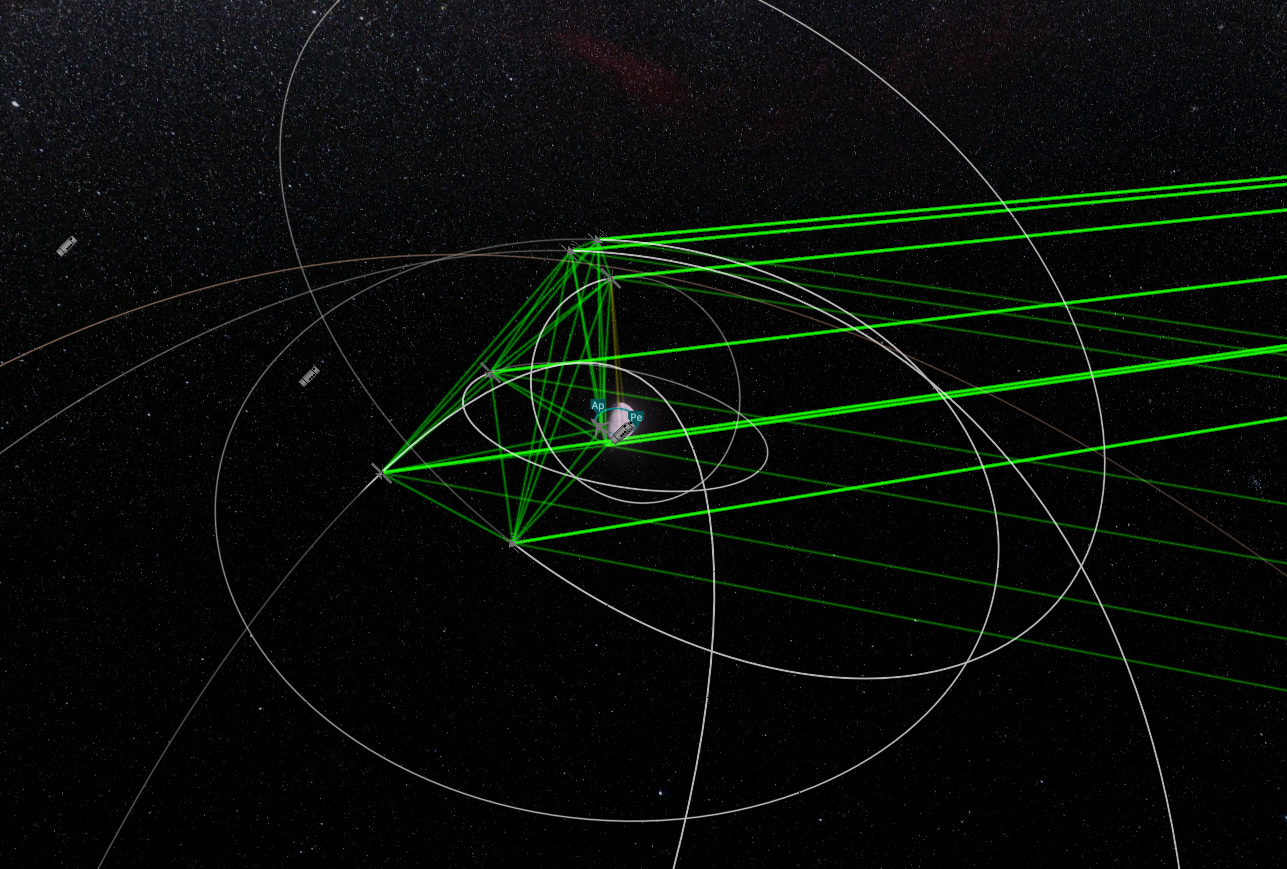
It was time to actually land the plane.
Part Seven - Flying on Eve
Still floating magnificently in low Eve orbit, Eve Plane Mk. 3 was fully prepared for its maiden voyage. It was time to get out of the simulator and into the real world.27
At first, everything proceeded exactly according to Munmore’s dream, the plane reentered without issue, descended into the lower atmosphere and spun up its rotors, and pointed in the direction of Munmore’s pod. Jebediah, at this point an old hand at the controls from his time in the simulator, easily flew the craft straight to the original lander, delaying for just one barrel roll before he had to pass on command to the long-abandoned pilot.
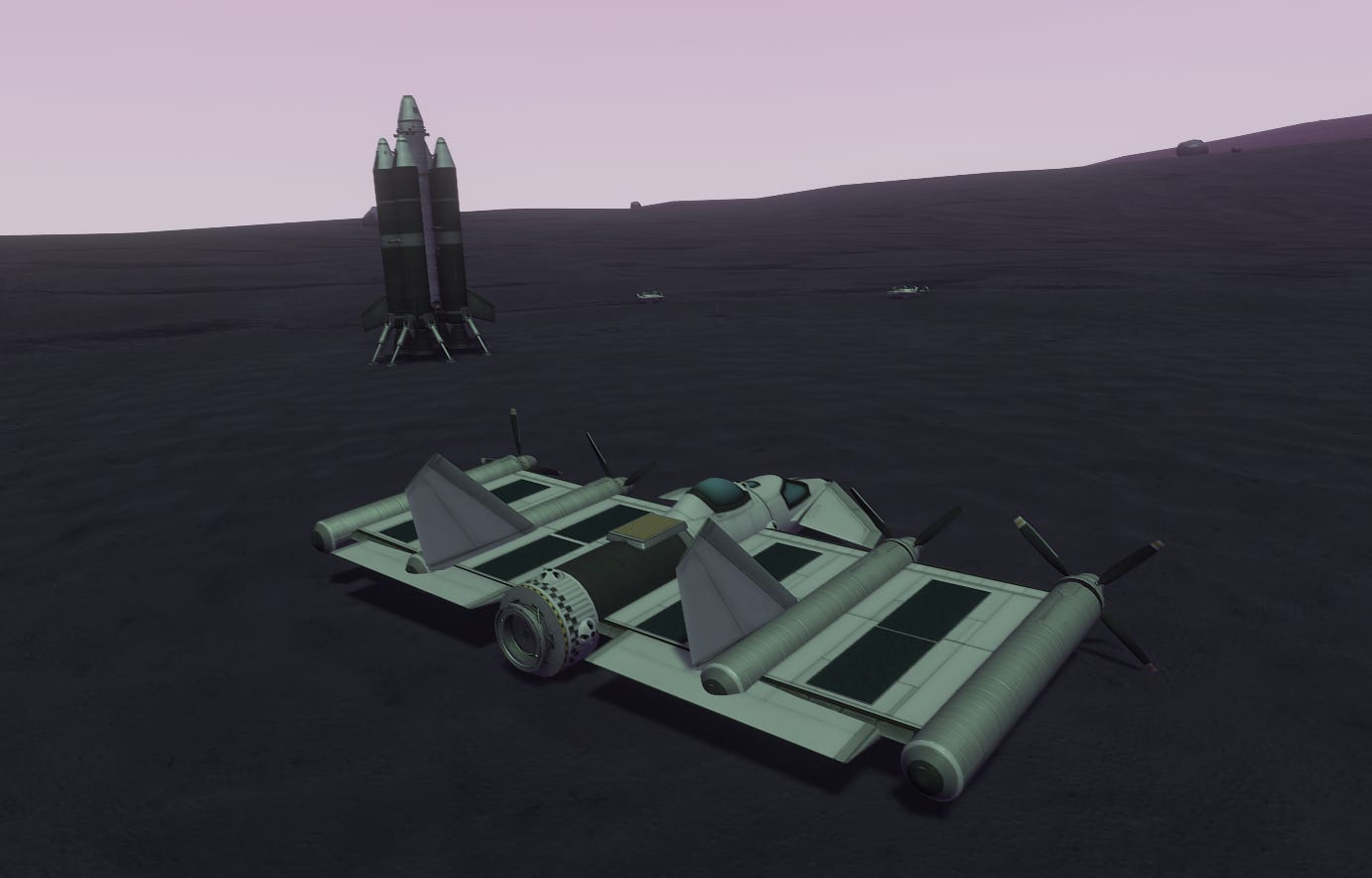
So long as you don’t look too carefully at this image, you won’t notice the minor flaw in this artist’s depiction of the real event
Munmore Kerman, free at last of his cupholder-less pod, grabbed the last of his scant belongings and ran to the plane, ecstatic to be free of his former prison. (He would have bounded, but the extreme gravity prevented such a show of joy.)
Taking the controls of the newly landed plane, Munmore rapidly acclimated to the craft’s abilities, accelerating toward Valentina at record speed.
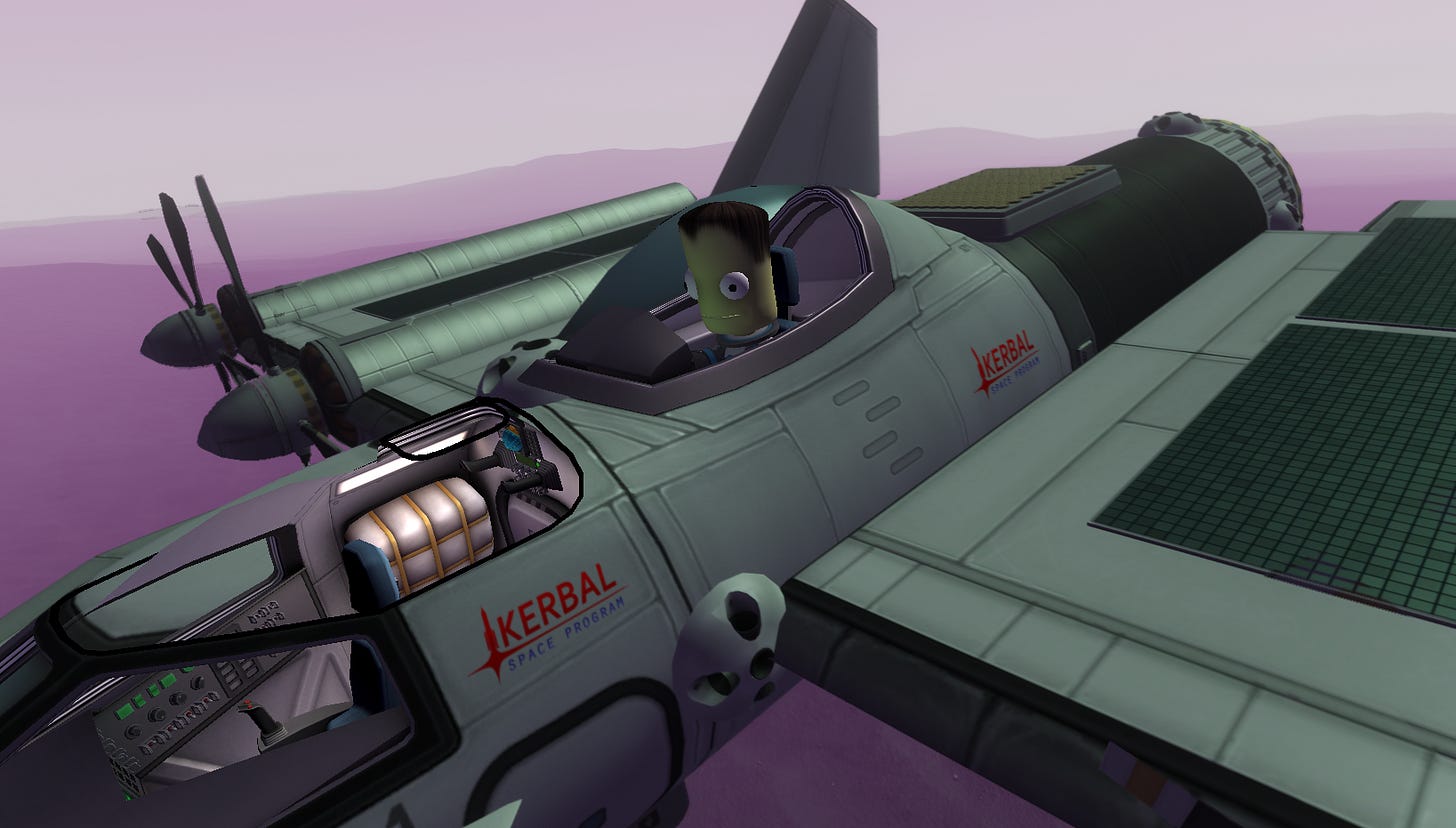
Pictured, Munmore Kerman, steely-eyed missile man
Now free of the confines of his capsule, Munmore took the opportunity of both the added room, increased energy, excessive snacks, and improved reception to lambast the engineers who had designed his, Valentina’s, and Jebediah’s craft, comparing them to puddlefish with delusions of grandeur. He blamed a mysterious controlling entity for giving him the dream of failed relays and concluded his rant with a heartfelt fifteen minutes of congratulation to his son and the pension department for finally “giving an honest attempt at rocketry and earning their paychecks.” Promising to find and repay every member of the engineering profession that had wronged him, several staffers at mission control invested in life insurance and started asking if there was a way to remotely disable Lander Mk. 3 before he was aboard.
In the meantime, Valentina started packing her things, and when she heard the thumpa-thumpa-thumpa of the rotors, she was ready to go, one hand on the hatch and the other on her small bag containing her remaining steak. Her pod, complete with cupholders and a large snack cabinet had been a more comfortable stay, and though she’d been on the planet a few years fewer than Munmore, she too was ready to depart.
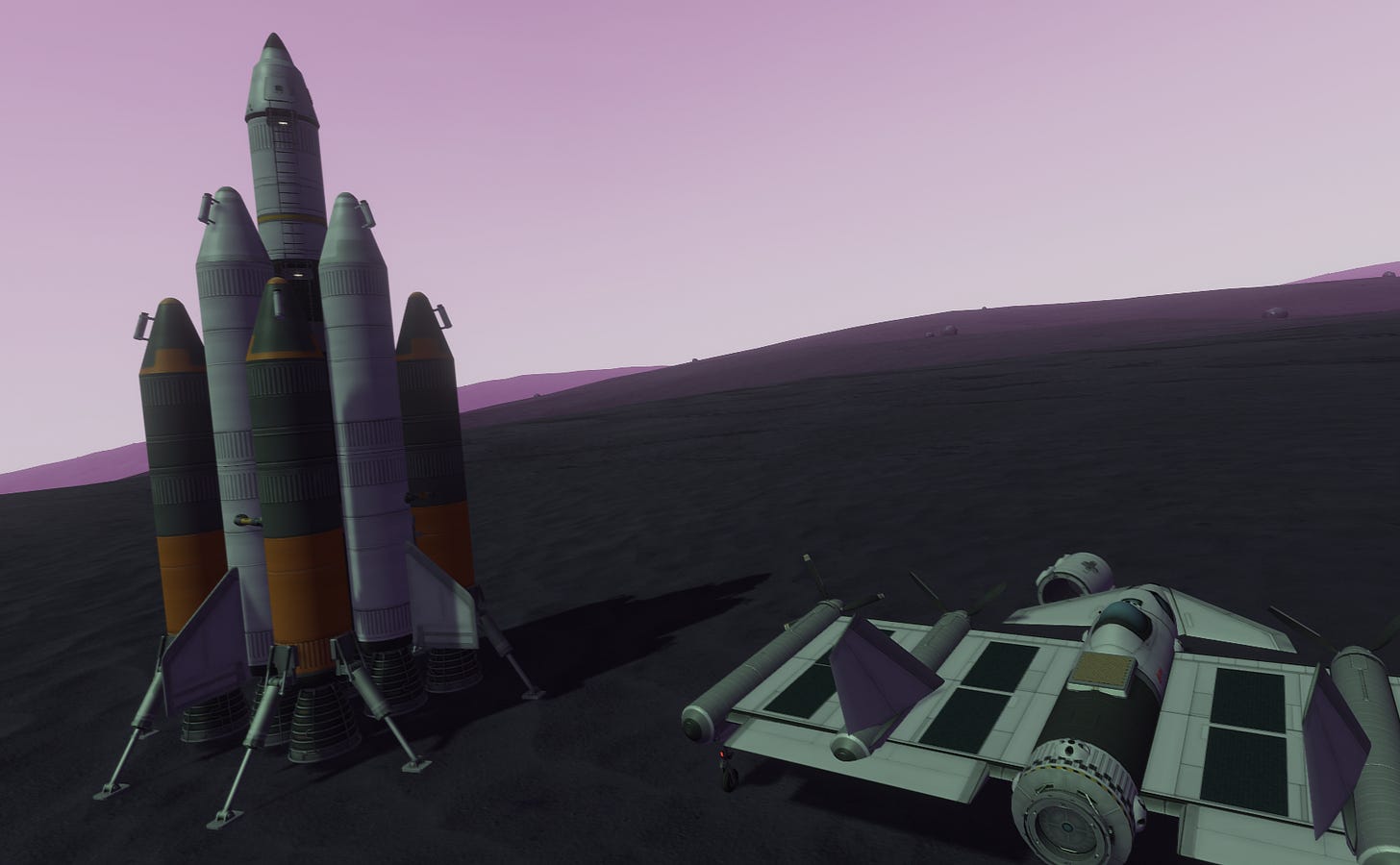
Inexplicably, unlike the ground around Lander Mk. 1, the ground around the landing site for Lander Mk. 2 was not bugged to Moho and back. This made landing possible. safe, and easy.
When both kerbals were safely aboard, mission control directed the two to their (hopefully) final destination, Lander Mk. 3. Left on the ground for years, the refueling module had filled the dry tanks to the brim with fuel and oxidizer, and though the system had never been tested, the engineers that had designed had been optimistic that it would work. Several of them had been transferred to administrative roles rather than fired and surreptitiously purchased yet more bottles of champagne in anticipation. The final bottle of the original run was also brought out (it had been lost in a closet when the other bottles were given to the graduating intern).
Munmore and Valentina together were an excellent pair, and the two who had been in communication over radio for years finally got to meet in person. Their shared interest in piloting was both a blessing and a curse. A blessing because they had something to talk about, and a curse because it took mission control calling in law enforcement hostage negotiators to finally decide who would pilor the plane.28
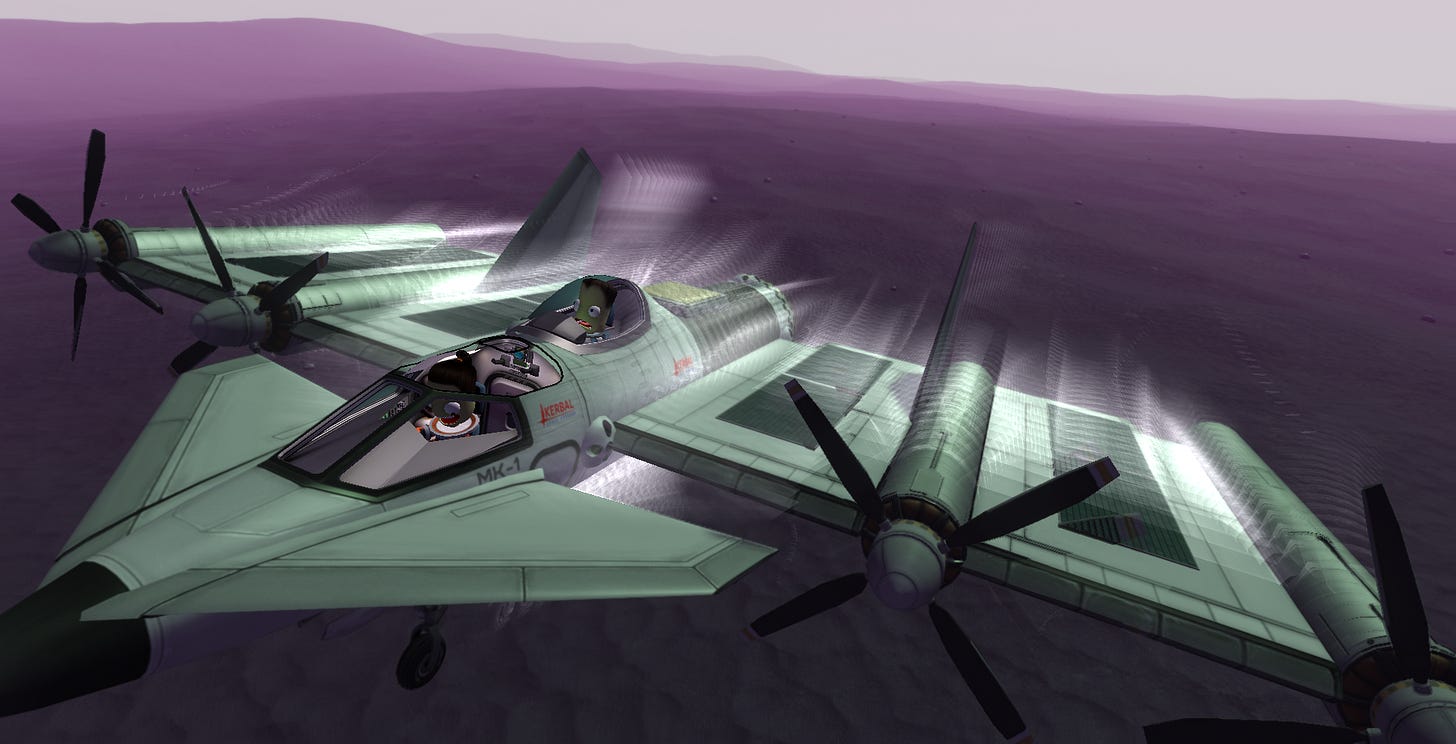
Valentina also had a slightly higher risk tolerance when flying compared to Munmore.
Finally, after the much shorter flight between Lander Mk. 2 and Lander Mk. 3, the two were ready to board the much-anticipated (and cupholder-having) return flight.
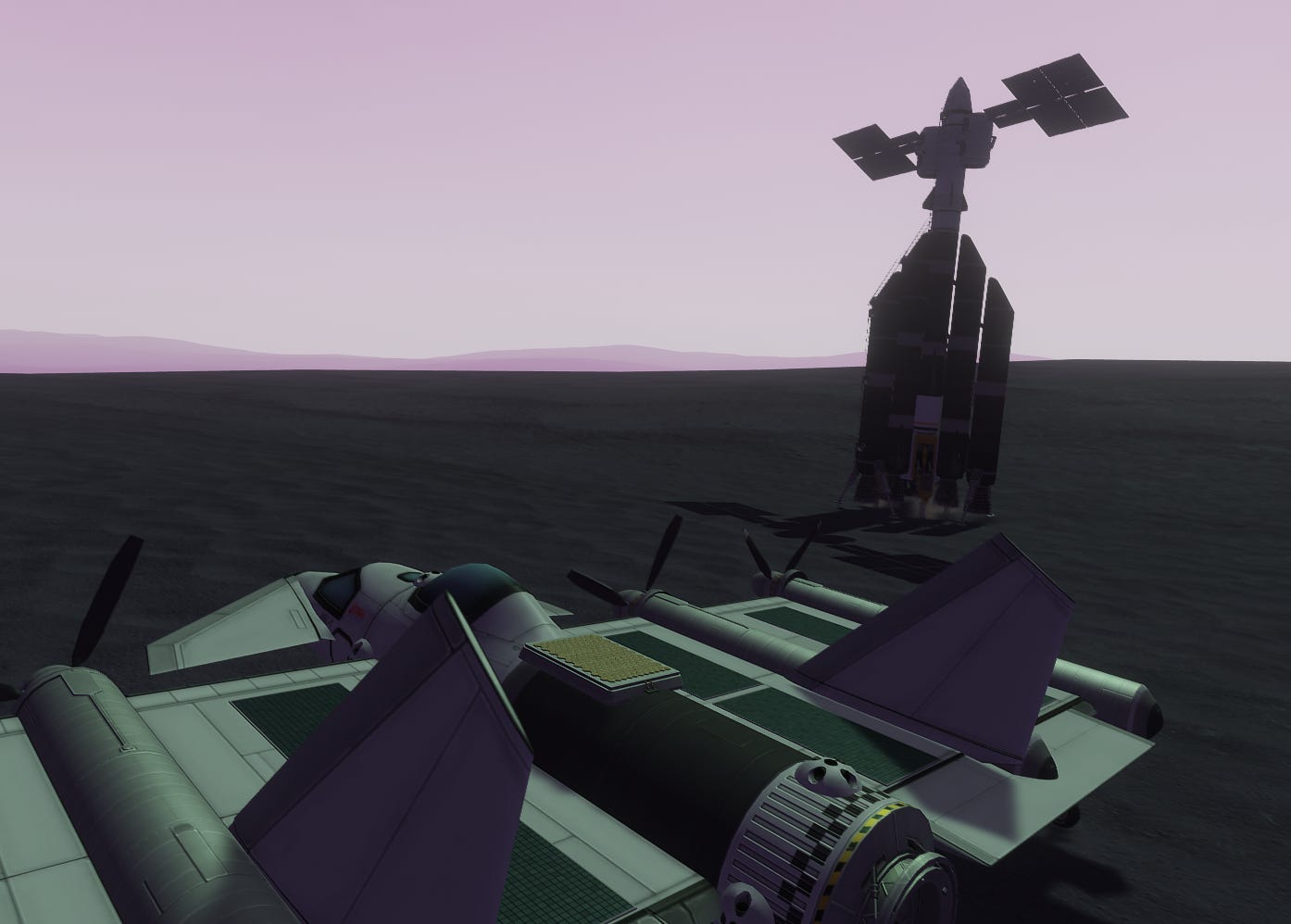
The amount of time and effort I had put into getting these kerbals both to Eve and to this specific lander was more than I’d like to admit, but on the plus side, the amount of time I’ve spent writing this is comparable.
Part Eight - The Return
It had been over three years since Munmore had landed on Eve, and more than that since he had been on Kerbin. In that time the yearly turnover rate of the engineering department was 120%, there had been two additional landers sent through the purple clouds, Valentina had missed her 15th anniversary, the kerbin economy had undergone a massive recession, three planes of varying quality had been designed and tested, Jebediah Kerman had been located exactly where he was when he was ‘lost,’ and mission control had installed an incinerator to deal with unauthorized celebratory beverages. It had been a long three years. Soon, hopefully, those three years wouldn’t turn into five, but just in case they did, the pension department was already hard at work designing new options for landers.
Their preferred design looked like this:
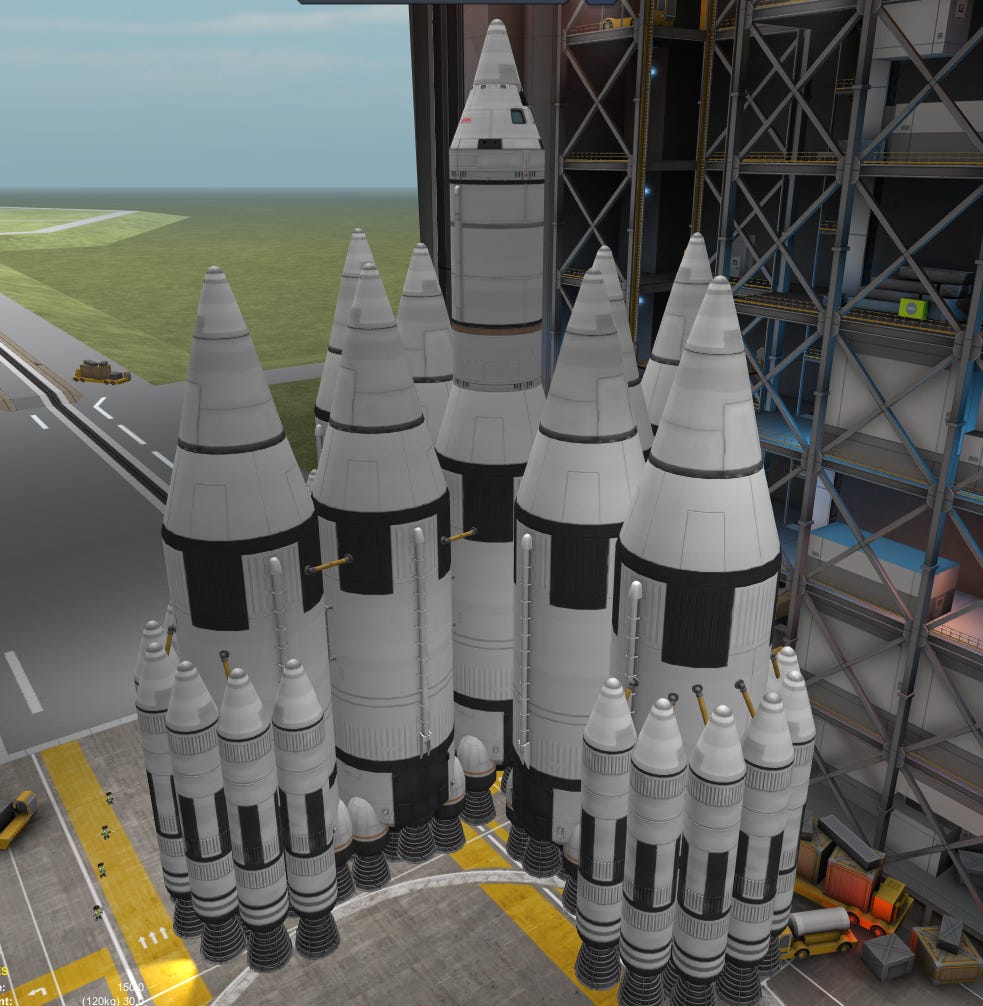
A lifter sufficient to bring this to Eve would also be sufficient to turn my laptop into a heating element.
While they sketched out monstrous rockets with reserve margins sufficient to reach most moons in the outer solar system and return, all eyes in mission control were glued to the screen as Munmore and Valentina went through the preflight checklist.
Board the vessel. Check.
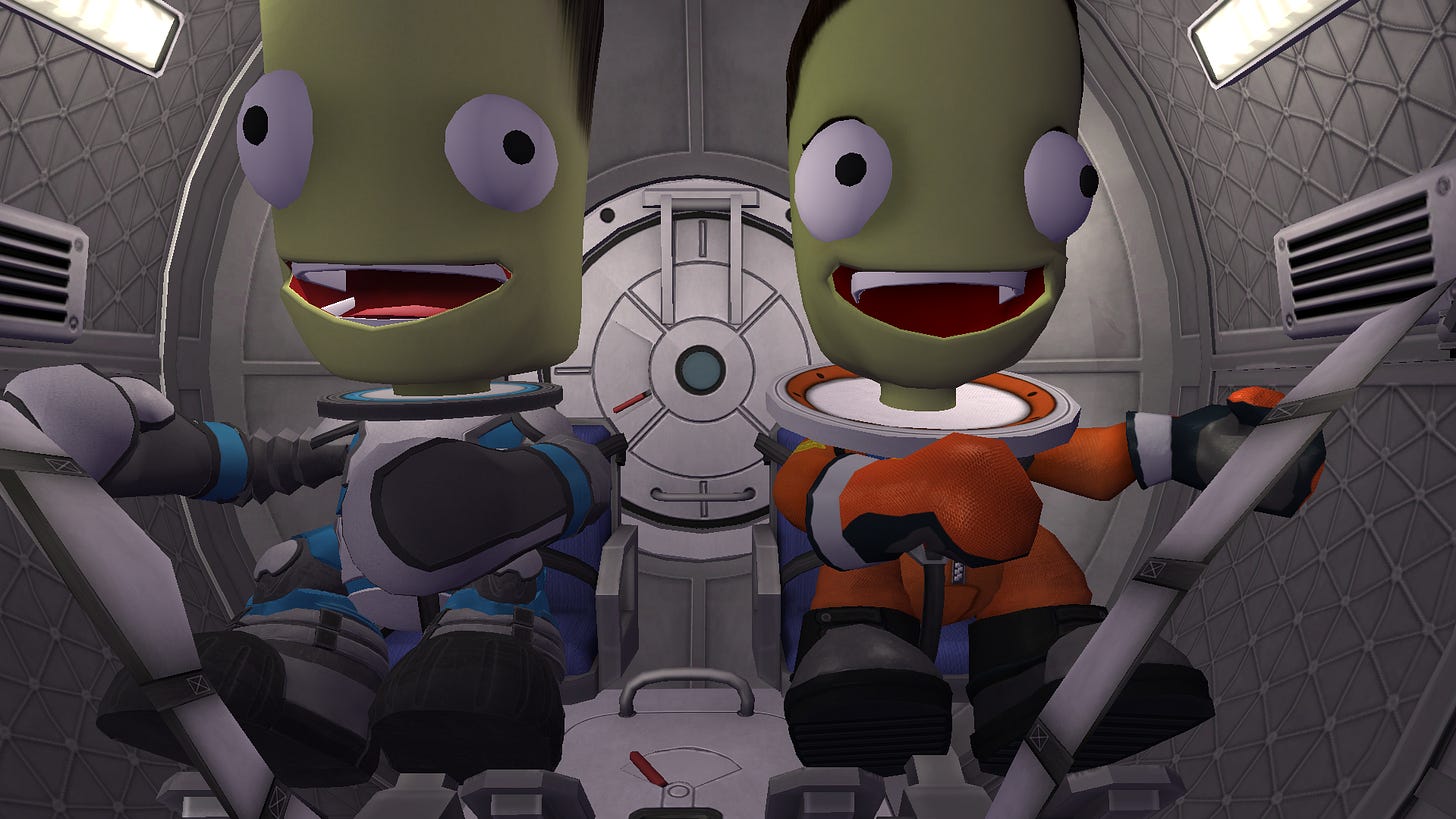
Stow all carry-ons in the overhead compartment. Check.
Disable the mining system. Check.
Detach the parachute modules. Check.
Detach the mining system. Check.
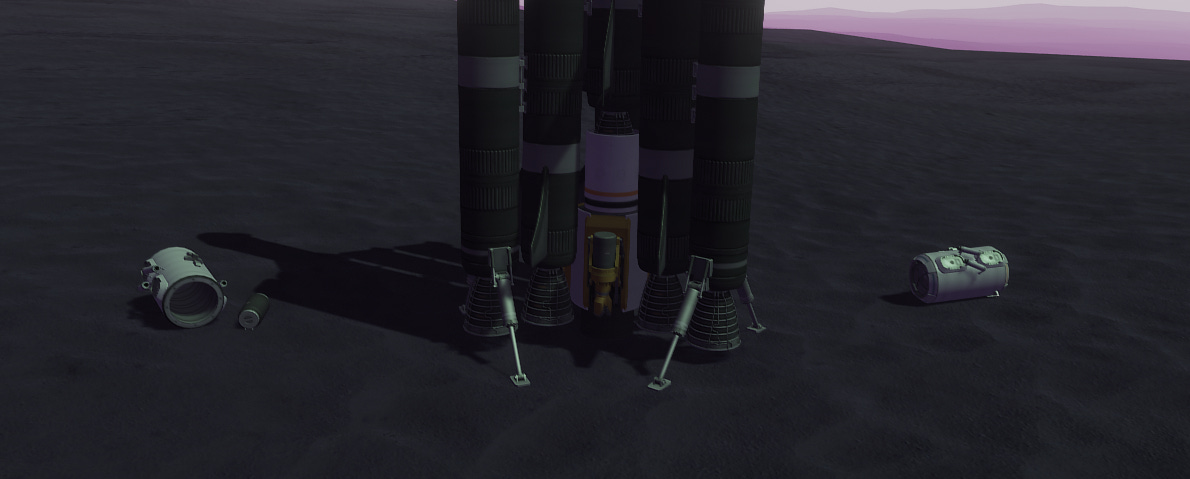
If you look carefully you’ll note the radial holding tank has fallen out of the place I hid it inside the structural fuselage and is now rolling around on the ground like a very rolly thing.
Prepare for liftoff, appeal to the kraken, and put on your seatbelt. Check, check, and check.
Munmore and Valentina were ready to go home.
They took a deep breathe, exhaled, and punched the throttle.
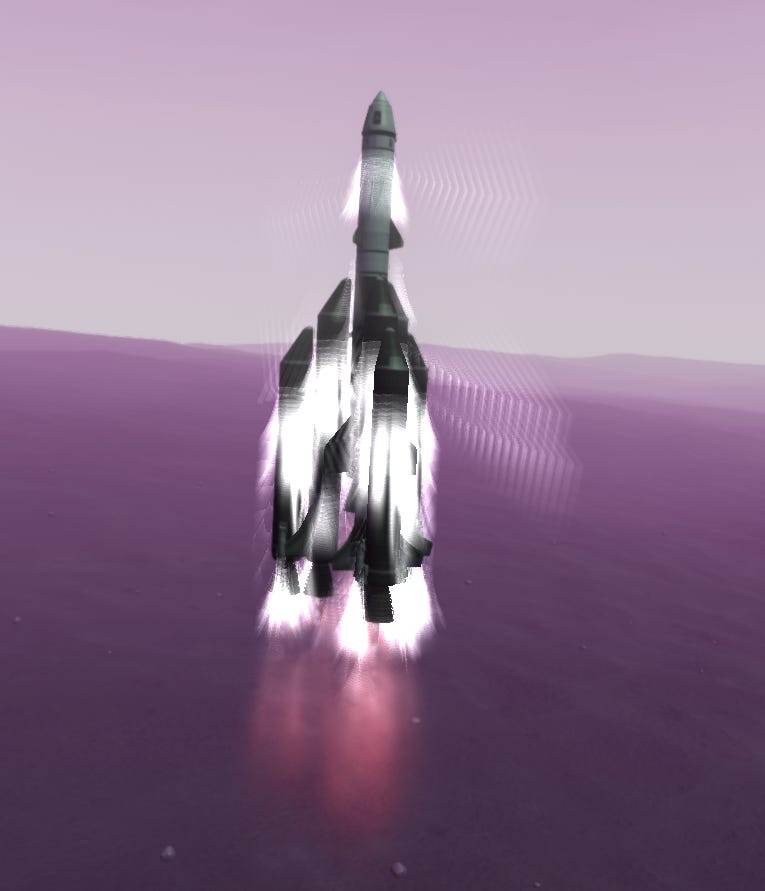
The first stage handled smoothly, far better than anything they had seen in the old landers. Cutting through the lower atmosphere like a knife through butter, Lander Mk. 3 was handling like a champ.
Stage two deployed as intended, and the craft continued to rocket toward the heavens.
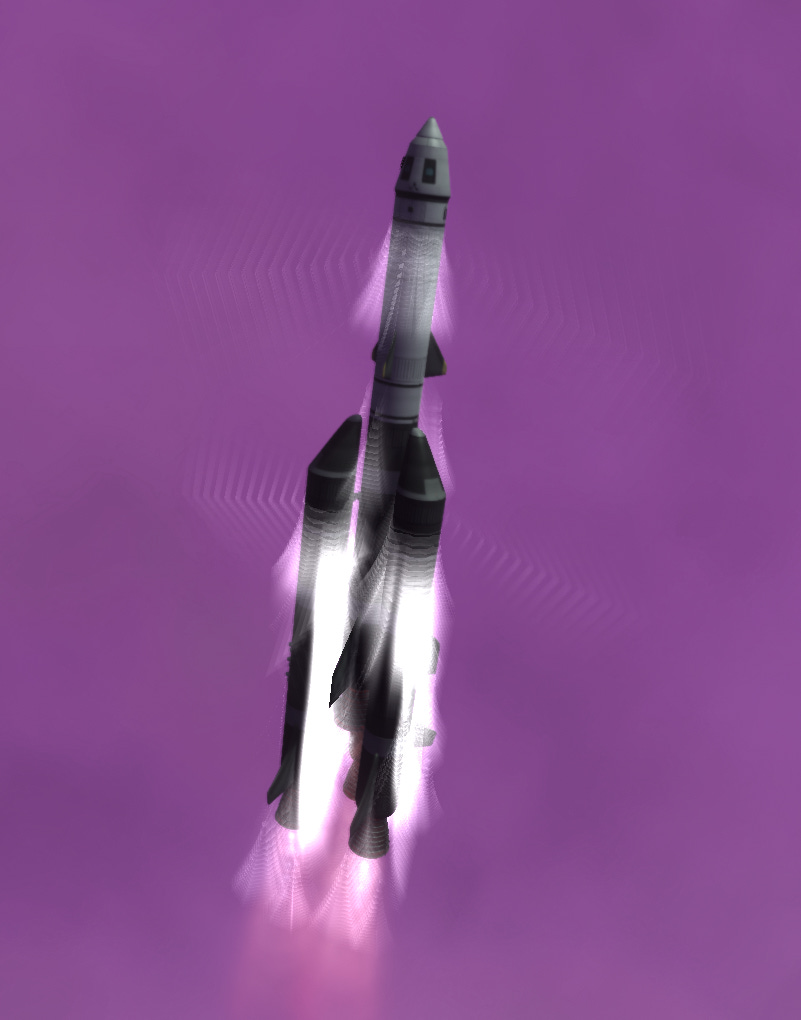
Stage three worked similarly well, continuing the breakneck ascent toward the vacuum of space. At this point the acceleration started to burn off nose cones, fins, unknown scientific doohickeys that certainly sounded important as explosions and disintegrations rocked the crew cabin and Eve’s atmosphere made a final grasp at holding the brave kerbals hostage.
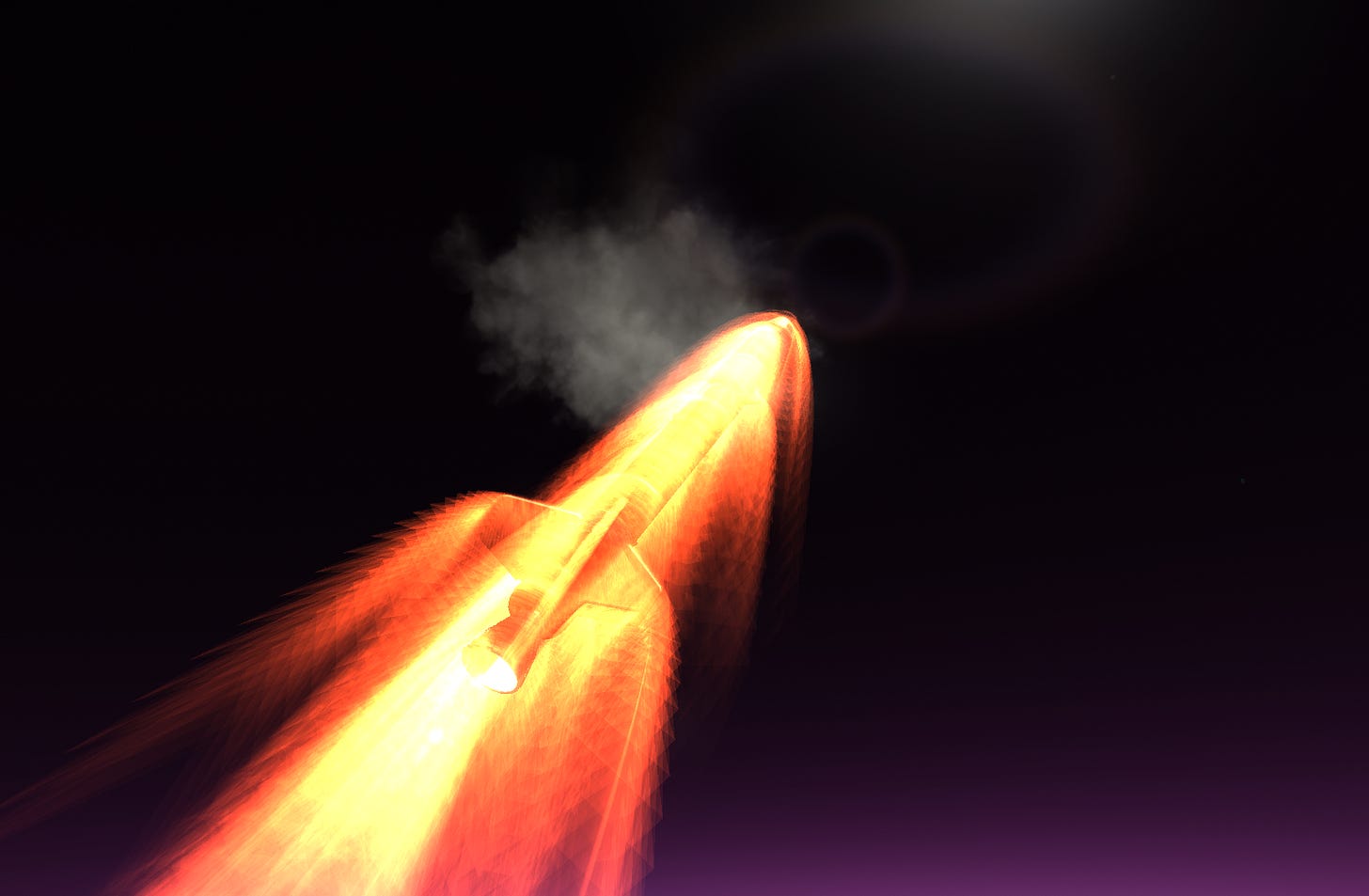
Stage four, deploying the final engine left on the vehicle, pushed the craft further, passing the Karman line and breaching the vacuum of space.
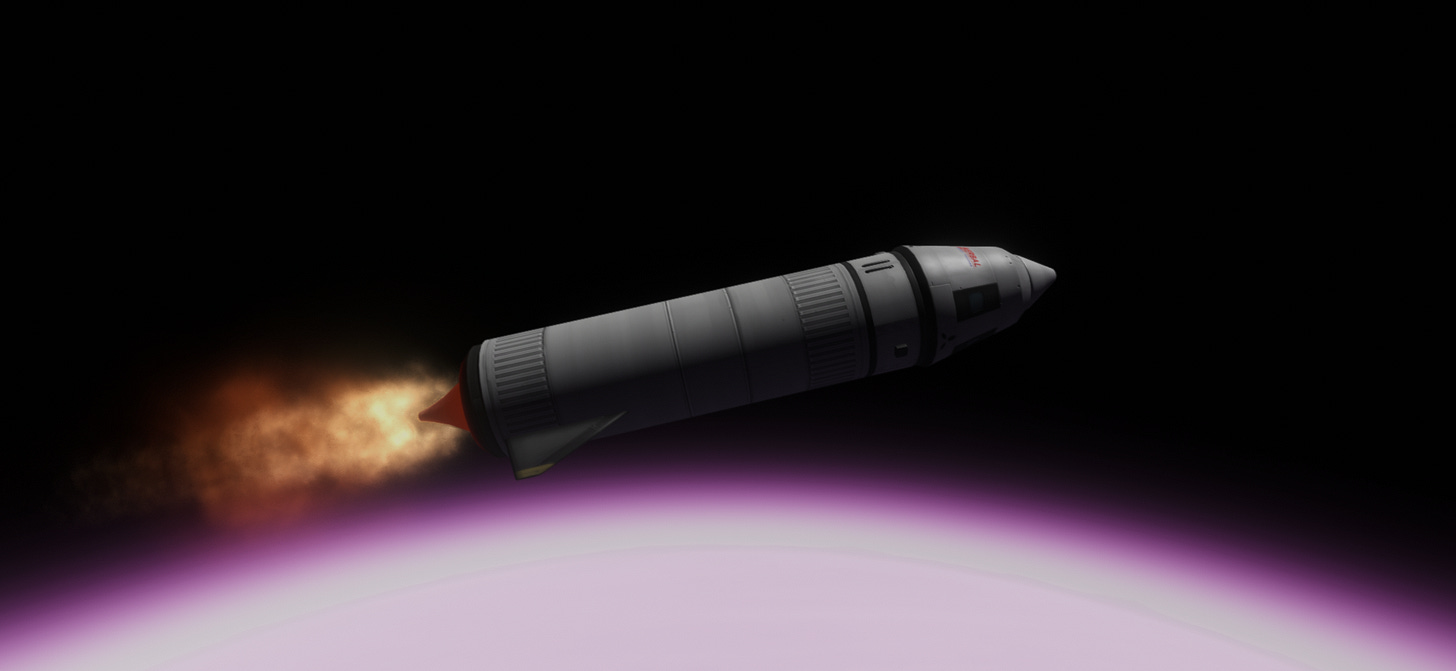
One final push, expending nearly all of the remaining fuel was all that it took to get Munmore and Valentina safely to low Eve orbit.29 The clutches of Eve, the tentacles wrapped around the throats of the entire engineering staff, the reason the space program’s insurance premiums were absolutely enormous, the thing that had hung over mission control like an albatross for three years was over. Munmore and Valentina were free.
The sound of the champagne corks was deafening.
The party at mission control was legendary.
Then someone thought to turn on the radio to check-in on Munmore and Val. They had a question that made everyone’s blood run cold.
So, should we expect the rendezvous today or tomorrow?
And with that, a joint task force composed of the engineering team that built Lander Mk. 3 and the pension department was at their desks and drafting.30 Within hours the team had built an appreciably large return vehicle.31 The next day, it launched.
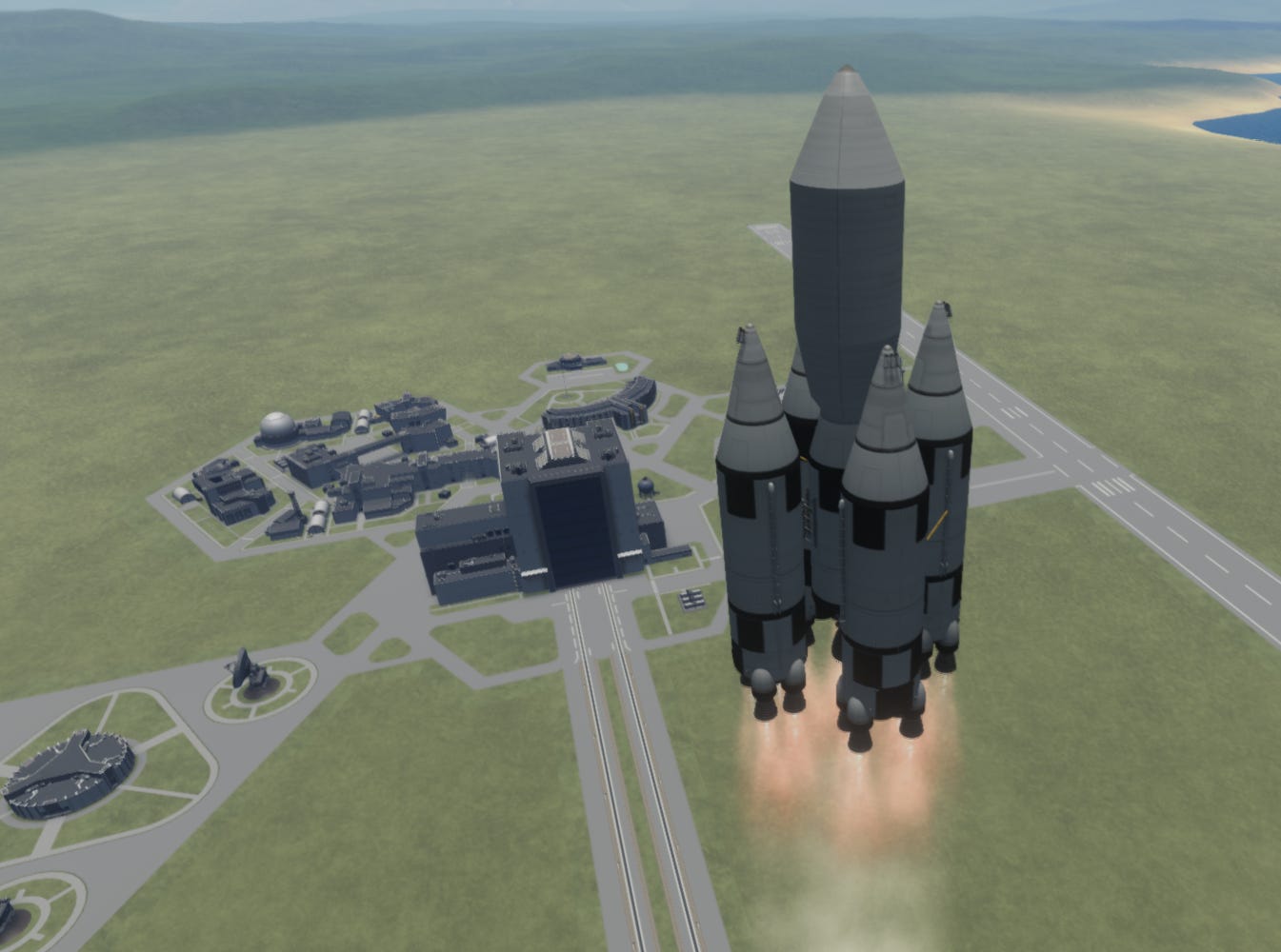
Several months later (the transfer window was suboptimal, but the most expeditious course possible was undertaken), the craft was on an intercept course with Eve. One rendezvous later and the brave kerbonauts were finally headed home.
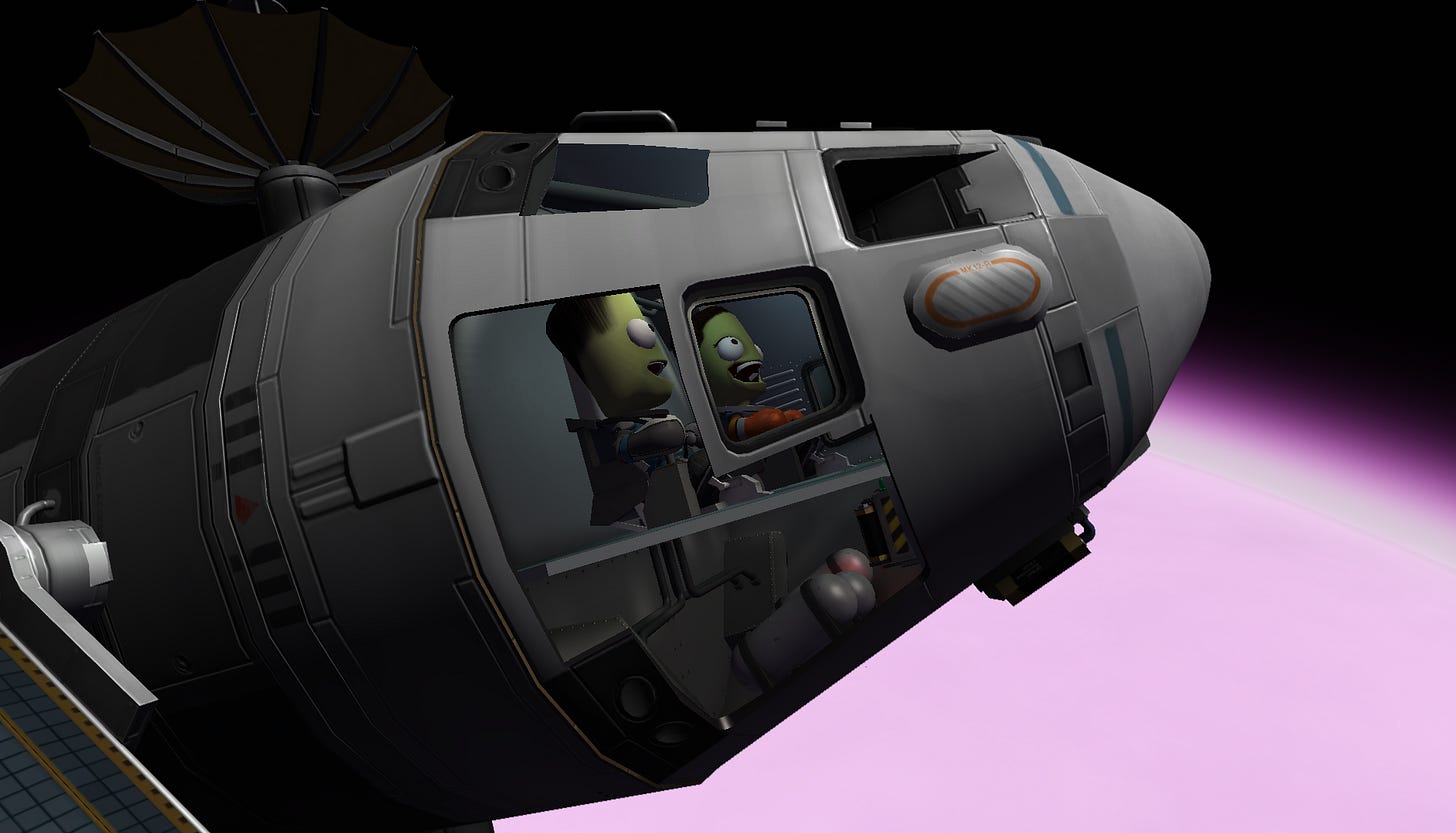
The IVA mode was criminally underutilized in the making of this report. Also, correcting for the orientation of Lander Mk. 3’s orbit was an absolute bear.
Valentina, upon reaching Kerbin’s sphere of influence burst into a wordless song of joy and swore that she would never again trust the engineering department, hinting either that she’d rather the pension department design her rockets or that she’d be taking an early retirement and would be glad to have her pension. Munmore just muttered incomprehensible threats and giggled.32
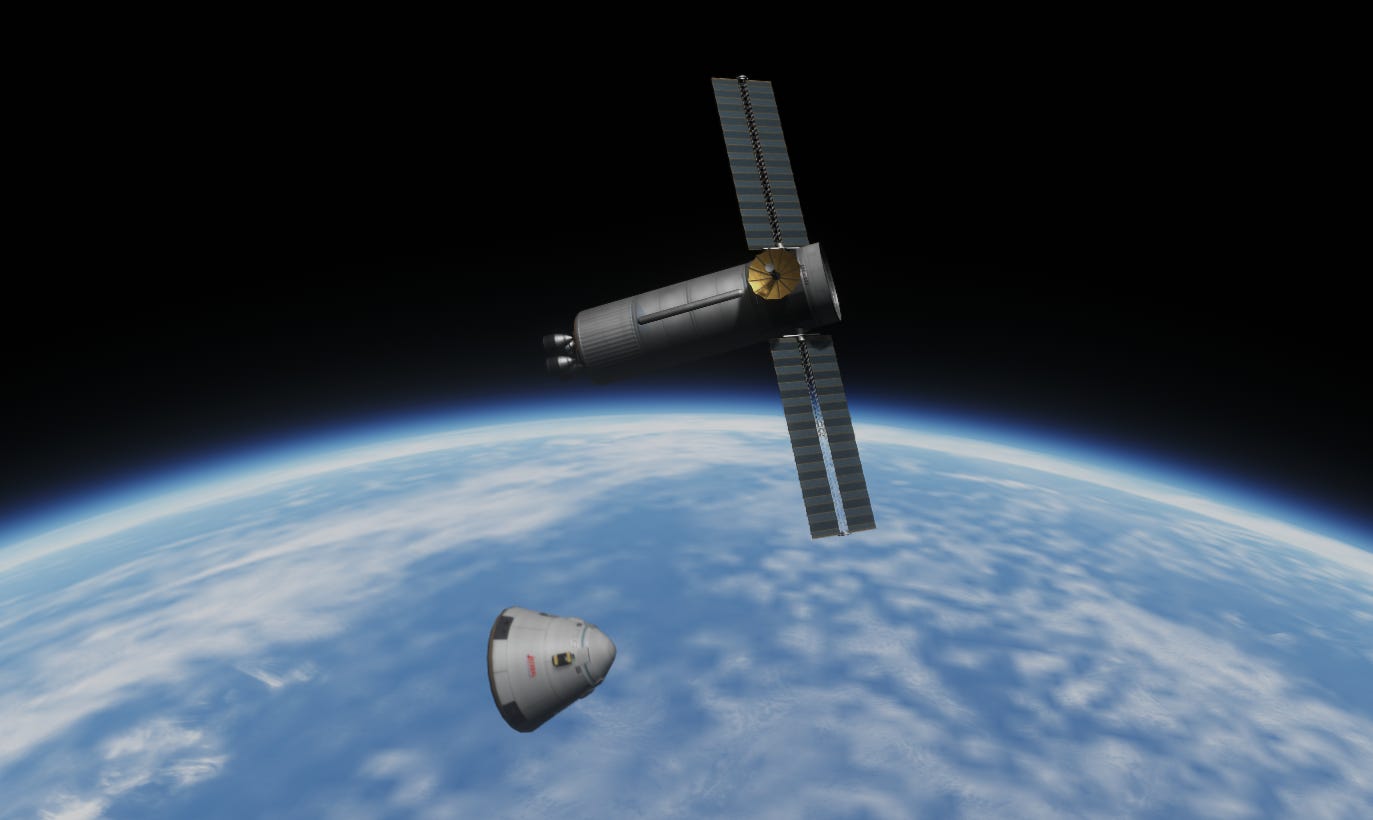
The pod and the transfer vessel pose in anticipation of reentry. Only the pod will survive.
The reentry into Kerbin’s atmosphere was fiery but mostly peaceful, and the aerobraking pass was sufficient to de-orbit the pod. Some heating was experienced, but nothing overwhelming. Valentina even taped a bit more steak to the side of the craft on the basis that twice seared meat, once on Eve and once on Kerbin, could bring out flavors heretofore unknown to kerbalkind.
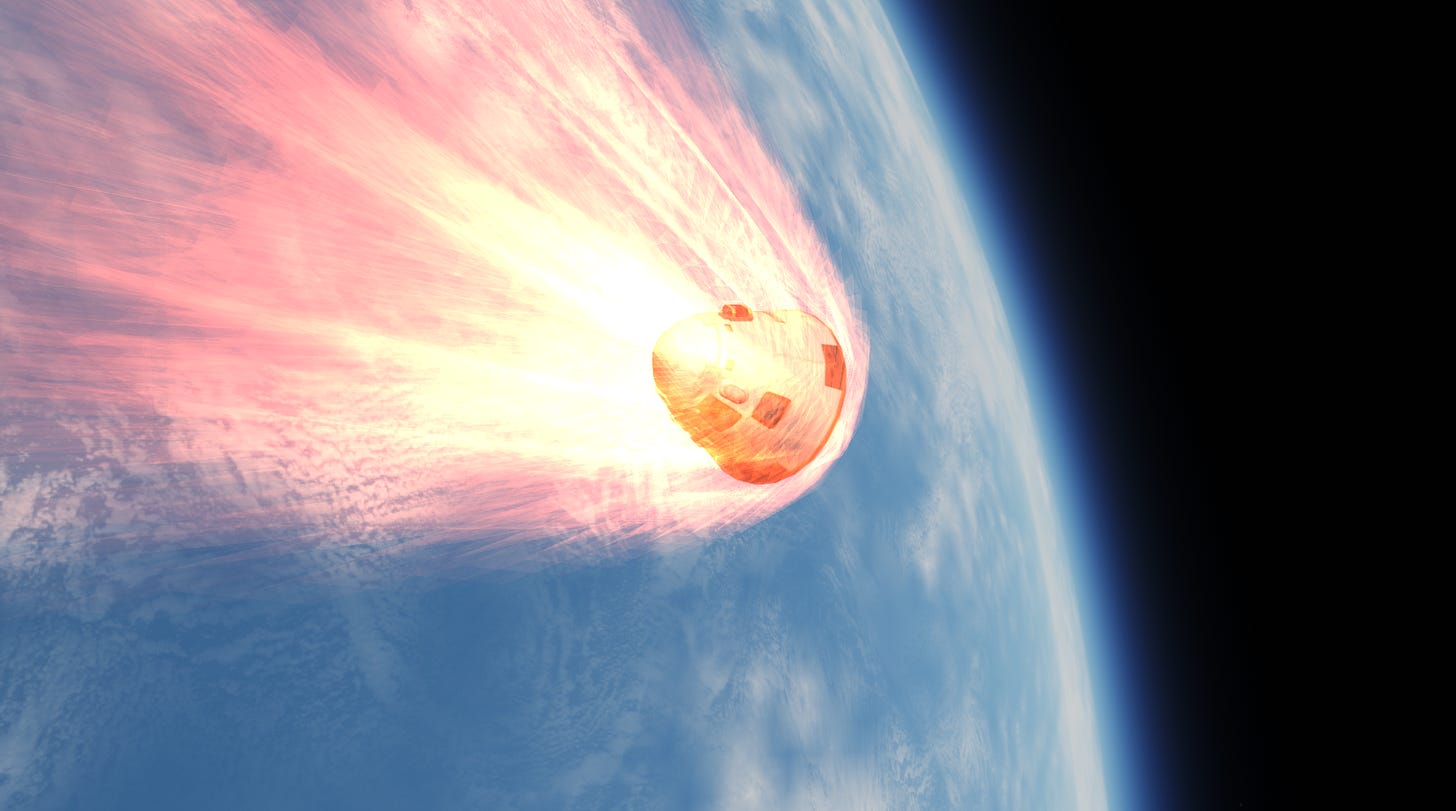
Unfortunately, I couldn’t manage to get a shot of the transfer stage exploding as the pod reentered.
One final parachute deployment later and the long-lost kerbals were finally safe, splashed down, on Kerbin.
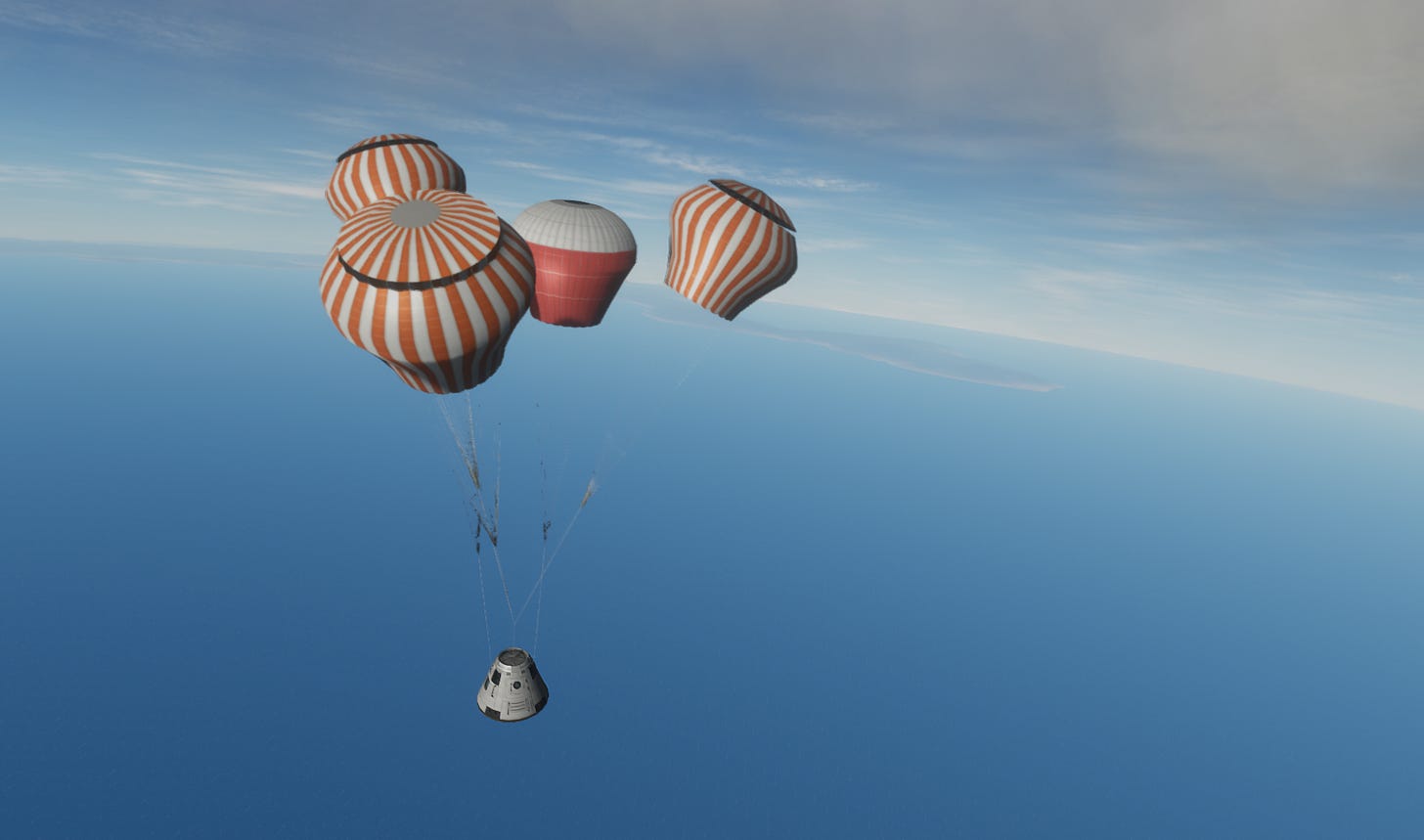
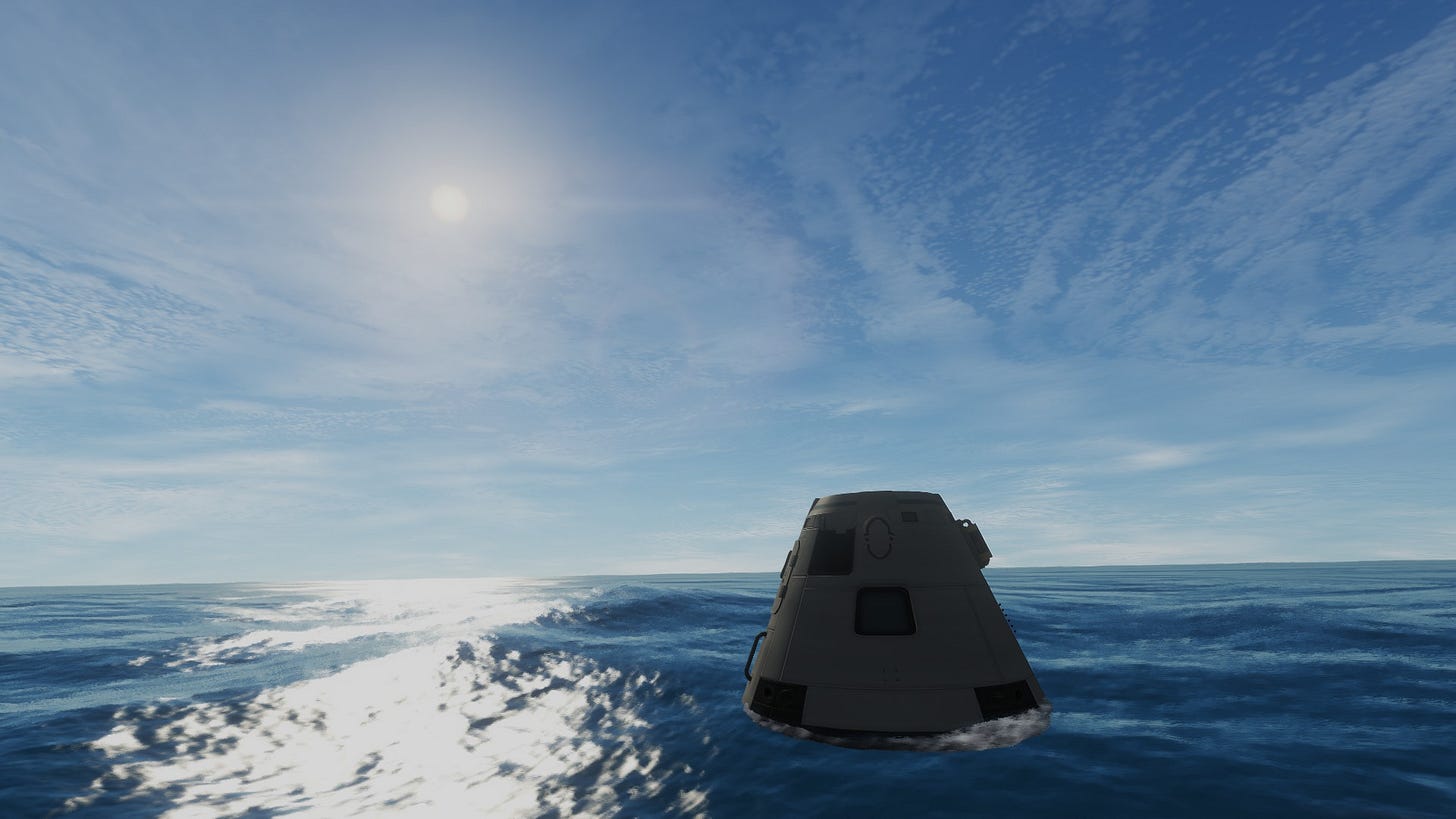
The long journey was finally over.
Part Nine - Epilogue
Upon return, the Kerbal Space Program underwent some changes. The title ‘Engineer’ was retired for all non-active kerbonauts, and the new title of ‘technical pension fund manager’ replaced it. Many of the engineers on the design team for Lander Mk. 3 were hired into that role, and the intern whose grad pictures featured the accursed champagne was as well.
Munmore Kerman Jr., first in his class at pension fund management school would also eventually be hired as a communications specialist, and his design prowess would be sought by dozens of private sector comms networks as well. His input would be instrumental in delivering 6G coverage to Dres.
The designers of Lander Mk. 1 and 2 are now in witness protection, as Munmore Sr. is still looking for them.
Valentina celebrated her 16th anniversary in style at her new beach house, but she isn’t sure that she’ll be able to stay retired long.
Munmore Kerman slept in for a week, hit an all you can eat buffet, and put himself back on the active-duty roster. He’s pretty sure they’ll have him fly another mission soon.
Jebediah purchased a junkyard. He’ll be on an interplanetary mission soon enough, but whether that goes through the KSP or builds his own rocket from scrap remains to be seen.
Mission control is as bustling as ever, and the word on the street is that they’re preparing to visit Eeloo and the other moons of Sarnus.
Until then, this has been Patrick, and I hope you’ve enjoyed this Mission Report.33
If you’ve made it this far, congratulations! I hope you enjoyed, this is the first long-form ‘fiction’ I’ve written in a long time. If you want to see another entry into this series, let me know! In fact, if you’ve made it through to the end of this marathon of a read, please just text me something obscure like “wheeee.” I don’t have any other missions that have ever gone quite this wrong (and Lord willing I won’t ever again), but even so, I’m sure that slightly less catastrophic missions are something that I can produce for reading in the future.
Footnotes
-
I also have several different ideas related to castles. ↩
-
To be fair, also in my bookmarks are links for Wagging the Moondoggie, the Taurus Judge Magnum, and the ebay listing for used pacifiers, so the bar is pretty low. ↩
-
The moon analog, a fictional moon of Kerbin (the earth analog) made of mint ice cream, the mars analog, the mercury analog, and the largest moon of the gas giant Jool respectively.
Tylo is generally considered to be the second most difficult destination to visit in the game. The gravity is approximately the same as Kerbin’s and there’s no atmosphere, meaning parachutes don’t function and a difficult powered landing is required. ↩
-
Eve is located where Venus is in the real solar system, but has several distinguishing characteristics included presumably because creating a planet where it rains acid in a game without weather was deemed too complicated. ↩
-
This is code for “I didn’t think to cheat the lander onto Eve to see if it would work before I launched it. ↩
-
We don’t need to talk about the thought process behind putting the parachutes on a giant hinge. Frankly, I have no idea. ↩
-
I did this for all of the landers, I saw it in YouTube videos and I think it’s there to make sure that the craft is equally draggy on both sides, which prevents flipping pointy and very flammable end first into an atmosphere that will melt anything not made of asbestos when you’re moving at 3,500 meters per second.I did this for all of the landers, I saw it in YouTube videos and I think it’s there to make sure that the craft is equally draggy on both sides, which prevents flipping pointy and very flammable end first into an atmosphere that will melt anything not made of asbestos when you’re moving at 3,500 meters per second. ↩
-
The actual reason for this is that for some reason I thought I might want to send the craft up in stages. Or maybe it was because I wanted to dock a nosecone to the top of it (the fully dockable nosecone even got designed, though to this minute, I cannot think of how I thought it would actually be used). ↩
-
This is a term that means in the opposite of the direction of movement. If you want to slow down, you burn your rocket retrograde. ↩
-
This was a goofy problem that, for some reason, none of the other landers had. It seemed to be an alchemical failure between the inversion of the roll controls on the fins due to the novel direction of airflow and the stability assist’s attempt to reverse the spin by pointing the fins in the exact direction that accelerated rotation (because the controls were inverted). ↩
-
I have eight tally marks for each attempt that I made. None of them approached success. ↩
-
The reason for this was the single axis of fins which was left after the first stage fired, and the total lack of fins on the main body of the craft. It would take two more iterations for me to realize the true depth of the problem. ↩
-
I didn’t have delusions of grandeur with this lander and ditched the plans to have dockable nosecone. I still have no idea why I thought that was a good idea, but I have distinct memories, not only of thinking this was a good idea, but also only bailing on it after I realized that the fully autonomous nosecone that I designed wasn’t something I could effectively control … ↩
-
It would have been the Christmas card for almost three years if the lander had actually worked. As it was, the image was a bit embarrassing, and most copies were burned during the construction of the barrel of relays. ↩
-
This was absolutely crushing. At this point I was questioning everything I knew about the game and preparing to give up. It’s also worth noting this is when I signed off and wrote Stan. The reason only Munmore was stranded in the note to that poem was that I initially planned on reverting to before Valentina was landed on Eve. ↩
-
The actual reason for that is that the ladders had to be reversed in order to attach to the nosecones without using the rotate too, which, in hindsight, could have been used very easily to create a non-janky ascent system. ↩
-
When I designed the craft, I thought it was substantially heavier than Lander Mk. 2. As it turns out, even fully fueled, the Mk. 3 is lighter. ↩
-
Between the mods I’ve installed and the sheer size of the craft, the load times on my pc are very long ↩
-
For information on this particular system, please refer to chapter 20 of Jasper Dash and the Flame Pits of Delaware, an actual book that follows the adventures of the Pals in Peril as they journey through darkest Delaware to answer an urgent call for distress from a monastery that titular character, Jasper Dash, learned to win staring contests at. M. T. Anderson, the author, is my literary inspiration for the footnotes of this and many other pieces that I’ve written. ↩
-
I have no idea why, but any time I build an airplane, it only functions effectively when I put canards on it. ↩
-
Ironically, if I had remembered an antenna on Landers Mk. 1 or 2, Munmore and Valentina could have provided full control to the probes. As it is, I forgot, and the following chapter will describe my pain.
Before you ask, no I didn’t actually test whether the antenna could reach Kerbin when it was on the opposite side of the sun from Eve. I choose to believe it wouldn’t. ↩
-
That is, this was entirely reverted as I decided that the strategy I display in Part 6 - Relay City was a more sanity efficient method of maintaining probe control. You’ll understand why I thought that by the end of this section. ↩
-
All was bright. Round yon virgin, mother with child, Holy infant so tender and mild … etc. etc. ↩
-
The flight I made originally, rather than the one that I took to gather screenshots for this report did not make it quite so close to Munmore, but the basics of the story are the same. Land, get close, spin out, give up. Given that I framed this whole portion as a dream sequence anyway, I chose to write the story as it appears above, given both the generally true nature of it, and the unlucky timing that I stumbled on in the screenshot flight. ↩
-
I messed this up and forgot to extend the solar panels on the first attempt at launching this craft. Upon realizing the mistake, I attempted to reload the save that I had been using. Then my computer crashed, and I wrote Eve. The next day I booted up the laptop and learned I apparently could still deploy the solar panels I thought were failures, and continued where I left off, without needing to load the save at all. ↩
-
Relay number seven had an orientation problem that led it to miss orbit by a very slim margin ↩
-
Canonically, the four failed landing attempts made long after successful reentry mean that technically the simulations continued for a while after that, but we’ll pretend those didn’t happen. The ground and the plane’s wheels have a poor relationship depending on the time of day it seems and when I tried to get pictures for this part of the mission, everything kept exploding or bouncing everywhere for no apparent reason, hence the picture of plane parked without the landing gear deployed. ↩
-
The argument went something like this:
Munmore (M): I get to fly it, I’ve been stranded here two years longer than you have, in a crew capsule built before we invented liquid-fuel engines
Valentina (V): You just flew it halfway across a continent
M: And?
V: That means that I should fly it
muffled sounds of violence ↩
-
As a note: while I successfully piloted this into orbit on my second attempt, later loads of the save file for the purpose of screenshots were substantially less successful, and not just because I was trying to get pictures. That isn’t to say that it doesn’t work, it does, it’s more to say that I got lucky finding the optimal ascent profile on my second attempt (and then forgot). ↩
-
Legend says that Jebediah’s facepalm could be heard from the vehicle assembly building ↩
-
Initially, I built the thing with a centrifuge on it, and it wasn’t until I made it to Eve that I learned that you need engineer kerbals to actually deploy the thing. (Un)Fortunately, the craft lacked the delta-v to return to Kerbin anyway, so the reversion was for design failures that went beyond forgetting to include qualified personnel. ↩
-
When I wrote this, I had forgotten that Munmore has actually been on longer journeys. The Tylo mission required much longer stays in deep space, though at least in those missions he had friends with him. ↩
-
This probably took ten hours to write, which makes sense given that it’s nearly 8,000 words and I had to deal with the absolutely abysmal loading times, frequent bugs, and general to-do of creating this. ↩