Despite my joyous years free from college policy debate, I still pay attention to the occasional community happening, both for entertainment, and to get a look of what life is like in the mirror image of Liberty University (a godless bubble of leftist extremism). Today, I saw something more entertaining than usual, a post asking what the point of traditional policy debate is any more:
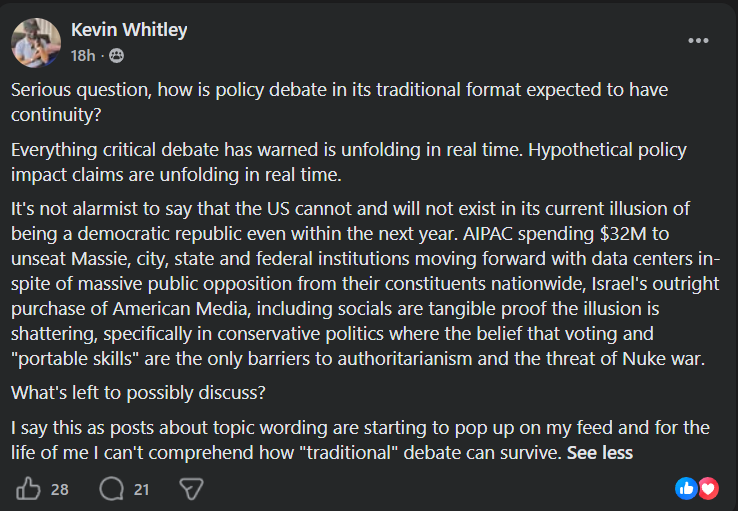
While the entire post is quite amusing, the part that is most interesting is the tension that the term “conservative politics” is placed under. Specifically, it refers to two groups of people:
- Actual conservative and right-wing voters who are discovering in real time that America is controlled by foreign interests which are powerful beyond political action.
- A set of extremely liberal judges, coaches, and debaters who think that there is pedagogical value in learning to debate the value of policy propositions because there is value in becoming educated in areas of public policy and that the skills developed in doing so create better citizens who are more able to participate in the civic process.
The Venn diagram between these two groups of people is two circles.

It’s actually more like this:

Group one, actual conservatives, share zero political objectives with group two, do not believe that debate stops authoritarianism or nuclear war, and have never heard of “portable skills.” Group two was convinced in 2016 that the reason the political process doesn’t work is because of group one not having portable skills or the civic education that debate provides.
The only feeling that conservative politics has for college debate, kritikal or otherwise is disdain. Disdain because the underlying utilitarian structure of policy debate is inimical to conservative politics, in the technical sense of conservatism—because utility cares nothing for tradition—the colloquial sense of the term—because utility cares nothing for the liberal notions of individual rights undergirding the founding—and in the religious right’s adoption of the term—because there is a God, but His name is not trade-off. Nothing about traditional policy debate, as it’s evolved in a highly ideologically homogenous academia offers anything to the conservative (other than, perhaps ironically, portable skills).
In case it wasn’t obvious, on some level, I ask the same question as Kevin: “How is policy debate in its traditional format expected to have continuity?” Like Kevin, I find the progressive order of traditional policy debate to be a house of cards. Like Kevin, I feel the edifice of America crack under the weight of moneyed interests. But the solution is not the kritik.
Not only because believing kritikal debate will change the world is a delusion of grandeur which places a tiny undergraduate activity at the center of the universe, but because the kritik is wrong. But that’s a conversation for another day.1
Addendum: What is this man even talking about
I also want to just take a long look at the three things this man thinks are sufficient to crack the conservative belief in the American system
- AIPAC spending $32 million to primary Thomas Massie
- Building data centers despite constituent disapproval
- Israeli purchase of American media and social media
To start off, these are three very different things, unless you’re really really deep in the weeds on theories about Jewish control of the country. There is not a strong through-line from Israel to data centers, but let’s keep moving:
AIPAC did not spend 5 million dollars, the Republican Jewish Coalition Victory Fund spent about $4 million and the rest of that money was spent in the total spend for the race.2 Now, that’s still a lot of money, but let’s at least get the facts right.3
Conservatives aren’t looking at Massie’s primary loss and saying, “man, I knew the system was rigged,” they’re questioning the influence Israeli, and Israeli-linked interests have in US politics and then checking X and asking how mail-in ballots broke overwhelmingly for Nithya Raman in the LA mayoral race, and why California takes a month to count ballots (some of which they accept after election day). Conservatives aren’t looking at Massie’s AIPAC funding, they’re looking at this:

Data centers. I’m too lazy to get the numbers, but so was he, so let’s just note that this is not a major issue for most people, and that there are compelling, non-malicious reasons for institutions to support their construction, even in the face of popular opposition (be they direct profits from sale of land, expansion of the tax base, national security, or simply protecting individual rights to dispose of their property). Besides that, government foisting unpopular infrastructure projects on unhappy populations is nothing new or surprising.
As for Israel’s “outright purchase” of American social media, it’s a stretch to say anything like this happened. Israel has paid influencers to post, but so have many others (you may remember hearing about Russian interference in the 2016 election lol), so that clearly isn’t what’s being discussed.4
The closest I can find to this claim is the purchase of Paramount by Larry Ellison and his role as co-founder of Oracle and it’s ownership stake in the sale of TikTok.5 Oracle has a 15% stake in TikTok; Oracle is not the same as Ellison; Ellison is not the same as Israel; this statement appears false. Further, conservatives aren’t particularly worried about videos of Gaza making it to their TikTok feeds, both because they aren’t using TikTok and because the sentiment among conservatives about Israel is based far more on perceived foreign influence and the conflict in Iran than about whether bombs were dropped on civilians in Gaza (and the things that do cause outrage, like bombing churches, make it to their own news sources, which aren’t TikTok)—this also lays aside the still sub-50% unfavorability rating of Israel among American conservatives.6
Don’t gloss over what happened here either. TikTok was not owned by Americans, it was owned by America’s geopolitical adversary. It was not controlled by Israel until very recently, and it was certainly not controlled by pro-American AI interests. The picture of the world painted by this post is incoherent.
What is left to discuss
Finally, I will answer Kevin’s final question: “what’s left to discuss?”
While I could say foreign influence in elections; AI, data center, and infrastructure policy; eminent domain; social media ownership; anti-trust; or arms sales, I have a better answer.
Footnotes
-
To get started, think on this: the world is not ordered based on the power dynamics of oppressor and oppressed but rather on man’s relationship to his Creator ↩
-
How Much Did AIPAC and the Republican Jewish Coalition…
Massie’s primary is the most expensive in history. Pro-Israel groups have played a huge part. - POLITICO ↩ -
Even taking the largest number you can, TrackAIPACs whopping fifteen-and-a-half-million (which is a bit dubious), you still aren’t there
-
Inside Israel’s ‘Esther Project’: DOJ Filings Reveal Paid US Influencer Campaign Amid Ai-Powered PR Blitz | Jewish Telegraphic Agency | thejewishnews.com ↩
-
US views of Israel, Netanyahu more negative in 2026, especially among young adults | Pew Research Center ↩